Introduction to South Facing House Vastu
Have you ever heard someone say, “Don’t buy a south facing house—it brings bad luck”? Well, let me stop you right there. This is one of the biggest misconceptions floating around in the world of Vastu Shastra. South facing houses have been unfairly judged for decades, but the truth is far more interesting than you might think.
Vastu Shastra, the ancient Indian science of architecture, isn’t about superstition—it’s about creating harmony between your living space and natural energies. When it comes to south facing homes, there’s a whole treasure chest of guidelines that can turn your house into a beacon of prosperity and positive energy. The key? Understanding the right principles and applying them correctly.
Think of Vastu as your home’s personal GPS. Just as you wouldn’t randomly drive without directions, why would you arrange your home without understanding the energy flow? Whether you’re building from scratch, renovating, or simply rearranging furniture, knowing the Vastu principles for south facing houses can transform your living experience.
What Makes a House South Facing?
Before we dive deeper, let’s get our basics straight. What exactly qualifies as a south facing house? It’s simpler than you think—a house is considered south facing when the main entrance door faces the south direction. Notice I said “main entrance,” not just any door. This is the door through which most people enter and exit your home daily.
To determine your house’s direction, stand at your main entrance with your back to the door, looking outward. If you’re facing south, congratulations—you have a south facing house! You can also use a compass or smartphone app to confirm the exact direction. Remember, we’re talking about magnetic south here, so precision matters.
Many people confuse the plot’s orientation with the house’s direction. Your plot might have a south-facing boundary, but if your main door opens toward the east, it’s an east facing house. The entrance is what counts in Vastu terminology.
The Truth About South Facing Houses
Let’s tackle the elephant in the room—why do south facing houses get such a bad reputation? The answer lies in half-understood knowledge and misapplication of Vastu principles. In ancient texts, certain configurations of south facing houses were considered inauspicious, but that doesn’t mean ALL south facing houses are problematic.
Here’s what actually matters: it’s not the direction itself but how you design and utilize the space that determines the energy flow. A poorly designed east facing house can be worse than a well-planned south facing one. The devil, as they say, is in the details.
From a scientific perspective, south facing houses in the Northern Hemisphere receive maximum sunlight throughout the day. This means better natural lighting, warmth during winters, and when properly designed, excellent ventilation. Southern exposure has practical benefits that ancient architects understood intuitively.
The stigma primarily comes from incorrect entrance placement and ignoring the pada system (more on this later). When these factors are ignored, yes, problems can arise. But when respected? South facing houses can be absolute powerhouses of positive energy and prosperity.
Benefits of South Facing Houses
Financial Prosperity
Surprised? You shouldn’t be. When designed according to proper Vastu guidelines, south facing houses are actually associated with financial growth and stability. The south direction is governed by Lord Yama in Vastu, representing discipline, righteousness, and dharma. This energy, when channeled correctly, translates into steady income and wealth accumulation.
Many successful business owners and entrepreneurs live in south facing homes. The key is proper entrance placement and maintaining the right energy balance through room positioning and décor choices.
Career Growth Opportunities
The disciplined energy of the south direction supports focus, determination, and career advancement. People living in correctly designed south facing houses often report enhanced professional recognition and growth opportunities. It’s like having a cosmic career coach built into your home’s architecture!
Enhanced Energy Flow
When you get the design right, south facing houses offer excellent energy circulation. The abundant sunlight naturally purifies spaces, reduces dampness, and creates a vibrant atmosphere. This physical brightness translates into mental clarity and emotional positivity for the residents.
Vastu Guidelines for South Facing House Entrance
Ideal Entrance Positions
Here’s where things get technical—and important. The south wall is divided into nine equal parts called “padas” in Vastu terminology. Not all padas are created equal! The ideal entrance positions for a south facing house are in padas 4 and 5, counting from the southeast corner.
These positions are considered highly auspicious and can bring tremendous benefits to the residents. If your entrance falls in these padas, you’ve hit the Vastu jackpot! These positions allow positive energy to flow freely while blocking negative influences.
Pada System Explained
Think of the pada system as dividing your south wall into nine vertical slices, like cutting a cake. Each pada has different energy characteristics. Some are friendly and welcoming, while others are, well, best avoided for entrance placement.
Auspicious Padas for South Entrance
Padas 4 and 5 (the central-left positions when viewed from outside) are your best friends. These positions balance the intense southern energy and create harmony within the home. Pada 4 specifically is associated with wealth and prosperity, while Pada 5 connects with success and recognition.
If you’re building or buying, aim for these positions. If you already have an entrance elsewhere, don’t panic—remedies exist, and we’ll discuss them shortly.
Padas to Avoid
Padas 1, 2, 3, 6, 7, 8, and 9—basically everything except 4 and 5—should ideally be avoided for main entrance placement. Particularly problematic are padas 1 and 2 (extreme left from southeast) and pada 9 (extreme right near southwest). These positions can create health issues, financial instability, and relationship problems if used as main entrances.
The southwest corner (pada 9) is considered the energy storage point of your home—punching a hole there with an entrance is like draining your home’s battery!
Room Placement in South Facing Homes
Master Bedroom Location
Where you sleep matters—a lot. For south facing houses, the master bedroom ideally belongs in the southwest corner of the home. This position provides stability, authority, and strong relationships. It’s the power corner of your house, and the heads of the household should claim it.
Avoid placing the master bedroom in the northeast corner—that’s the zone of lightness and spirituality, not the groundedness needed for restful sleep and marital harmony. The bed should be positioned so that you sleep with your head toward the south or west, never toward the north.
Kitchen Placement
The kitchen represents the fire element and should be positioned accordingly. For south facing houses, the ideal kitchen location is the southeast corner—the Agni (fire) corner in Vastu. This aligns with the natural fire element and supports health and prosperity.
If southeast isn’t possible, the northwest corner works as a secondary option. Avoid placing the kitchen in the northeast (water zone) or southwest (earth zone) corners, as these create elemental conflicts that can manifest as health issues and family discord.
Living Room Arrangement
Your living room is where you entertain guests and family gathers—it should radiate welcoming energy. The north, northeast, or east portions of your south facing house work beautifully for living spaces. These areas are naturally bright and create positive impressions on visitors.
Keep heavy furniture toward the south and west walls, leaving the north and east more open. This arrangement allows positive energy to circulate freely and creates a sense of spaciousness.
Pooja Room Position
The northeast corner is sacred in Vastu—it’s the Ishan corner, representing divine energy and spiritual connection. Your pooja room or meditation space should ideally occupy this position in your south facing house. This placement enhances spiritual practices and brings peace to the entire household.
If a dedicated pooja room isn’t possible, create a small altar in the northeast corner of any room. Face east or north while praying for maximum benefit.
Colors and Materials for South Facing Houses
Exterior Color Recommendations
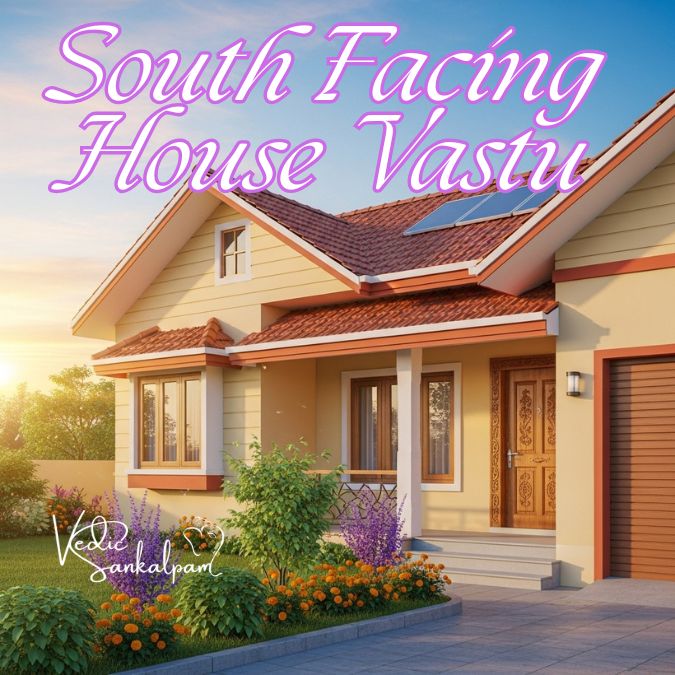
The exterior of your south facing house acts as its face to the world—and colors matter! Shades of red, orange, pink, and brown work exceptionally well for south facing homes. These warm tones complement the fire element associated with the south direction and create visual harmony.
Avoid blue and black as dominant exterior colors—these represent water and space elements that conflict with the south’s fire nature. White and cream are neutral options that work universally if you prefer subtlety.
Interior Color Schemes
Inside your south facing home, balance is key. While you can incorporate warmer tones, don’t go overboard. The south and west portions of your house can handle deeper colors—think terracotta, warm yellows, or light reds. These create a cozy, grounded feeling.
For north and east portions, stick with lighter shades—whites, light blues, light greens, or pastels. This creates a balance between the intense south energy and the lighter north energy, making your home feel harmonious rather than overwhelming.
Bedrooms benefit from calming colors regardless of direction—soft blues, greens, or neutral beiges promote restful sleep. Your kitchen can embrace brighter yellows, oranges, or whites to stimulate appetite and energy.
Common Vastu Defects and Remedies
Extended South Corners
If the south or southwest portion of your house extends beyond the rest of the structure, you have an extension—which sounds good but isn’t ideal in Vastu terms. Southwest extensions can create health issues and obstacles in life progress.
The remedy? Create a heavy stone boundary in the extended area, add weight through rock gardens or heavy planters, and paint this section in earthy tones. You’re essentially grounding the excess energy.
Missing Sections
Conversely, if the southwest corner has a cut or missing section, your house lacks stability. This can manifest as financial insecurity and relationship instability. Remedies include placing a pyramid or crystal in the missing corner’s projected space, using mirrors to create visual completeness, or adding heavy items in the adjacent areas to compensate.
Simple Remedial Measures
Got an entrance in the wrong pada? Here are some practical fixes:
- Install a brass metal strip or threshold at the entrance—metal creates a protective barrier
- Place a Vastu pyramid or crystal at the entrance
- Use bright lighting to energize the entrance
- Add auspicious symbols like swastika or Om near the door
- Keep the entrance area impeccably clean and clutter-free
- Plant tulsi (holy basil) on the left side of the entrance
Remember, remedies work best when combined with positive intentions and regular maintenance.
South Facing House Plot Selection
Buying a plot for your south facing house? Smart move to consider Vastu from the start! Look for plots that are square or rectangular—irregular shapes create energy disturbances. The plot should ideally be level or slightly sloping toward north or east.
Avoid plots that slope toward the south or west—these create downward energy flow that drains prosperity. If you’re stuck with such a plot, create a retaining wall to level it before construction.
Check the neighborhood too. Is your plot lower than surrounding properties? Not ideal—you want to be on equal or slightly higher ground. South facing plots work exceptionally well when the road is on the south side, as this creates the right energy flow pattern.
Architectural Considerations
Window Placement
Windows are your home’s eyes—they need strategic placement! In south facing houses, maximize windows on the north and east sides to capture positive energy and morning sunlight. The south and west sides should have fewer, smaller windows to prevent energy loss.
Large south-facing windows can lead to excessive heat in summer and energy drain, so balance is crucial. Use quality curtains or blinds to control light and heat in southern windows.
Balcony Direction
Love balconies? Place them in the north, east, or northeast directions of your south facing house. These directions support open spaces and benefit from balcony placement. Avoid balconies in the southwest corner—this area needs weight and stability, not openness.
If you do have a south-facing balcony, keep it partially covered and add some weight through planters or furniture. This mitigates the negative effects of the open space.
Staircase Location
Staircases represent movement and transition—their placement affects energy flow significantly. Ideal positions for staircases in south facing houses are the south, southwest, or west portions of the building. These directions handle the heavy, grounded energy of staircases well.
Avoid placing staircases in the northeast corner—this blocks the most auspicious energy zone of your house. If stairs must be in the center (though not ideal), ensure they turn clockwise as you ascend.
Do’s and Don’ts for South Facing Houses
Essential Do’s
- Do keep the northeast corner light, clean, and clutter-free
- Do place heavy furniture and storage in the south and west sections
- Do ensure your main entrance is well-lit and welcoming
- Do maintain proper ventilation, especially in southern rooms
- Do use appropriate colors that complement the south direction
- Do sleep with your head toward the south or east
- Do place your study or home office in the west or southwest
- Do keep water features (if any) in the northeast corner
- Do maintain your entrance door regularly—oil hinges, fresh paint
- Do create height gradient—higher in southwest, lower in northeast
Critical Don’ts
- Don’t place your entrance in padas 1, 2, 8, or 9
- Don’t have water bodies or sumps in the southwest
- Don’t keep the southwest corner empty or light
- Don’t place your kitchen in the northeast corner
- Don’t sleep with your head pointing north
- Don’t have your main entrance in the exact south center
- Don’t create extensions in the southwest
- Don’t ignore cracks, leaks, or damage—repair immediately
- Don’t paint your entire house in dark, heavy colors
- Don’t block the northeast with heavy structures or tall trees
Modern Adaptations of Traditional Vastu
Let’s face reality—we don’t all live in sprawling bungalows where every Vastu principle can be perfectly applied. Many of us inhabit apartments, townhouses, or compact homes where structural changes aren’t possible. Does this mean Vastu doesn’t work for us?
Absolutely not! The beauty of Vastu lies in its flexibility. While the traditional principles remain unchanged, modern practitioners have developed practical adaptations. Can’t change your apartment’s entrance direction? Focus on what you CAN control—room purposes, furniture arrangement, color schemes, and décor elements.
Think of it like cooking—you might not have the traditional clay oven, but you can still make delicious food with a modern stove if you understand the principles. Similarly, Vastu’s core goal is harmonizing energies, and you can achieve this through adjustments rather than structural changes.
Use mirrors strategically to redirect energy flow, employ colors to balance elements, position your bed and desk for optimal energy, and keep spaces organized. These “soft” Vastu techniques can create significant improvements in your living experience, even in a rented apartment where you can’t knock down walls.
Real-Life Success Stories
Theory is great, but does this stuff actually work? Let me share some compelling examples. I know a software entrepreneur in Bangalore who was struggling with business despite working tirelessly. After consulting a Vastu expert, he made simple changes to his south facing apartment—relocated his office to the southwest room, adjusted his sleep direction, and reorganized the entrance with proper lighting and remedies.
Within six months, he landed three major contracts and doubled his revenue. Coincidence? Perhaps. But he credits the mental clarity and confidence boost from living in a harmoniously designed space.
Another example—a couple experiencing constant health issues moved into a south facing house with the entrance in pada 5 (auspicious position). They followed Vastu guidelines for room placement and within a year reported significant improvements in health and family relationships. The wife mentioned feeling “lighter” and more energized in their new home.
These stories aren’t magic—they’re about creating environments that support rather than drain your energy. When your living space aligns with natural energy principles, you simply function better.
Conclusion
So, what have we learned? South facing houses aren’t the villains they’re made out to be! When designed with proper Vastu principles, they can be absolute powerhouses of prosperity, health, and positive energy. The secret lies in understanding the pada system, placing rooms strategically, using appropriate colors and materials, and maintaining balance throughout your space.
Whether you’re building a new home, buying property, or simply looking to improve your current south facing residence, these principles offer a roadmap to harmony. Remember, Vastu isn’t about rigid rules—it’s about creating flow, balance, and alignment with natural energies.
Don’t let myths and misconceptions scare you away from a south facing property. With the right knowledge and application, your south facing house can become your greatest asset, supporting your dreams and aspirations every single day. The direction your door faces matters far less than the awareness you bring to your living space.
Start with small changes—adjust your sleep direction, reorganize furniture, add appropriate colors. Notice how you feel. Vastu works subtly but powerfully, transforming your home from just a shelter into a sanctuary that truly supports your life journey.
FAQs
1. Are south facing houses really unlucky according to Vastu?
Not at all! This is a widespread misconception. South facing houses aren’t inherently unlucky—what matters is the proper application of Vastu principles, especially entrance placement in the correct padas (4 and 5). When designed correctly, south facing homes can bring tremendous prosperity and success. The stigma comes from improper designs where entrances are placed in inauspicious padas, which can create problems. Focus on getting the details right rather than worrying about the direction itself.
2. Which is the best location for the main door in a south facing house?
The best positions for your main entrance in a south facing house are pada 4 and pada 5, counting from the southeast corner. These central-left positions when viewing from outside are considered highly auspicious. Pada 4 is particularly associated with wealth creation, while pada 5 connects with recognition and success. Avoid placing the entrance in padas 1, 2, 8, and especially 9 (near the southwest corner), as these positions can create various challenges in health, finance, and relationships.
3. Can I make changes to my existing south facing house if the entrance is in the wrong position?
Yes! While structural changes aren’t always feasible, several Vastu remedies can significantly improve energy flow even with a poorly positioned entrance. Install a brass threshold, place a Vastu pyramid or crystal at the entrance, ensure bright lighting, add auspicious symbols near the door, and maintain impeccable cleanliness. You can also balance energy through proper room utilization, correct furniture placement, and appropriate color schemes. These adjustments, combined with positive intention, can create substantial improvements in your home’s energy.
4. What colors should I use for my south facing house?
For exteriors, warm tones like red, orange, pink, and brown work excellently as they complement the fire element of the south direction. For interiors, use warmer colors (terracotta, warm yellows, light reds) in south and west portions, and lighter shades (whites, light blues, pastels) in north and east areas. This creates energetic balance. Bedrooms benefit from calming neutrals or soft colors regardless of direction. Avoid using blue and black as dominant colors in south facing houses, as these water-element colors conflict with the south’s fire nature.
5. Where should I place my bedroom and kitchen in a south facing house?
The master bedroom should ideally be in the southwest corner of your south facing house, providing stability and strong relationships. Position your bed so you sleep with your head toward south or west, never north. The kitchen belongs in the southeast corner (Agni or fire zone), aligning with the natural fire element. If southeast isn’t possible, northwest works as a secondary option. Avoid placing the kitchen in northeast or southwest corners, as these create elemental conflicts that can manifest as health and family issues.