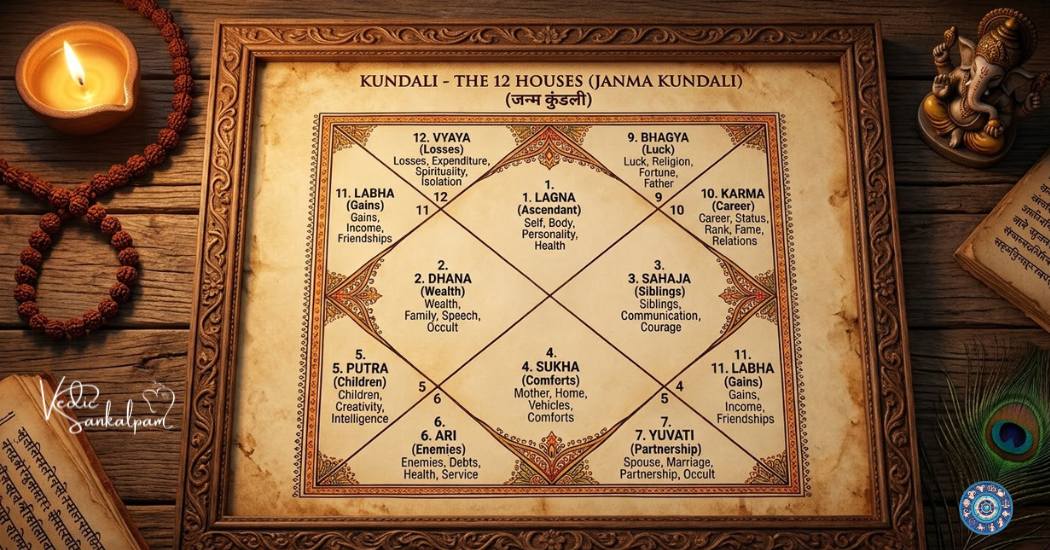
A Kundli, also known as a birth chart or janam patrika, is the foundational tool of Vedic astrology. It is a snapshot of the sky at the exact moment of a person’s birth, mapped across twelve distinct segments known as houses, or bhavas. We explain, in complete detail, what each of these twelve houses represents, how they interact with planets and signs, and why understanding them is essential to reading any horoscope accurately.
What Are Houses in Kundli?
In Vedic astrology, the zodiac wheel, spanning 360 degrees, is divided into twelve equal segments of 30 degrees each. Each of these segments is called a house, and each house governs a specific sphere of human life — from personality and wealth to relationships, career, and spirituality. The First House, also called the Lagna or Ascendant, is calculated based on the exact time and place of birth, and all subsequent houses are measured counter-clockwise from it.
Unlike the zodiac signs, which are fixed patterns of stars, the houses are entirely dependent on the birth time. This is why an accurate birth time is considered critical for a correct Kundli reading — even a difference of a few minutes can shift the Ascendant and, consequently, the entire house structure.
The First House: Self and Personality
The First House, or Lagna, represents the self — physical appearance, personality, temperament, and overall vitality. It is considered the most important house in the chart because it sets the tone for how all other houses are interpreted. A strong Lagna Lord generally indicates good health, confidence, and a well-defined sense of identity.
The Second House: Wealth and Family
The Second House governs accumulated wealth, family lineage, speech, and values. It reflects one’s financial standing, savings, and the way a person communicates. Afflictions to this house often point toward difficulties in financial stability or friction within the family unit.
The Third House: Courage and Communication
Known as the house of courage, siblings, short journeys, and communication skills, the Third House reveals a person’s initiative, willpower, and relationship with siblings. It is also linked to writing, media, and short-distance travel.
The Fourth House: Home and Emotional Foundation
The Fourth House represents domestic happiness, mother, property, vehicles, and emotional security. This house is deeply tied to one’s roots and sense of belonging. A well-placed Fourth House Lord typically indicates a comfortable home life and strong maternal bonds.
The Fifth House: Creativity and Progeny
Associated with children, creativity, romance, intelligence, and past-life merit (purva punya), the Fifth House is central to any discussion of education, artistic talent, and the ability to conceive. It is closely examined in matters of childbirth and academic success.
The Sixth House: Health and Obstacles
The Sixth House deals with enemies, debts, disease, and daily work routine. It is often called a house of struggle, but it also indicates one’s capacity to overcome obstacles through effort and discipline. Strong placements here can indicate resilience and the ability to defeat competition.
The Seventh House: Marriage and Partnerships
Perhaps the most consulted house in matchmaking, the Seventh House governs marriage, business partnerships, and public relations. It directly opposes the Lagna and reflects how a person relates to others in committed one-on-one relationships, whether romantic or professional.
The Eighth House: Transformation and Longevity
The Eighth House is associated with longevity, sudden events, inheritance, occult knowledge, and transformation. Though often viewed with caution, this house also governs deep research abilities, insurance, and hidden wealth gained through inheritance or unexpected means.
The Ninth House: Fortune and Higher Learning
Regarded as the most auspicious house, the Ninth House governs luck, higher education, long-distance travel, spirituality, and one’s father. It is often called the house of dharma, reflecting one’s higher purpose and ethical grounding.
The Tenth House: Career and Public Standing
The Tenth House, directly opposite the Fourth, represents career, social status, authority, and public reputation. It is the house most closely studied when evaluating professional success, leadership potential, and government-related matters.
The Eleventh House: Gains and Aspirations
Known as the house of income, gains, elder siblings, and social networks, the Eleventh House reflects the fulfillment of desires and financial rewards from one’s efforts. It is considered a strongly beneficial house in most chart evaluations.
The Twelfth House: Loss, Isolation, and Liberation
The final house, the Twelfth House, governs expenditure, foreign settlement, isolation, and spiritual liberation (moksha). While it is often associated with losses, it equally represents subconscious growth, meditation, and detachment from material concerns.
How Planets Influence the Houses
Every planet placed within a house colors that house’s significance according to its own nature. For example, Jupiter in the Ninth House amplifies fortune and wisdom, while Saturn in the Sixth House can strengthen one’s ability to overcome hardship through discipline. The house lord — the planet ruling the sign on the cusp of a house — must also be examined for its placement, strength, and aspects, since this reveals how the themes of that house will actually manifest in a person’s life.
Why House Analysis Matters More Than Sign Analysis Alone
Many beginners focus solely on zodiac signs, but a complete Kundli reading demands equal attention to house placement. Two people born with the same Moon sign can have entirely different life experiences depending on which house that Moon occupies. This is why professional astrologers place such heavy emphasis on house-based analysis rather than sign-based generalizations alone.
Bringing It All Together
Understanding the twelve houses in Kundli provides the structural framework needed to interpret any birth chart with precision. Each house tells a distinct part of a person’s story — from identity and wealth to relationships, career, and ultimate spiritual growth. When combined with planetary strength, aspects, and dashas (planetary periods), house analysis becomes the most reliable method for delivering accurate, meaningful astrological guidance.