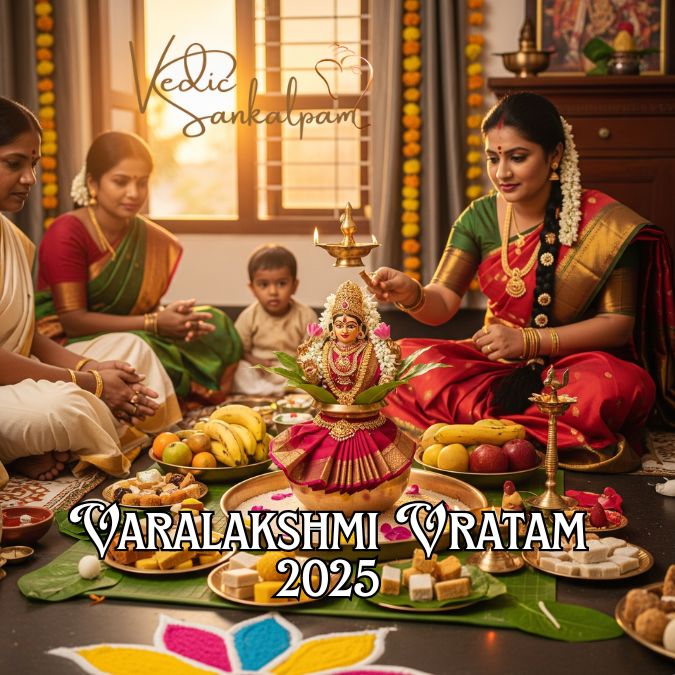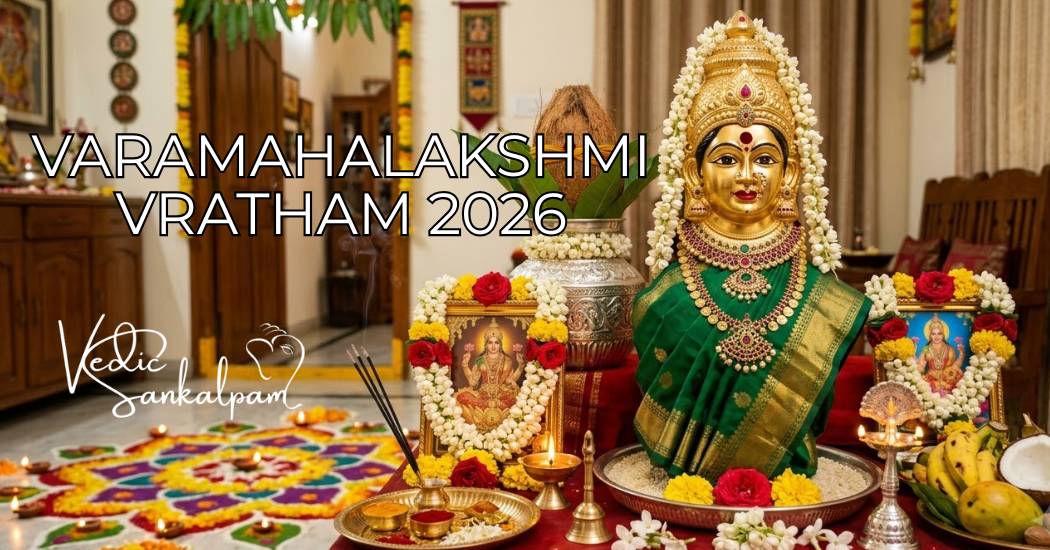
Varamahalakshmi Vratham, also widely known as Varalakshmi Vratam, stands among the most cherished festivals in the Hindu calendar, dedicated entirely to Goddess Mahalakshmi, the divine embodiment of wealth, prosperity, health, and family well-being. As the sacred month of Shravana unfolds, households across South India and Hindu communities worldwide prepare to welcome the Goddess into their homes through this deeply meaningful vrat. In this comprehensive guide, we walk through everything a devotee needs to know about Varamahalakshmi Vratham 2026 — its exact date, the most auspicious puja muhurat timings, the significance behind the ritual, and a complete step-by-step pooja vidhi.
When Is Varamahalakshmi Vratham 2026?
Varamahalakshmi Vratham 2026 falls on Friday, August 28, 2026. The festival is traditionally observed on the second Friday of the Shukla Paksha (bright fortnight) of the Shravana month, just before Shravana Purnima, the full moon day. Friday, or Shukravara, holds special significance in Hindu tradition as the day sacred to Goddess Lakshmi, which is precisely why this vrat is aligned with that particular weekday every year.
The festival carries immense weight in states such as Andhra Pradesh, Telangana, Karnataka, Tamil Nadu, and Maharashtra, where it is celebrated with grandeur, elaborate decorations, and heartfelt devotion. Married women primarily observe this vrat, though many unmarried women and even men participate to seek the Goddess’s divine blessings for their families.
Auspicious Puja Muhurat Timings for Varamahalakshmi Vratham 2026
Selecting the right muhurat is considered essential for the pooja to yield its fullest spiritual benefit. According to Vedic astrology, worship performed during a fixed Lagna (Sthira Lagna) is believed to bestow long-lasting prosperity upon the household. The key muhurat windows for August 28, 2026, are as follows:
- Simha Lagna (Morning Muhurat): 06:23 AM to 07:48 AM — a duration of 1 hour 25 minutes
- Vrishchika Lagna (Afternoon Muhurat): 12:06 PM to 02:20 PM — a duration of 2 hours 14 minutes
- Kumbha Lagna (Evening Muhurat): 06:16 PM to 07:52 PM — a duration of 1 hour 37 minutes
- Vrishabha Lagna (Midnight Muhurat): 11:10 PM on August 28 to 01:10 AM on August 29 — a duration of 2 hours
Most families choose the morning muhurat immediately after their ritual bath, as this is considered the most traditional and widely followed time. However, the evening Pradosha Kaal is also regarded as a powerful window for invoking the Goddess’s grace, and many households conduct the pooja at this hour based on family custom and convenience.
The Meaning and Significance of Varamahalakshmi
The name Varalakshmi is derived from two Sanskrit words — Vara, meaning “boon,” and Lakshmi, meaning “wealth” or “the Goddess of prosperity.” Together, the name translates to “the Goddess who grants boons.” This form of the divine mother is also referred to as Varamahalakshmi, and it is believed that she is inherently generous, accessible, and quick to bless her sincere devotees.
According to sacred tradition, this vrat was first revealed by Lord Parameswara (Shiva) to his consort Goddess Parvati, instructing her to observe the fast for the prosperity, happiness, and well-being of her family. Parvati faithfully performed the vrat, and from that divine origin, the tradition has been passed down through generations of women, particularly across South Indian households.
A particularly profound belief associated with this festival is that worshipping Goddess Varalakshmi on this single day is considered equivalent to worshipping the Ashtalakshmi, the eight forms of Goddess Lakshmi representing:
- Sri Lakshmi — Wealth
- Bhu Lakshmi — Earth
- Saraswati Lakshmi — Learning and Knowledge
- Priti Lakshmi — Love
- Kirti Lakshmi — Fame
- Shanti Lakshmi — Peace
- Tushti Lakshmi — Pleasure and Satisfaction
- Pushti Lakshmi — Strength and Nourishment
This makes Varamahalakshmi Vratham one of the rare occasions in the Hindu calendar where a single day of devoted worship is believed to invoke the combined blessings of all eight aspects of the Goddess simultaneously.
Essential Items Required for Varamahalakshmi Pooja (Samagri List)
A well-organized samagri list makes the preparation smooth and stress-free. The essential items typically include:
- A Kalasha (brass or copper pot) filled with rice or water
- Coins, betel nuts, and betel leaves to place inside the Kalasha
- A coconut and fresh mango leaves to adorn the Kalasha
- Turmeric and vermilion (kumkum) for the swastika symbol drawn on the Kalasha
- A face of the Goddess (Ammavari Mukham), often crafted from silver, brass, or clay
- New saree and jewellery to drape and decorate the Goddess’s form
- Fresh flowers, garlands, and mango leaf torans for decoration
- Fruits, sweets (naivedyam), and betel leaf sets (thamboolam) as offerings
- A lamp (deepam), incense sticks, camphor, and cotton wicks
- Turmeric-coated thread for tying the sacred Vratha Dharana around the wrist
Step-by-Step Varamahalakshmi Pooja Vidhi
1. Preparation and Purification Devotees begin the day with an early ritual bath, wear clean or new attire, and thoroughly clean the pooja space, often decorating the entrance with rangoli or kolam designs.
2. Setting Up the Kalasha The Kalasha is filled with rice or water, along with a coin, betel nut, and turmeric. A swastika is drawn on its exterior, mango leaves are arranged around its neck, and a coconut smeared with turmeric and kumkum is placed on top, symbolizing the head of the Goddess.
3. Adorning the Goddess The Ammavari face is affixed to the coconut, and the entire Kalasha is dressed in a saree, adorned with jewellery, flower garlands, and a decorative backdrop, transforming it into a resplendent form of Goddess Varamahalakshmi.
4. Invocation and Shodashopachara Puja The Goddess is invoked through mantra chanting, followed by the Shodashopachara Puja — the sixteen-step traditional worship that includes offering water for washing the feet and hands, bathing (abhishekam), applying sandalwood paste, dressing, adorning with flowers, lighting incense and lamps, and presenting naivedyam.
5. Tying the Sacred Thread Married women tie a turmeric-dyed sacred thread, known as the Vratha Dharana, around their right wrist while reciting the corresponding mantra, symbolizing the vow undertaken and the protection sought from the Goddess.
6. Reciting the Vrat Katha The traditional story of Varalakshmi Vratam is recited or listened to attentively, narrating the divine origin of the vrat and the blessings received by devotees who observed it with faith.
7. Aarti and Prasad Distribution The ritual concludes with aarti performed to the Goddess, followed by the distribution of prasad, thamboolam, and gifts among family members and invited guests, particularly married women who are honored during this celebration.
Benefits of Observing Varamahalakshmi Vratham
Devotees who observe this vrat with sincerity and devotion are believed to receive numerous blessings, including:
- Financial prosperity and abundance for the household
- Good health and longevity for family members, particularly the husband
- Marital harmony and strengthened family bonds
- Removal of obstacles and negative energies from the home
- Spiritual growth and inner peace through disciplined devotion
- Fulfillment of desires, as the very name Varalakshmi signifies the Goddess who grants boons
Celebrating Varamahalakshmi Vratham Away From Home
For families residing outside India, particularly NRI households, observing this vrat need not be compromised by distance. Many devotees now organize the pooja at home using readily available samagri kits, while others coordinate with a qualified pujari for guided rituals conducted virtually, ensuring the same devotion and authenticity as a traditional celebration back home. What remains most important, irrespective of location or scale, is the sincerity of the prayer and the purity of intention behind the worship.
Conclusion
Varamahalakshmi Vratham 2026, observed on Friday, August 28, offers devotees a beautiful opportunity to invite abundance, health, and harmony into their homes through heartfelt worship of the Goddess of Wealth. Whether performed as an elaborate, multi-hour ceremony or a simple, intimate pooja at home, the essence of this sacred day lies in devotion, gratitude, and the unwavering faith that Goddess Varamahalakshmi bestows her boons upon all who seek her with a pure heart.