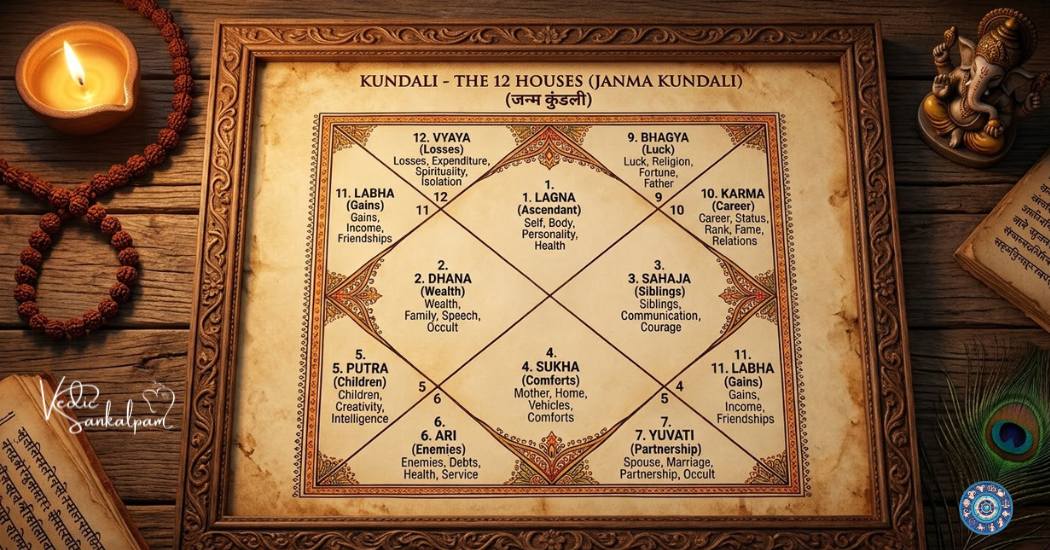
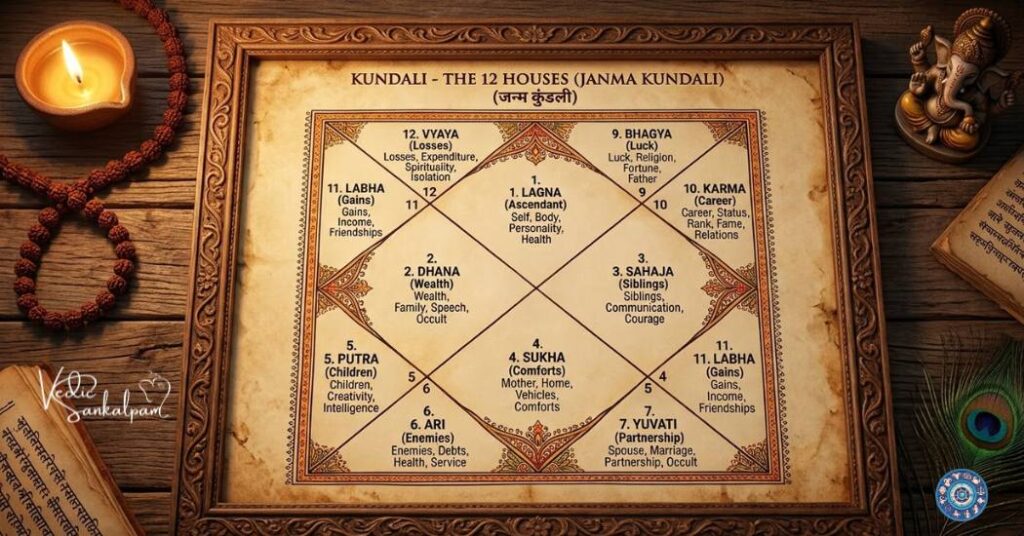
A Kundli, also known as a birth chart or janam patrika, is the foundational tool of Vedic astrology. It is a snapshot of the sky at the exact moment of a person’s birth, mapped across twelve distinct segments known as houses, or bhavas. We explain, in complete detail, what each of these twelve houses represents, how they interact with planets and signs, and why understanding them is essential to reading any horoscope accurately.
What Are Houses in Kundli?
In Vedic astrology, the zodiac wheel, spanning 360 degrees, is divided into twelve equal segments of 30 degrees each. Each of these segments is called a house, and each house governs a specific sphere of human life — from personality and wealth to relationships, career, and spirituality. The First House, also called the Lagna or Ascendant, is calculated based on the exact time and place of birth, and all subsequent houses are measured counter-clockwise from it.
Unlike the zodiac signs, which are fixed patterns of stars, the houses are entirely dependent on the birth time. This is why an accurate birth time is considered critical for a correct Kundli reading — even a difference of a few minutes can shift the Ascendant and, consequently, the entire house structure.
Houses in Kundli
The First House: Self and Personality
The First House, or Lagna, represents the self — physical appearance, personality, temperament, and overall vitality. It is considered the most important house in the chart because it sets the tone for how all other houses are interpreted. A strong Lagna Lord generally indicates good health, confidence, and a well-defined sense of identity.
The Second House: Wealth and Family
The Second House governs accumulated wealth, family lineage, speech, and values. It reflects one’s financial standing, savings, and the way a person communicates. Afflictions to this house often point toward difficulties in financial stability or friction within the family unit.
The Third House: Courage and Communication
Known as the house of courage, siblings, short journeys, and communication skills, the Third House reveals a person’s initiative, willpower, and relationship with siblings. It is also linked to writing, media, and short-distance travel.
The Fourth House: Home and Emotional Foundation
The Fourth House represents domestic happiness, mother, property, vehicles, and emotional security. This house is deeply tied to one’s roots and sense of belonging. A well-placed Fourth House Lord typically indicates a comfortable home life and strong maternal bonds.
The Fifth House: Creativity and Progeny
Associated with children, creativity, romance, intelligence, and past-life merit (purva punya), the Fifth House is central to any discussion of education, artistic talent, and the ability to conceive. It is closely examined in matters of childbirth and academic success.
The Sixth House: Health and Obstacles
The Sixth House deals with enemies, debts, disease, and daily work routine. It is often called a house of struggle, but it also indicates one’s capacity to overcome obstacles through effort and discipline. Strong placements here can indicate resilience and the ability to defeat competition.
The Seventh House: Marriage and Partnerships
Perhaps the most consulted house in matchmaking, the Seventh House governs marriage, business partnerships, and public relations. It directly opposes the Lagna and reflects how a person relates to others in committed one-on-one relationships, whether romantic or professional.
The Eighth House: Transformation and Longevity
The Eighth House is associated with longevity, sudden events, inheritance, occult knowledge, and transformation. Though often viewed with caution, this house also governs deep research abilities, insurance, and hidden wealth gained through inheritance or unexpected means.
The Ninth House: Fortune and Higher Learning
Regarded as the most auspicious house, the Ninth House governs luck, higher education, long-distance travel, spirituality, and one’s father. It is often called the house of dharma, reflecting one’s higher purpose and ethical grounding.
The Tenth House: Career and Public Standing
The Tenth House, directly opposite the Fourth, represents career, social status, authority, and public reputation. It is the house most closely studied when evaluating professional success, leadership potential, and government-related matters.
The Eleventh House: Gains and Aspirations
Known as the house of income, gains, elder siblings, and social networks, the Eleventh House reflects the fulfillment of desires and financial rewards from one’s efforts. It is considered a strongly beneficial house in most chart evaluations.
The Twelfth House: Loss, Isolation, and Liberation
The final house, the Twelfth House, governs expenditure, foreign settlement, isolation, and spiritual liberation (moksha). While it is often associated with losses, it equally represents subconscious growth, meditation, and detachment from material concerns.
How Planets Influence the Houses
Every planet placed within a house colors that house’s significance according to its own nature. For example, Jupiter in the Ninth House amplifies fortune and wisdom, while Saturn in the Sixth House can strengthen one’s ability to overcome hardship through discipline. The house lord — the planet ruling the sign on the cusp of a house — must also be examined for its placement, strength, and aspects, since this reveals how the themes of that house will actually manifest in a person’s life.
Why House Analysis Matters More Than Sign Analysis Alone
Many beginners focus solely on zodiac signs, but a complete Kundli reading demands equal attention to house placement. Two people born with the same Moon sign can have entirely different life experiences depending on which house that Moon occupies. This is why professional astrologers place such heavy emphasis on house-based analysis rather than sign-based generalizations alone.
Bringing It All Together
Understanding the twelve houses in Kundli provides the structural framework needed to interpret any birth chart with precision. Each house tells a distinct part of a person’s story — from identity and wealth to relationships, career, and ultimate spiritual growth. When combined with planetary strength, aspects, and dashas (planetary periods), house analysis becomes the most reliable method for delivering accurate, meaningful astrological guidance.
Upapada Lagna is one of the most important concepts in Jaimini Astrology. It helps astrologers understand marriage, spouse characteristics, family life, relationship stability, and long-term marital happiness.
While the birth ascendant (Lagna) represents your personality and life path, Upapada Lagna specifically focuses on your married life. It is derived from the twelfth house using Jaimini principles rather than being a physical zodiac sign rising at birth.
Ancient astrologers believed that the Upapada Lagna reveals hidden aspects of relationships that cannot always be understood by examining only the seventh house.
Many experienced astrologers analyze Upapada Lagna together with:
Birth Lagna
Seventh House
Venus
Jupiter
Navamsa (D9)
Darakaraka
Moon Chart
This combined approach provides more accurate marriage predictions.
Why Upapada Lagna Matters in Vedic Astrology
Marriage isn’t simply about finding a partner. It involves emotional compatibility, financial stability, mutual respect, family support, and spiritual growth.
Upapada Lagna provides insights into:
Timing of marriage
Nature of spouse
Family background
Marital happiness
Financial life after marriage
Possibility of separation
Social status after marriage
Long-term compatibility
For this reason, professional Vedic astrologers rarely ignore Upapada Lagna during marriage analysis.
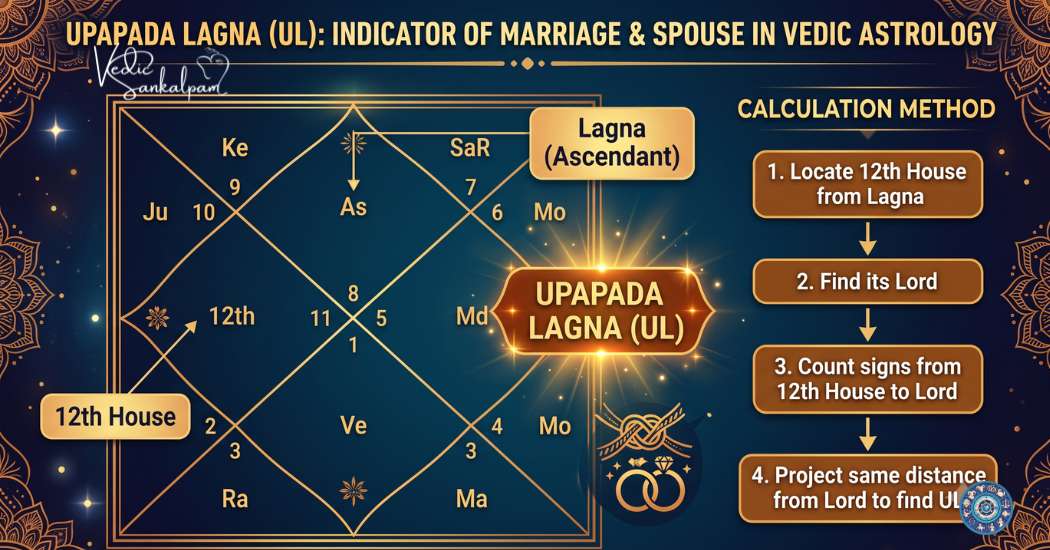
How to Calculate Upapada Lagna
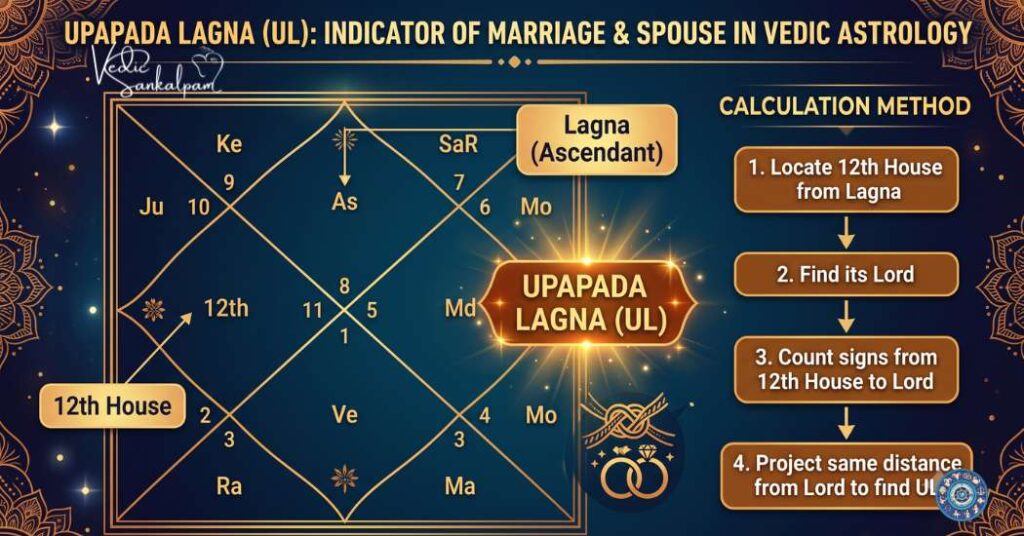
Upapada Lagna
The Upapada Lagna is calculated from the 12th house.
Step-by-Step Calculation
Identify the 12th house from Lagna.
Find the lord of the 12th house.
Count the distance from the 12th house to its lord.
Count the same number of signs from the lord.
The resulting sign becomes the Upapada Lagna.
Special Rule
If the lord is placed in:
Same sign
Seventh sign
Special Jaimini rules are applied.
Because of these exceptions, astrologers often use astrology software to avoid calculation mistakes.
Practical Example
Suppose:
Aries Lagna
12th House = Pisces
Pisces Lord = Jupiter
Jupiter placed in Gemini
Count from Pisces to Gemini.
Then count the same distance from Gemini.
The resulting sign becomes the Upapada Lagna.
Difference Between Lagna and Upapada Lagna
Lagna
Upapada Lagna
Represents self
Represents marriage
Physical body
Married life
Personality
Spouse
Career
Relationship
Life direction
Family after marriage
Both are essential, but each serves a different purpose.
Importance of Upapada Lagna in Marriage
Upapada Lagna Marriage
Marriage prediction becomes much deeper when astrologers examine the Upapada Lagna.
Spouse’s Nature
The sign of the Upapada Lagna indicates:
Personality
Communication style
Emotional behavior
Spiritual interests
Intelligence
Social image
Benefic planets generally indicate a supportive partner, while challenging influences may require greater understanding and patience.
Married Life
The Upapada Lagna helps identify:
Harmony
Emotional bonding
Trust
Family responsibilities
Mutual respect
Financial cooperation
Strong benefic influences often support stable and fulfilling relationships.
Family Happiness
Marriage involves two families.
Upapada Lagna reveals:
Family acceptance
Social status
Domestic peace
Household environment
Relationship with in-laws
These factors contribute significantly to long-term marital satisfaction.
Planetary Effects on Upapada Lagna
Each planet influences the Upapada Lagna differently.
Sun
The Sun represents:
Authority
Leadership
Respect
Reputation
A well-placed Sun may indicate a respected spouse or a family with social standing.
Moon
The Moon signifies:
Emotions
Care
Sensitivity
Nurturing
A strong Moon often supports emotional connection and family happiness.
Mars
Mars represents:
Courage
Passion
Energy
If well-placed, Mars brings confidence and determination. If afflicted, it may increase arguments unless balanced by benefic influences.
Mercury
Mercury governs:
Communication
Intelligence
Humor
Business skills
Mercury supports healthy conversations and practical problem-solving within marriage.
Jupiter
Jupiter is considered highly favorable.
It represents:
Wisdom
Children
Prosperity
Dharma
Blessings
Many astrologers consider Jupiter’s influence on Upapada Lagna especially beneficial for long-lasting marriages.
Venus
Venus naturally governs:
Love
Romance
Beauty
Comfort
Luxury
A strong Venus often enhances affection, attraction, and harmony.
Saturn
Saturn represents:
Discipline
Responsibility
Patience
Maturity
While Saturn may delay marriage, it can also encourage commitment and endurance when positively placed.
Rahu and Ketu
These shadow planets bring unusual experiences.
Possible indications include:
Intercaste marriage
Foreign spouse
Spiritual transformation
Unexpected relationship developments
Interpretation depends on the complete birth chart.
Role of the Second House from Upapada Lagna
Many Jaimini astrologers give great importance to the second house from Upapada Lagna because it reflects the sustainability of marriage.
A strong second house may indicate:
Stable married life
Family growth
Financial security
Supportive relatives
Afflictions should always be interpreted carefully and in the context of the entire horoscope.
Benefic and Malefic Influences
Benefic Planets
Jupiter
Venus
Mercury (when unafflicted)
Waxing Moon
These planets generally promote:
Harmony
Peace
Understanding
Prosperity
Malefic Planets
Saturn
Mars
Rahu
Ketu
Sun (in some contexts)
Their effects depend on dignity, aspects, conjunctions, and overall chart strength.
Common Marriage Yogas Related to Upapada Lagna
Astrologers may examine combinations involving the Upapada Lagna alongside other chart factors.
Some commonly studied indications include:
Benefic influence on Upapada Lagna
Strong second house from Upapada Lagna
Favorable connection with Jupiter or Venus
Supportive Navamsa placements
Harmonious relationship between the seventh house and Upapada Lagna
No single combination guarantees a specific outcome. Accurate predictions require analysis of the complete horoscope.
Remedies for Weak Upapada Lagna
Traditional Vedic practices may help strengthen positive qualities associated with marriage and relationships.
Commonly suggested remedies include:
Respect parents and elders.
Maintain honesty in relationships.
Practice regular prayers or meditation.
Donate food and clothing to those in need.
Chant appropriate Vedic mantras under qualified guidance.
Perform charity on auspicious days.
Strengthen Jupiter and Venus through righteous living.
Consult an experienced Vedic astrologer for personalized guidance.
Remedies should complement practical efforts such as communication, empathy, and mutual respect.
Frequently Asked Questions
1. What is Upapada Lagna in astrology?
Upapada Lagna is a special ascendant calculated from the twelfth house in Jaimini Astrology. It primarily helps analyze marriage, spouse, and family life.
2. Is Upapada Lagna more important than the seventh house?
No. Both are important. Most astrologers study the seventh house, Upapada Lagna, Venus, Jupiter, Navamsa, and other chart factors together.
3. Can Upapada Lagna predict divorce?
Upapada Lagna alone cannot predict divorce. Astrologers must evaluate the complete horoscope before drawing conclusions.
4. Which planets are considered favorable for Upapada Lagna?
Jupiter, Venus, Mercury (when unafflicted), and a strong Moon are generally viewed as supportive influences.
5. Does everyone have an Upapada Lagna?
Yes. Every birth chart has an Upapada Lagna calculated using Jaimini Astrology principles.
6. Can I calculate Upapada Lagna manually?
Yes. However, because of special calculation rules, beginners often use reliable Vedic astrology software or consult an experienced astrologer.
Conclusion
The Upapada Lagna is one of the most valuable tools in Jaimini Astrology for understanding marriage, spouse characteristics, and relationship dynamics. Rather than relying on a single factor, skilled astrologers combine the Upapada Lagna with the birth Lagna, seventh house, Navamsa chart, planetary strengths, and overall horoscope to provide balanced and meaningful insights.
Whether you’re studying astrology or seeking a deeper understanding of marital indicators, learning about the Upapada Lagna can enrich your knowledge of Vedic astrological traditions. Remember that astrology offers guidance and possibilities—not certainties—and personal choices, communication, and mutual respect remain the foundation of any successful relationship.
If you’ve ever wondered why your grandmother rushes to light a diya right as the sun dips below the horizon on certain evenings, chances are she’s observing Pradosh Kaal. This isn’t just another entry on the Hindu religious calendar — it’s a twice-monthly window that millions of devotees across India treat as a direct line to Lord Shiva. And with 2026 already underway, a lot of people are searching for exact Pradosh Vrat 2026 dates, correct timings, and the right way to observe this fast without messing up the ritual. That’s exactly what we’re unpacking here, in plain language, without the confusing jargon that most panchang websites throw at you.
Think of Pradosh Kaal as a kind of spiritual “golden hour,” similar to how photographers chase that perfect soft light right before sunset. Except here, instead of a camera, you’re bringing devotion, patience, and a bit of ritual discipline. Whether you’re a lifelong Shiv bhakt or someone who just heard about this vrat from a friend and got curious, this guide walks you through everything — the mythology behind it, the full 2026 date list, how to perform the puja correctly, and which dates this year are considered extra powerful.
What Is Pradosh Kaal?
Pradosh Kaal literally refers to the twilight period that begins roughly 45 minutes before sunset and extends to about 45 minutes after it — a window of nearly 1.5 to 2.5 hours depending on which tradition or panchang you follow. In Vedic timekeeping, this isn’t treated as an ordinary transitional phase between day and night. It’s considered one of the most spiritually charged moments of the entire day, sitting right at the meeting point of light and darkness, activity and stillness. Hindu scriptures describe this junction as a time when the veil between the material and divine realms grows thin, making it especially receptive to prayer, meditation, and worship.
The Pradosh Vrat, meanwhile, is the fast observed specifically during this twilight window on Trayodashi Tithi — the thirteenth day of each lunar fortnight. Since the lunar month has two fortnights (Shukla Paksha, the waxing phase, and Krishna Paksha, the waning phase), Trayodashi — and therefore Pradosh Vrat — occurs twice every month. That works out to roughly 24 Pradosh Vrat occasions across a typical year, though 2026 has a slightly higher count due to how the lunar calendar aligns with the solar one. Devotees fast partially or fully through the day and then perform an elaborate puja to Lord Shiva and Goddess Parvati precisely during the Pradosh Kaal window in the evening.
Why Pradosh Kaal Matters in Hindu Tradition
Pradosh Kaal
The Mythological Roots: Samudra Manthan and Neelakantha
Every powerful ritual has an origin story, and Pradosh Kaal’s story is one of the most dramatic tales in Shaivite mythology. During the great churning of the cosmic ocean — the Samudra Manthan — Devas and Asuras worked together to extract the nectar of immortality. But before the nectar surfaced, a terrifying byproduct emerged: Halahala, a poison so deadly it threatened to annihilate the entire universe. Panic spread through both camps, and neither gods nor demons had the power to neutralize it. It was Lord Shiva who stepped forward, consuming the poison out of compassion for all of creation and holding it in his throat rather than swallowing it, which turned his throat blue and earned him the name Neelakantha, meaning “the blue-throated one.”
Here’s the part that ties directly to our topic: the moment Shiva performed this act of cosmic sacrifice was during the twilight period of Trayodashi Tithi — the very definition of Pradosh Kaal. Overwhelmed with gratitude, the Devas and Asuras worshipped Shiva right then and there, and pleased by their devotion, Shiva declared that anyone who worships him during this specific twilight window would be freed from their own poisons — sorrow, disease, karmic debt, and worldly suffering. That single divine promise is why, thousands of years later, devotees still light lamps and chant mantras at sunset on Trayodashi, believing they’re tapping into the same grace that saved the universe.
Astrological and Spiritual Significance
Beyond the mythology, Vedic astrology treats Pradosh Kaal as a rare convergence point where lunar and solar energies briefly harmonize. The number 13, corresponding to Trayodashi, is considered deeply connected to Shiva in Shaivite numerology, and this alignment is said to amplify the potency of prayers offered during this window compared to an ordinary evening puja. Many astrologers also link consistent Pradosh Vrat observance to the pacification of malefic planetary influences, particularly those tied to Saturn, Mars, and Jupiter depending on which weekday the Trayodashi falls on. There’s also a physiological angle that modern wellness commentators have started drawing attention to — twilight fasting and focused meditation around sunset align naturally with the body’s circadian shift, supporting melatonin onset and a calmer, more parasympathetic-dominant state. Whether you approach it from a place of pure faith or a more holistic wellness lens, the underlying idea remains the same: this particular slice of the evening is uniquely suited for turning inward.
Pradosh Vrat 2026: Complete Month-Wise Date List
Here’s the practical part you probably came here for. Based on the Trayodashi Tithi calculations for 2026 (referenced to New Delhi sunset timings), here is a consolidated list of major Pradosh Vrat dates through the year. Because Pradosh Kaal is tied to local sunset, treat these as a reliable planning guide and always cross-check the exact time for your city closer to the date.
Date (2026)
Day
Paksha
Type of Pradosh
January 1
Thursday
Shukla Trayodashi
Guru Pradosh
January 16
Friday
Krishna Trayodashi
Shukra Pradosh
January 30
Friday
Shukla Trayodashi
Shukra Pradosh
February 14
Saturday
Krishna Trayodashi
Shani Pradosh
March 1
Sunday
Shukla Trayodashi
Ravi Pradosh
March 16
Monday
Krishna Trayodashi
Soma Pradosh
April 15
Wednesday
Krishna Trayodashi
Budha Pradosh
April 28
Tuesday
Shukla Trayodashi
Bhauma Pradosh
May 14
Thursday
Krishna Trayodashi
Guru Pradosh
May 28
Thursday
Shukla Trayodashi
Guru Pradosh
June 27
Saturday
Shukla Trayodashi
Shani Pradosh
August 10
Monday
Krishna Trayodashi
Soma Pradosh
August 22
Saturday
Shukla Trayodashi
Shani Pradosh
September 8
Tuesday
Krishna Trayodashi
Bhauma Pradosh
September 24
Thursday
Shukla Trayodashi
Guru Pradosh
October 8
Thursday
Krishna Trayodashi
Guru Pradosh
November 22
Sunday
Shukla Trayodashi
Ravi Pradosh
December 6
Sunday
Krishna Trayodashi
Ravi Pradosh
December 21
Monday
Shukla Trayodashi
Soma Pradosh
A handful of additional Trayodashi dates fall in the July and October-November gap between these listed occasions, bringing the year’s total closer to 24-25 Pradosh Vrat days once every fortnight is counted. If a specific month isn’t showing here, it simply means that fortnight’s Trayodashi is close to a major festival or Adhik Maas adjustment, so it’s worth double-checking a regional panchang for that particular stretch.
How Pradosh Kaal Timing Is Calculated
Pradosh Kaal isn’t a fixed clock-time slot the way “6 PM to 8 PM” would be — it’s calculated relative to your local sunset. Traditionally, the window is considered to begin around 45 minutes before sunset and extend to roughly 45 minutes to over an hour after it, giving a total span that some panchangs stretch to nearly 2.5 hours. The exact start and end depend on the geographic coordinates of your location, which is why a devotee in Mumbai and one in Kolkata will be performing the puja at slightly different clock times even on the same calendar date. Panchang calculators like Drik Panchang factor in your city’s latitude and longitude to pinpoint the precise sunset moment and then apply the traditional formula to derive the puja window, which is far more accurate than eyeballing “evening time” from a generic national list.
Why Dates May Vary by City
Here’s something that trips up a lot of first-time observers: the Trayodashi Tithi itself can straddle two calendar days depending on when it starts and ends according to lunar movement, and whether it overlaps with sunset in your specific city determines which day is treated as the “official” Pradosh Vrat date. This is also why you’ll sometimes see two websites list Pradosh Vrat a day apart from each other — one might be using Amanta calendar conventions common in South India, while another uses Purnimanta conventions typical of North India. Neither is “wrong”; they’re just applying different regional calculation traditions. The safest approach, especially if you’re publishing content or planning a puja for a specific audience, is to always specify the city you’re calculating for and link back to a trusted Panchang source for hyper-local accuracy.
Types of Pradosh Vrat Based on the Day of the Week
One of the more fascinating aspects of this vrat is that its name — and its believed benefits — shift depending on which day of the week the Trayodashi falls on. It’s almost like each weekday adds its own flavor to the same core ritual.
Som, Bhauma and Budh Pradosh
When Trayodashi falls on a Monday, it becomes Som Pradosh (or Chandra Pradosh), which devotees consider especially good for attracting positive thinking, emotional balance, and the fulfillment of long-held wishes. A Tuesday occurrence turns it into Bhauma Pradosh, also called Mangal Pradosh, which is closely associated with better health outcomes and removing obstacles linked to Mars-related afflictions in one’s chart. Wednesday’s Budh Pradosh is generally sought out by students, writers, and anyone chasing clarity of thought, since it’s believed to sharpen wisdom and communication skills. These three variations tend to attract slightly younger crowds and working professionals who are looking for practical, day-to-day life improvements rather than purely spiritual outcomes.
Guru, Shukra, Shani and Ravi Pradosh
Move to Thursday, and you get Guru Pradosh, prized by those seeking blessings tied to higher education, ancestral grace (Pitru Kripa), and overall spiritual elevation — it’s particularly recommended for anyone dealing with a weak Jupiter placement astrologically. Friday’s Shukra Pradosh leans toward peace of mind, relationship harmony, and removing negativity, making it popular among couples and families. Saturday’s Shani Pradosh is widely regarded as the single most powerful version of this vrat, believed to bring stability, long-term wealth accumulation, and major breakthroughs — largely because it directly appeases Saturn, a planet associated with discipline, delays, and karmic lessons. Finally, Sunday’s Ravi Pradosh rounds things out with associations to longevity, inner peace, and general prosperity, closing the weekly cycle on a note of holistic well-being.
Most Auspicious Pradosh Dates to Watch in 2026
Not every devotee has the bandwidth to observe all 24-plus Pradosh Vrat days in a year, and honestly, most traditional families don’t expect you to. Instead, many households prioritize the ones considered exceptionally powerful, and 2026 has a few standout dates worth circling on your calendar.
Shani Pradosh Highlights
Saturday’s Shani Pradosh deserves special attention in 2026 because the year features a rare back-to-back pattern. February 14, June 27, and August 22 are all Shani Pradosh occasions, but the real highlight is September 5, which falls remarkably close to another Shani Pradosh in the same lunar cycle, creating what astrologers call an exceptionally significant window for anyone dealing with persistent Saturn-related challenges, career delays, or long-standing obstacles. If you’ve been putting off a major life decision or feel like you’re stuck in a rut, this cluster of Shani Pradosh dates is often the one traditional families rally around the most.
Guru and Som Pradosh Highlights
On the Guru Pradosh side, 2026 offers six occasions, with May 14 and May 28 standing out as consecutive Guru Pradosh dates within the same lunar month — a relatively uncommon alignment that’s considered particularly potent for students preparing for exams, professionals eyeing a promotion, or anyone seeking a deeper spiritual awakening. Similarly, May 11 and May 25 bring back-to-back Som Pradosh occasions, giving devotees a rare double dose of Monday-linked blessings centered on emotional peace and wish fulfillment. If your family typically picks just a handful of dates to observe seriously, these May clusters and the September Shani Pradosh window are the ones most panchang experts recommend prioritizing this year.
How to Observe Pradosh Vrat: Step-by-Step Vidhi
Observing Pradosh Vrat correctly isn’t about performing some elaborate, hours-long ceremony that only trained priests can pull off. At its core, it’s a fairly accessible ritual that any devoted household can perform, as long as you understand the sequence and timing involved.
Preparation Before Sunset
The day typically begins with a light breakfast or complete abstention from grains, depending on how strict you want to be, followed by a full or partial fast maintained until the puja is complete after sunset. Many devotees take a ritual bath in the late afternoon, wear clean clothes — traditionally white or light-colored — and set up a small worship area with an image or idol of Lord Shiva, ideally alongside Goddess Parvati and Nandi if available. It’s common practice to clean the puja space thoroughly beforehand, arrange fresh flowers, and keep all offering materials ready well before the actual Pradosh Kaal window begins, since rushing through preparation once twilight sets in defeats the calm, meditative purpose of the ritual.
Puja Rituals During Pradosh Kaal
Once the sun begins to set, the actual worship starts, typically with lighting a diya and incense, followed by an Abhishekam — a ceremonial bathing of the Shiva Lingam using water, milk, honey, and occasionally curd or ghee, symbolizing purification and surrender. Devotees then offer Bilva (Bel) leaves, white flowers, and sometimes Datura, all of which hold special significance in Shiva worship, before moving into chanting. The Maha Mrityunjaya Mantra and simple repetitions of “Om Namah Shivaya” are usually recited 108 times using a rudraksha mala, followed by the Aarti as the twilight period draws to a close. The entire sequence, done mindfully rather than mechanically, usually takes anywhere between 45 minutes to just over an hour.
Rules, Do’s and Don’ts of Pradosh Vrat
Like most Hindu vratas, Pradosh Vrat comes with a set of guidelines meant to keep the observer’s mind and body aligned with the ritual’s purpose rather than being arbitrary restrictions for their own sake. Devotees are generally advised to avoid non-vegetarian food, alcohol, and overly spicy or heavy meals in the days leading up to the vrat, since the goal is to keep the body light and the mind calm. Anger, gossip, and arguments are discouraged specifically on the day of observance, as the emotional state during Pradosh Kaal is believed to directly influence how “receptive” the prayer becomes. That said, scriptures and modern spiritual teachers alike emphasize that intention matters more than rigid perfection — if the fast is broken accidentally due to health reasons or an unavoidable situation, the traditional guidance is simply to offer a sincere apology to Lord Shiva and resolve to be more disciplined the next time around, rather than treating it as a spiritual failure.
Mantras and Chants for Pradosh Kaal
The two most widely recited mantras during this window are the Maha Mrityunjaya Mantra, revered for its protective and healing qualities, and the simpler but equally powerful “Om Namah Shivaya.” Both are traditionally chanted 108 times using a rudraksha mala, though even a shorter, heartfelt repetition is considered meaningful if time or circumstances don’t allow for the full count. Some households also recite the Shiv Chalisa or listen to the specific Vrat Katha associated with that weekday’s Pradosh — for instance, the Som Pradosh story on a Monday occurrence — since storytelling has always played a central role in how these fasts get passed down through generations.
Benefits of Observing Pradosh Vrat
Ask ten different devotees why they observe Pradosh Vrat and you’ll likely get ten slightly different answers, but a few common threads run through almost all of them. Many describe a tangible sense of mental clarity and emotional steadiness that builds over months of consistent observance, almost like a recurring reset button for the mind. Others point to specific life improvements — smoother relationships, resolved health concerns, or long-pending financial matters finally moving forward — that they attribute directly to their dedication toward this fortnightly ritual. Beyond the personal outcomes, there’s also a broader sense of connecting to something larger than daily routine, a reminder twice a month to pause, reflect, and reorient toward gratitude rather than getting swept up in life’s constant demands.
Conclusion
Pradosh Kaal 2026 offers devotees roughly two dozen opportunities across the year to pause at sunset and reconnect with a tradition that stretches back to one of Hinduism’s most dramatic origin stories. Whether you choose to observe every single Trayodashi or selectively pick the standout Shani and Guru Pradosh dates this year, the underlying spirit remains the same — showing up with sincerity during that fleeting twilight window when, according to tradition, the universe itself once found relief through Shiva’s grace. Keep a local panchang handy, respect the timing nuances specific to your city, and approach the ritual less like a rigid checklist and more like a recurring appointment with your own inner calm.
Frequently Asked Questions
1. What exactly is the difference between Pradosh Kaal and Pradosh Vrat? Pradosh Kaal refers to the twilight time window itself — roughly 45 minutes before and after sunset — while Pradosh Vrat is the fasting and worship ritual performed specifically during that window on Trayodashi Tithi.
2. How many Pradosh Vrat dates are there in 2026? There are approximately 24 to 25 Pradosh Vrat occasions across 2026, occurring twice each lunar month on the Shukla Paksha and Krishna Paksha Trayodashi.
3. Which Pradosh date in 2026 is considered the most powerful? Shani Pradosh, which falls on Saturdays, is widely regarded as the most potent, with the cluster around late August and early September 2026 receiving particular attention from astrologers.
4. Can Pradosh Vrat be observed without a strict full-day fast? Yes, many devotees opt for a partial fast — avoiding grains or heavy meals rather than abstaining from food and water entirely — and this is considered acceptable as long as the evening puja is performed with sincerity.
5. Why do Pradosh dates sometimes differ between websites or panchangs? Differences usually come down to regional calendar conventions (Amanta versus Purnimanta) and local sunset time variations by city, so it’s best to confirm the exact date and window for your specific location before the fast.
Introduction to Hasta Nakshatra in Vedic Astrology
Hasta Nakshatra is the thirteenth lunar constellation in Vedic astrology, symbolizing skill, dexterity, intelligence, and manifestation power. Spanning from 10°00′ to 23°20′ in Virgo (Kanya Rashi), this Nakshatra is governed by the Moon and presided over by the divine solar deity Savitar, the creative aspect of the Sun.
The word “Hasta” translates to “hand”, and its primary symbol is an open palm, representing creation, craftsmanship, blessings, healing, and control. Individuals born under this Nakshatra are known for their precision, practical intelligence, charm, communication ability, and strategic mindset.
We now explore every dimension of Hasta Nakshatra in detail — from personality traits and planetary influences to career prospects, marriage compatibility, strengths, weaknesses, and effective remedies.
Hasta Nakshatra falls entirely within Virgo, ruled by Mercury. Therefore, natives combine the emotional sensitivity of the Moon with the analytical precision of Mercury, producing individuals who are mentally sharp, emotionally aware, and highly skilled in execution.
Hasta Nakshatra Personality Traits
Hasta Nakshatra
1. Natural Skill and Precision
People born under Hasta possess remarkable manual skills, craftsmanship, and coordination. Whether it is writing, designing, performing surgery, managing details, or handling negotiations, their ability to “handle” situations sets them apart.
They are excellent at:
Problem-solving
Organizing complex tasks
Creating tangible results
Multitasking efficiently
2. Intelligent Communicators
With Virgo’s analytical influence, Hasta natives are articulate, persuasive, and diplomatic. They know how to use words strategically. Their communication style is:
Clear and structured
Convincing
Practical rather than emotional
3. Emotional Sensitivity with Control
As the Moon rules this Nakshatra, emotional depth is strong. However, unlike other lunar constellations, Hasta natives maintain emotional discipline. They rarely display vulnerability publicly and prefer handling emotions privately.
4. Adaptive and Strategic Thinkers
The open palm symbolizes control and flexibility. These individuals adapt quickly and adjust their approach based on circumstances. Their success often lies in:
Strategic planning
Negotiation
Behind-the-scenes management
Positive Traits of Hasta Nakshatra
Highly skilled and talented
Organized and disciplined
Sharp memory
Excellent observation skills
Charismatic personality
Practical decision-makers
Strong sense of responsibility
Their divine (Deva Gana) nature makes them inclined toward helping others, teaching, healing, and guiding.
Challenges and Weaknesses
Every Nakshatra carries shadow aspects. In Hasta, the need for control may manifest as:
Over-criticism
Manipulative tendencies
Perfectionism
Restlessness
Hidden emotional anxiety
When the Moon is afflicted in the birth chart, natives may experience mood fluctuations, trust issues, or excessive worry.
Hasta Nakshatra Career and Professional Success
Best Career Fields for Hasta Natives
Thanks to their precision and analytical power, Hasta individuals excel in:
Medicine and Surgery
Writing and Journalism
Law and Legal Advisory
Business Management
Handicrafts and Design
Teaching and Academics
Finance and Accounting
Astrology and Occult Sciences
Their strong hands-on ability makes them exceptional in professions requiring manual expertise such as surgeons, artists, sculptors, or technicians.
Business Success
Hasta natives possess natural business intelligence. They understand:
Market dynamics
Risk management
Negotiation strategies
They perform best in ventures where precision and planning are required rather than speculative risk-heavy environments.
Marriage and Relationship Compatibility
Love Nature of Hasta Nakshatra
Emotionally reserved yet deeply loyal, Hasta natives seek:
Intellectual compatibility
Stability
Emotional security
Mutual respect
They may not be overly expressive romantically, but they demonstrate love through actions and responsibility.
Best Nakshatra Compatibility
Hasta Nakshatra is generally compatible with:
Rohini
Uttara Phalguni
Anuradha
Revati
Compatibility improves when emotional maturity and communication are strong in both partners.
Marriage Life
Marriage life is generally stable if:
The Moon is strong in the horoscope
Mercury is well placed
Seventh house influences are positive
Conflicts usually arise from over-analysis or excessive criticism.
Health Predictions for Hasta Nakshatra
Since it resides in Virgo, health issues may relate to:
Digestive system disorders
Nervous tension
Anxiety-related problems
Skin sensitivity
Maintaining routine, meditation, and lunar remedies strengthens emotional balance and physical health.
Four Padas of Hasta Nakshatra
Hasta Nakshatra has four quarters (padas), each influencing personality uniquely:
Each pada modifies the native’s behavior significantly depending on planetary placements.
Spiritual Significance of Hasta Nakshatra
Under the blessings of Savitar, Hasta symbolizes divine creativity and manifestation power. It represents the ability to turn ideas into reality through effort and skill.
Spiritual practices suitable for Hasta natives include:
When the Moon is weak or afflicted, the following remedies help:
Chant “Om Chandraya Namah” daily
Wear a high-quality Pearl after astrological consultation
Observe fasts on Mondays
Donate white items such as rice or milk
Practice meditation during Moon hora
Strengthening Mercury through mantra or emerald (if suitable) also enhances Virgo energy.
Famous Personalities with Hasta Nakshatra Influence
Many individuals with strong Virgo-Moon influence display characteristics of Hasta — intellectual sharpness, diplomacy, and refined skill. These personalities often excel in communication-heavy or precision-based fields.
Symbolism of the Hand: Deeper Meaning
The hand represents:
Power to create
Authority
Control
Blessings
Karma in action
Hasta natives are karmic executors — they do not just plan, they implement.
Financial Prospects and Wealth
Financial growth is steady rather than sudden. These natives:
Avoid reckless investments
Prefer systematic savings
Build wealth gradually
Value security over luxury
When well supported by planetary positions, they achieve substantial prosperity after mid-life.
Psychological Profile of Hasta Natives
Mentally sharp and observant, they are:
Detail-oriented thinkers
Analytical yet intuitive
Emotionally contained
Pragmatic in decision-making
Their greatest strength is the ability to convert thought into structured action.
Conclusion: The Power of Manifestation in Hasta Nakshatra
Hasta Nakshatra represents the sacred union of mind, emotion, and execution. With the Moon’s emotional depth and Virgo’s analytical structure, these individuals are capable of extraordinary achievements when disciplined and balanced.
They embody the power of skilled hands guided by intelligent thought. When aligned with spiritual awareness and emotional stability, Hasta natives rise as creators, strategists, healers, and leaders.
Their life path revolves around mastering skill, refining communication, and manifesting purposeful results in the material world.
कुंडली में राजयोग (Kundli Mein Rajyog) : जानिए इसके रहस्य और महत्व
क्या आपने कभी सोचा है कि कुछ लोग जीवन में इतनी सफलता, प्रतिष्ठा और धन-संपत्ति कैसे प्राप्त कर लेते हैं? ज्योतिष शास्त्र के अनुसार, इसका एक प्रमुख कारण कुंडली में राजयोग का होना है। राजयोग एक ऐसा विशेष ग्रह संयोजन है जो व्यक्ति को राजा के समान जीवन प्रदान करता है। आइए इस लेख में विस्तार से जानें कि राजयोग क्या है, यह कैसे बनता है, और इसके क्या प्रभाव होते हैं।
राजयोग (Rajyog) क्या है?
राजयोग (Rajyog) की परिभाषा
राजयोग दो शब्दों से मिलकर बना है – “राज” और “योग”। राज का अर्थ है राजा या शासक, और योग का अर्थ है संयोग या मेल। सरल शब्दों में कहें तो राजयोग वह ग्रह स्थिति है जो किसी व्यक्ति को राजसी सुख, सत्ता, प्रतिष्ठा और धन-संपत्ति प्रदान करती है। यह एक ऐसा योग है जो व्यक्ति को समाज में विशिष्ट स्थान दिलाता है।
ज्योतिष में राजयोग का महत्व
ज्योतिष शास्त्र में राजयोग को सबसे शुभ और फलदायी योगों में से एक माना गया है। यह योग व्यक्ति के भाग्य को चमका देता है और उसे जीवन में अप्रत्याशित सफलता दिलाता है। जिन लोगों की कुंडली में राजयोग होता है, वे अक्सर नेता, उद्योगपति, प्रशासक या समाज में प्रभावशाली व्यक्ति बनते हैं। यह योग न केवल भौतिक सुख देता है बल्कि आध्यात्मिक उन्नति में भी सहायक होता है।
कुंडली में राजयोग (Kundli Mein Rajyog) कैसे बनता है?
Raj Yog in Kundali
ग्रहों की स्थिति और राजयोग
राजयोग का निर्माण कुंडली में ग्रहों की विशेष स्थिति से होता है। मुख्य रूप से केंद्र (1, 4, 7, 10) और त्रिकोण (1, 5, 9) भावों के स्वामी जब आपस में संबंध बनाते हैं, तो राजयोग बनता है। उदाहरण के लिए, यदि लग्नेश और नवमेश एक साथ बैठे हैं या एक-दूसरे की राशि में हैं, तो यह एक शक्तिशाली राजयोग है।
भाव और भावेश का संबंध
कुंडली के 12 भाव व्यक्ति के जीवन के विभिन्न पहलुओं को दर्शाते हैं। राजयोग तब बनता है जब शुभ भावों के स्वामी आपस में मैत्री संबंध स्थापित करते हैं। विशेष रूप से केंद्र और त्रिकोण भावों का मेल राजयोग की नींव होता है। यह संबंध युति (एक साथ बैठना), दृष्टि (एक-दूसरे को देखना) या परस्पर राशि परिवर्तन से बन सकता है।
केंद्र और त्रिकोण भाव की भूमिका
केंद्र भाव (1, 4, 7, 10) व्यक्ति की शक्ति, संसाधन और कर्म क्षेत्र को दर्शाते हैं, जबकि त्रिकोण भाव (1, 5, 9) भाग्य, बुद्धि और धर्म का प्रतिनिधित्व करते हैं। जब इन दोनों के स्वामी मिलते हैं, तो कर्म और भाग्य दोनों का संयोग होता है, जो व्यक्ति को शिखर पर पहुंचाता है। यह संयोजन जितना मजबूत होगा, राजयोग उतना ही प्रभावशाली होगा।
राजयोग के विभिन्न प्रकार
गजकेसरी योग
गजकेसरी योग सबसे प्रसिद्ध राजयोगों में से एक है। यह योग तब बनता है जब बृहस्पति और चंद्रमा केंद्र भाव में एक-दूसरे से हों। “गज” का अर्थ है हाथी और “केसरी” का अर्थ है शेर। यह योग व्यक्ति को हाथी की शक्ति और शेर का साहस प्रदान करता है। इस योग वाले व्यक्ति बुद्धिमान, प्रभावशाली और समाज में सम्मानित होते हैं।
नीचभंग राजयोग
जब कोई ग्रह अपनी नीच राशि में हो लेकिन कुछ विशेष परिस्थितियों में उसकी नीचता भंग हो जाए, तो नीचभंग राजयोग बनता है। यह योग अत्यंत शक्तिशाली माना जाता है क्योंकि यह व्यक्ति को विपरीत परिस्थितियों से उठकर शिखर पर पहुंचाता है। उदाहरण के लिए, यदि नीच ग्रह का उच्च स्वामी केंद्र में हो, तो नीचभंग हो जाता है।
धनयोग और राजयोग का संबंध
धनयोग और राजयोग अक्सर साथ-साथ चलते हैं। जब धन भाव (2, 11) के स्वामी राजयोग में शामिल हों, तो व्यक्ति को अपार धन-संपत्ति की प्राप्ति होती है। राजयोग के साथ धनयोग होना व्यक्ति को न केवल प्रतिष्ठा बल्कि भौतिक समृद्धि भी प्रदान करता है।
अन्य महत्वपूर्ण राजयोग
कुछ अन्य प्रमुख राजयोग हैं – हंसयोग, मालव्य योग, रुचक योग, भद्र योग और शश योग। ये पंच महापुरुष योग कहलाते हैं और विशेष ग्रहों की उच्च या स्वराशि में केंद्र स्थिति से बनते हैं। इसके अलावा विपरीत राजयोग भी होता है जो दुष्ट भावों के स्वामियों के संयोग से बनता है और अप्रत्याशित सफलता देता है।
राजयोग के प्रभाव और फल
व्यक्तिगत जीवन पर प्रभाव
राजयोग वाले व्यक्ति का व्यक्तित्व आकर्षक और प्रभावशाली होता है। ऐसे लोगों में नेतृत्व क्षमता, निर्णय लेने की शक्ति और दूरदर्शिता होती है। वे आत्मविश्वासी होते हैं और कठिन परिस्थितियों में भी धैर्य से काम लेते हैं। इनका व्यक्तिगत जीवन सुखमय और संतुलित होता है।
करियर और व्यवसाय में सफलता
राजयोग व्यक्ति को करियर में अप्रत्याशित ऊंचाइयां प्रदान करता है। ऐसे लोग अक्सर उच्च पदों पर आसीन होते हैं, चाहे वह सरकारी नौकरी हो या निजी क्षेत्र। व्यवसाय में भी इन्हें असाधारण सफलता मिलती है। राजयोग की दशा में व्यक्ति अपने क्षेत्र में शीर्ष पर पहुंच सकता है।
सामाजिक प्रतिष्ठा और मान-सम्मान
राजयोग का सबसे बड़ा फल है समाज में प्रतिष्ठा। ऐसे व्यक्ति को लोग सम्मान की दृष्टि से देखते हैं। इनकी बातों का प्रभाव होता है और समाज में इनकी एक अलग पहचान बनती है। यह योग व्यक्ति को नाम, यश और कीर्ति दिलाता है जो पीढ़ियों तक याद रखी जाती है।
राजयोग की पहचान कैसे करें?
कुंडली विश्लेषण की विधि
राजयोग की पहचान के लिए कुंडली का गहन विश्लेषण आवश्यक है। सबसे पहले लग्न और लग्नेश की स्थिति देखें। फिर केंद्र और त्रिकोण भावों के स्वामियों की स्थिति, युति और दृष्टि का अध्ययन करें। नवमांश कुंडली भी राजयोग की पुष्टि के लिए महत्वपूर्ण है। ग्रहों की दशा-अंतर्दशा भी राजयोग के फल देने के समय को निर्धारित करती है।
ज्योतिषी से परामर्श का महत्व
कुंडली विश्लेषण एक जटिल प्रक्रिया है जिसमें अनुभव और गहरे ज्ञान की आवश्यकता होती है। एक अनुभवी ज्योतिषी न केवल राजयोग की पहचान करता है बल्कि यह भी बताता है कि वह योग कितना प्रभावी है और कब फल देगा। इसलिए किसी विद्वान और प्रामाणिक ज्योतिषी से परामर्श लेना उचित रहता है।
राजयोग को सक्रिय करने के उपाय
मंत्र और साधना
राजयोग को सक्रिय करने के लिए संबंधित ग्रहों के मंत्रों का जाप लाभकारी होता है। उदाहरण के लिए, सूर्य के लिए “ॐ घृणि सूर्याय नमः”, बृहस्पति के लिए “ॐ ब्रीं बृहस्पतये नमः” आदि। नियमित रूप से इन मंत्रों का जाप करने से ग्रहों की शक्ति बढ़ती है और राजयोग सक्रिय होता है।
रत्न धारण करना
राजयोग से संबंधित ग्रहों के रत्न धारण करने से भी लाभ मिलता है। लेकिन रत्न धारण करने से पहले किसी अनुभवी ज्योतिषी से परामर्श अवश्य लें क्योंकि गलत रत्न उल्टा प्रभाव भी डाल सकता है। रत्न को शुभ मुहूर्त में धारण करना चाहिए।
दान और पुण्य कर्म
ग्रहों को प्रसन्न करने के लिए दान भी एक महत्वपूर्ण उपाय है। संबंधित ग्रह के अनुसार दान करें – जैसे सूर्य के लिए गेहूं, बृहस्पति के लिए चना या गुड़ आदि। इसके साथ ही सत्कर्म, गरीबों की सहायता और मंदिरों में सेवा करना भी शुभ फल देता है। पुण्य कर्म आपके कर्म बंधन को कम करते हैं और राजयोग की शक्ति को बढ़ाते हैं।
राजयोग में आने वाली बाधाएं
ग्रह दोष और उनका प्रभाव
कई बार कुंडली में राजयोग होते हुए भी व्यक्ति को उसका पूरा लाभ नहीं मिल पाता। इसका कारण होता है – अन्य ग्रह दोष जैसे राहु-केतु दोष, शनि की साढ़े साती, या मंगल दोष। ये दोष राजयोग के फल में बाधा डालते हैं। इसके अलावा यदि राजयोग बनाने वाले ग्रह पाप ग्रहों से पीड़ित हों या षड्बल में कमजोर हों, तो भी योग का पूरा लाभ नहीं मिलता।
महादशा और अंतर्दशा की भूमिका
राजयोग का फल तब मिलता है जब राजयोग बनाने वाले ग्रहों की दशा-अंतर्दशा चल रही हो। यदि जीवन में ऐसे ग्रहों की दशा ही न आए जो राजयोग बना रहे हैं, तो व्यक्ति को उस योग का लाभ नहीं मिलेगा। यही कारण है कि कुछ लोगों में राजयोग होते हुए भी वे साधारण जीवन जीते हैं। दशा विश्लेषण राजयोग के फल प्राप्ति के समय को जानने के लिए अत्यंत महत्वपूर्ण है।
राजयोग और आम धारणाएं
मिथक और सच्चाई
राजयोग को लेकर कई भ्रांतियां हैं। कुछ लोग मानते हैं कि राजयोग होने पर व्यक्ति बिना परिश्रम के ही सब कुछ पा लेता है – यह सच नहीं है। राजयोग केवल अवसर और संभावनाएं प्रदान करता है, लेकिन उन्हें साकार करना व्यक्ति के परिश्रम और प्रयास पर निर्भर करता है। एक और भ्रम यह है कि राजयोग केवल अमीर या राजपरिवार में जन्मे लोगों में ही होता है – यह भी गलत है। राजयोग किसी भी जातक की कुंडली में हो सकता है।
यह भी समझना जरूरी है कि राजयोग का होना और उसका पूर्ण रूप से फल देना दो अलग बातें हैं। कुंडली में कमजोर राजयोग हो सकता है जो सीमित फल देता है, जबकि प्रबल राजयोग असाधारण सफलता दिला सकता है। इसलिए केवल यह देखना पर्याप्त नहीं है कि राजयोग है या नहीं, बल्कि यह भी देखना चाहिए कि वह कितना बलवान है।
निष्कर्ष
कुंडली में राजयोग एक अद्भुत वरदान है जो व्यक्ति को जीवन में विशिष्टता प्रदान करता है। यह योग केंद्र और त्रिकोण भावों के स्वामियों के मैत्री संबंध से बनता है और व्यक्ति को सत्ता, प्रतिष्ठा, धन और सामाजिक मान-सम्मान दिलाता है। हालांकि राजयोग का होना सफलता की गारंटी नहीं है – इसके लिए व्यक्ति का परिश्रम, सदाचार और सही दिशा में प्रयास भी आवश्यक है।
राजयोग को पहचानने के लिए कुंडली का गहन अध्ययन जरूरी है और इसके लिए किसी अनुभवी ज्योतिषी की मदद लेना उचित रहता है। मंत्र, रत्न, दान और पुण्य कर्म के माध्यम से राजयोग को सक्रिय और प्रबल बनाया जा सकता है। याद रखें, ज्योतिष हमें मार्गदर्शन देता है लेकिन हमारा कर्म ही हमारी नियति को आकार देता है। राजयोग एक सुनहरा अवसर है – इसे पहचानें, इसका सम्मान करें और अपने परिश्रम से इसे सार्थक बनाएं।
अक्सर पूछे जाने वाले प्रश्न (FAQs)
1. क्या हर कुंडली में राजयोग होता है?
नहीं, हर कुंडली में राजयोग नहीं होता। राजयोग एक विशेष ग्रह संयोजन है जो केंद्र और त्रिकोण भावों के स्वामियों के मैत्री संबंध से बनता है। कुछ कुंडलियों में एक से अधिक राजयोग हो सकते हैं जबकि कुछ में कोई राजयोग नहीं होता।
2. राजयोग का फल कब मिलता है?
राजयोग का फल मुख्य रूप से उन ग्रहों की महादशा या अंतर्दशा में मिलता है जो राजयोग बना रहे हैं। कभी-कभी गोचर में भी जब शुभ ग्रह राजयोग से संबंधित भावों को प्रभावित करते हैं तो योग सक्रिय हो जाता है। प्रत्येक व्यक्ति के लिए यह समय अलग-अलग होता है।
3. क्या राजयोग होने पर बिना मेहनत के सफलता मिल जाती है?
बिल्कुल नहीं। यह एक बड़ी भ्रांति है। राजयोग केवल अनुकूल परिस्थितियां और अवसर प्रदान करता है, लेकिन उन अवसरों का सदुपयोग करना व्यक्ति के परिश्रम, योग्यता और सही निर्णय पर निर्भर करता है। कर्म के बिना राजयोग भी निष्फल रह सकता है।
4. क्या राजयोग को मजबूत बनाया जा सकता है?
हां, राजयोग को मजबूत बनाने के कई उपाय हैं। संबंधित ग्रहों के मंत्रों का जाप, उचित रत्न धारण करना, दान-पुण्य करना, और सत्कर्म करना राजयोग को प्रबल बनाता है। साथ ही अपने कर्म क्षेत्र में निरंतर प्रयास और सकारात्मक सोच भी योग को सक्रिय करती है।
5. क्या राजयोग बुरे ग्रहों से खत्म हो सकता है?
राजयोग पूरी तरह खत्म नहीं होता लेकिन पाप ग्रहों की दृष्टि या युति से इसका फल कम हो सकता है। यदि राजयोग बनाने वाले ग्रह पीड़ित हों या अन्य ग्रह दोष मौजूद हों तो योग का पूर्ण लाभ नहीं मिलता। ऐसे में उपचारात्मक उपाय करके योग के फल को बढ़ाया जा सकता है।
कुंडली में पितृ दोष: कारण, प्रभाव, पहचान और संपूर्ण समाधान
कुंडली में पितृ दोष क्या है
कुंडली में पितृ दोष एक अत्यंत गंभीर ज्योतिषीय दोष माना जाता है, जिसका प्रभाव व्यक्ति के जीवन के हर क्षेत्र पर गहराई से पड़ता है। यह दोष तब बनता है जब जन्म कुंडली में पितरों से संबंधित ग्रहों या भावों में असंतुलन उत्पन्न हो जाता है। विशेष रूप से सूर्य, चंद्रमा, राहु, केतु तथा नवम भाव और पंचम भाव की स्थिति पितृ दोष के निर्माण में महत्वपूर्ण भूमिका निभाती है। हम मानते हैं कि पितृ दोष केवल ग्रहों का दोष नहीं, बल्कि यह पूर्वजों के अधूरे कर्म, असंतोष या अनदेखी का संकेत भी हो सकता है।
कुंडली में पितृ दोष बनने के प्रमुख कारण
Kundali Mein Pitra Dosh
पितृ दोष बनने के कारण बहुआयामी होते हैं और इन्हें केवल एक ग्रह या भाव तक सीमित नहीं किया जा सकता। प्रमुख कारण निम्नलिखित हैं:
सूर्य का राहु या केतु से पीड़ित होना
नवम भाव (पितृ भाव) में पाप ग्रहों की स्थिति
पंचम भाव में राहु-केतु या शनि का प्रभाव
पितरों का श्राद्ध, तर्पण या पिंडदान न होना
पूर्वजों द्वारा किए गए अधार्मिक या अन्यायपूर्ण कर्म
वंश परंपरा का अपमान या कुल रीति-रिवाजों की अवहेलना
हम अनुभव करते हैं कि जब ये कारण एक साथ सक्रिय होते हैं, तब पितृ दोष अत्यंत प्रभावशाली बन जाता है।
कुंडली में पितृ दोष की पहचान कैसे करें
पितृ दोष की पहचान केवल जीवन की समस्याओं से नहीं, बल्कि कुंडली के सूक्ष्म विश्लेषण से होती है। इसके मुख्य संकेत इस प्रकार हैं:
जीवन में बार-बार असफलता और रुकावटें
पारिवारिक कलह और वंश वृद्धि में बाधा
संतान सुख का अभाव या विलंब
आर्थिक अस्थिरता और अचानक धन हानि
स्वास्थ्य संबंधी दीर्घकालिक समस्याएं
बिना स्पष्ट कारण के मानसिक तनाव और भय
कुंडली में यदि नवम भाव कमजोर हो, सूर्य पीड़ित हो या राहु-केतु का प्रभाव प्रमुख हो, तो हम इसे स्पष्ट रूप से पितृ दोष का संकेत मानते हैं।
पितृ दोष का जीवन पर प्रभाव
व्यक्तिगत जीवन पर प्रभाव
पितृ दोष व्यक्ति के आत्मविश्वास और निर्णय क्षमता को कमजोर करता है। हम देखते हैं कि ऐसे जातक अक्सर मेहनत के बावजूद उचित परिणाम प्राप्त नहीं कर पाते।
पारिवारिक जीवन पर प्रभाव
परिवार में आपसी मतभेद, पीढ़ीगत संघर्ष और भावनात्मक दूरी पितृ दोष का स्पष्ट संकेत हो सकते हैं। विवाह में विलंब या तनाव भी इसी दोष से जुड़ा होता है।
करियर और व्यवसाय पर प्रभाव
करियर में बार-बार बदलाव, प्रमोशन में रुकावट, व्यवसाय में घाटा पितृ दोष के सामान्य प्रभाव हैं। हम मानते हैं कि यह दोष स्थायित्व को प्रभावित करता है।
संतान और वंश पर प्रभाव
संतान प्राप्ति में बाधा, गर्भपात या संतान से जुड़ी चिंताएं पितृ दोष का सबसे संवेदनशील प्रभाव मानी जाती हैं।
पितृ दोष के प्रकार
पितृ दोष केवल एक प्रकार का नहीं होता, बल्कि कुंडली के अनुसार इसके कई रूप होते हैं:
सूर्य आधारित पितृ दोष
राहु-केतु जनित पितृ दोष
नवम भाव पितृ दोष
पंचम भाव पितृ दोष
शनि संबंधित पितृ दोष
हर प्रकार का पितृ दोष अलग-अलग स्तर पर जीवन को प्रभावित करता है और इसके समाधान भी उसी अनुसार निर्धारित किए जाते हैं।
पितृ दोष के प्रभावी ज्योतिषीय उपाय
श्राद्ध और तर्पण
हम मानते हैं कि नियमित श्राद्ध, तर्पण और पिंडदान पितृ दोष शांति का सबसे प्रभावी उपाय है। विशेष रूप से पितृ पक्ष में किए गए कर्म शीघ्र फल देते हैं।
पितृ दोष निवारण पूजा
गया, प्रयाग, हरिद्वार और त्र्यंबकेश्वर में की गई पितृ दोष निवारण पूजा अत्यंत प्रभावशाली मानी जाती है।
दान और सेवा
काले तिल, जौ, वस्त्र और भोजन का दान
गौ सेवा और वृद्ध सेवा हम अनुभव करते हैं कि ये उपाय पितरों की प्रसन्नता को बढ़ाते हैं।
मंत्र जाप
पितृ गायत्री मंत्र और महामृत्युंजय मंत्र का नियमित जाप मानसिक शांति और दोष शमन में सहायक होता है।
पितृ दोष और कर्म सिद्धांत
हम स्पष्ट रूप से मानते हैं कि पितृ दोष कर्म सिद्धांत से गहराई से जुड़ा हुआ है। जब वंश में किए गए कर्मों का संतुलन बिगड़ता है, तब उसका प्रभाव आने वाली पीढ़ियों पर पड़ता है। पितृ दोष हमें उत्तरदायित्व, संस्कार और परंपरा का महत्व समझाता है।
क्या पितृ दोष हमेशा हानिकारक होता है
हम यह मानते हैं कि पितृ दोष सदैव नकारात्मक नहीं होता, बल्कि यह आत्मनिरीक्षण और सुधार का अवसर भी देता है। उचित उपायों और सकारात्मक कर्मों से इसका प्रभाव धीरे-धीरे कम किया जा सकता है।
पितृ दोष से मुक्ति का सही मार्ग
सच्ची श्रद्धा, नियमित उपाय और संयमित जीवनशैली ही पितृ दोष से मुक्ति का स्थायी समाधान है। हम यह अनुभव करते हैं कि जब व्यक्ति अपने पूर्वजों का सम्मान करता है, उनके लिए प्रार्थना करता है और धर्म के मार्ग पर चलता है, तब पितृ दोष स्वतः शांत होने लगता है।
निष्कर्ष
कुंडली में पितृ दोष जीवन की अनेक जटिल समस्याओं का मूल कारण हो सकता है, परंतु सही पहचान और उचित उपायों से इसका समाधान संभव है। हम यह मानते हैं कि पितृ दोष केवल एक ज्योतिषीय दोष नहीं, बल्कि वंश, संस्कार और कर्म का दर्पण है। जब हम इसे समझकर समाधान की दिशा में आगे बढ़ते हैं, तब जीवन में स्थिरता, शांति और उन्नति का मार्ग प्रशस्त होता है।
Have you ever wondered why some people seem destined for government positions while others struggle despite their best efforts? The answer might lie in the stars—or more specifically, in your kundli. In Vedic astrology, certain planetary combinations called “yogas” can indicate a strong potential for securing a government job. These yogas reveal the cosmic blueprint of your career path and can provide valuable insights into your professional destiny.
Government jobs have always been highly sought after in many cultures, particularly in countries like India, where job security, respect, and stability are paramount. But not everyone gets the golden ticket. According to astrology, your birth chart holds clues about whether you’re naturally inclined toward government service or if you’ll need to work extra hard to achieve it.
Understanding Kundli and Its Significance
What is a Kundli?
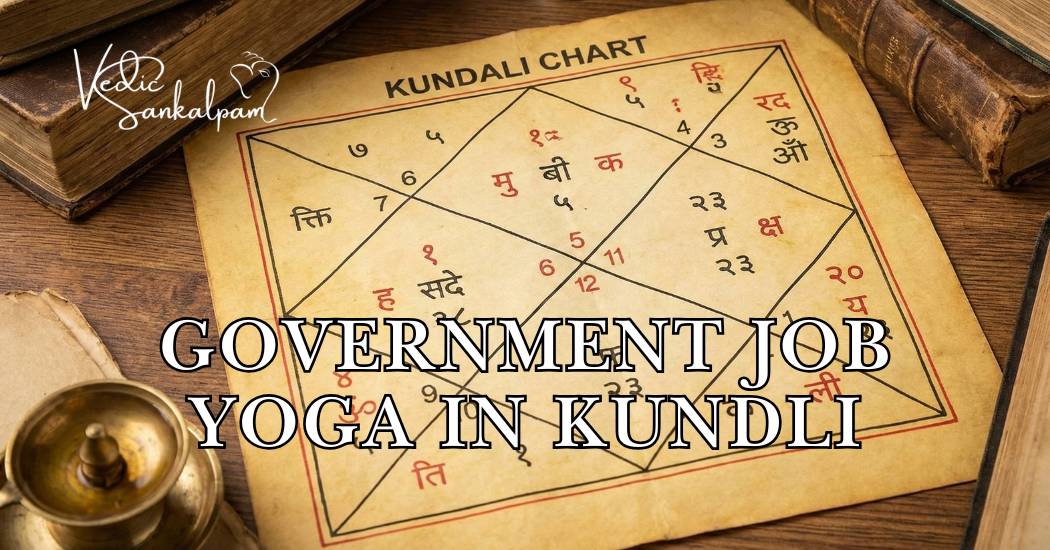
A kundli, also known as a birth chart or horoscope, is a detailed astrological diagram that maps the positions of planets at the exact moment of your birth. Think of it as your cosmic fingerprint—completely unique to you. This chart is divided into 12 houses, each representing different aspects of life, from relationships and health to career and spirituality.
The Role of Planets in Career
In Vedic astrology, planets aren’t just celestial bodies; they’re karmic indicators that influence various facets of your life. When it comes to career, especially government jobs, specific planets play crucial roles. Their placement, strength, and relationships with other planets in your kundli can make or break your chances of landing that coveted position.
Key Planets Responsible for Government Jobs
The Sun – The King of Government Positions
The Sun is the most significant planet when it comes to government jobs. Why? Because it represents authority, power, leadership, and the government itself. A strong Sun in your kundli—especially in the 10th house (career) or aspects with beneficial planets—can be a powerful indicator of success in government service.
If the Sun is well-placed and dignified in signs like Aries or Leo, you’re naturally equipped with leadership qualities that government positions demand. A weak or afflicted Sun, however, might require remedial measures to strengthen its influence.
Saturn – The Disciplinarian
Saturn might seem like a tough teacher, but it’s actually your best friend when it comes to government jobs. This planet governs discipline, hard work, perseverance, and service—all essential qualities for succeeding in competitive government exams and maintaining long-term careers in public service.
Saturn’s placement in the 6th or 10th house can be particularly beneficial. It teaches you to embrace challenges and develop the stamina needed for rigorous preparation and sustained performance.
Jupiter – The Planet of Wisdom
Jupiter represents knowledge, wisdom, ethics, and higher learning. For government administrative positions that require decision-making and ethical judgment, Jupiter’s blessings are invaluable. A well-placed Jupiter can enhance your analytical abilities and bring opportunities in judicial, educational, and administrative branches of government.
Mars – The Planet of Action
Mars gives you courage, determination, and the fighting spirit needed to compete in tough government exams. It’s especially important for defense services, police, and other action-oriented government roles. When Mars is favorably placed, it provides the energy and willpower to push through obstacles.
Important Houses for Government Job Yoga
The 10th House – Career and Profession
The 10th house is the throne of your career. It’s where your professional destiny unfolds. For government job yoga, this house must be strong and well-aspected by beneficial planets, particularly the Sun, Saturn, and Jupiter. The lord of the 10th house and its placement also significantly impact your career trajectory.
The 6th House – Service and Competition
The 6th house governs service, daily work, competition, and enemies. Since government jobs involve both service and intense competition, a strong 6th house is crucial. Planets like Saturn and Mars perform well here, giving you the competitive edge and service-oriented mindset required.
The 1st House – Self and Personality
Your ascendant or 1st house represents your personality and overall life approach. A strong 1st house with beneficial planetary influences can enhance your confidence and presentation—both vital during interviews and professional interactions.
Powerful Government Job Yogas in Astrology
Raj Yoga for Government Success
Raj Yoga is one of the most auspicious combinations in Vedic astrology. It occurs when the lords of Kendra (1st, 4th, 7th, 10th) and Trikona (1st, 5th, 9th) houses form a relationship through conjunction or aspect. This yoga can elevate your status and bring you recognition, power, and government positions.
When Raj Yoga involves the Sun or connects with the 10th house, it creates a powerful indication of government success. People born with this yoga often rise to prominent positions with relative ease.
Budh Aditya Yoga
Budh Aditya Yoga forms when Mercury (Budh) and the Sun (Aditya) are together in the same house. This combination sharpens your intellect, communication skills, and administrative abilities. It’s particularly beneficial for those aspiring to clerical, administrative, or intellectual government positions.
This yoga makes you naturally articulate and skilled at handling paperwork and bureaucratic processes—exactly what government jobs demand.
Gaj Kesari Yoga
Gaj Kesari Yoga occurs when Jupiter is in a Kendra (angular house) from the Moon. This is considered one of the most fortunate yogas, bestowing wisdom, prosperity, and respect. When this yoga influences the 10th house or its lord, it can pave the way for prestigious government appointments.
How These Yogas Influence Career
These yogas don’t work in isolation. They interact with other planetary placements and periods (dashas) in your life. Even if you have promising yogas, their fruits manifest during specific planetary periods. That’s why timing is everything in astrology.
Dasha and Transits Impact on Government Jobs
The Dasha system in Vedic astrology divides your life into planetary periods. During the Dasha of planets related to the 10th or 6th house, or planets that form government job yogas, you’re more likely to secure a government position.
For instance, if you’re running the Sun Mahadasha or Saturn Mahadasha with supportive transits, your efforts toward government jobs will likely bear fruit. Transits of Jupiter and Saturn over your 10th house or natal Sun can also trigger career breakthroughs.
Remedies to Strengthen Government Job Yoga
Gemstone Recommendations
Wearing gemstones can strengthen weak planets in your kundli. For government jobs:
Ruby strengthens the Sun
Blue Sapphire strengthens Saturn
Yellow Sapphire strengthens Jupiter
Always consult an experienced astrologer before wearing gemstones, as incorrect usage can backfire.
Mantras and Prayers
Chanting specific mantras can invoke planetary blessings:
Surya Mantra (Om Suryaya Namah) for the Sun
Shani Mantra (Om Shanaischaraya Namah) for Saturn
Guru Mantra (Om Brihaspataye Namah) for Jupiter
Regular recitation, especially during planetary hours, can create positive vibrations.
Charitable Acts
Performing charitable acts aligned with specific planets can reduce negative karmas:
Donate wheat or jaggery on Sundays for the Sun
Offer food to crows on Saturdays for Saturn
Donate yellow items on Thursdays for Jupiter
Real-Life Examples and Case Studies
Many successful government officials have strong Sun-Saturn combinations in their kundlis. Historical leaders and administrators often show prominent Raj Yogas and well-placed 10th houses. While specific personal charts require privacy, astrological literature is filled with examples demonstrating these principles.
Common Myths About Government Job Yoga
One common myth is that having government job yoga guarantees a position without effort. That’s not true. Astrology shows potential and timing, but effort, preparation, and skill are equally important. Another myth is that a weak chart means no chance—remedies and hard work can significantly improve outcomes.
How to Read Your Kundli for Government Job Prospects
To analyze your kundli for government job potential:
Check the strength and placement of the Sun, Saturn, and Jupiter
Examine the 10th house, its lord, and planets placed there
Look for Raj Yoga and other beneficial combinations
Analyze your current Dasha period
Consult with a qualified astrologer for detailed insights
Remember, astrology is a guide, not a guarantee. Your actions ultimately shape your destiny.
Conclusion
Government job yoga in kundli offers fascinating insights into your career potential through the lens of Vedic astrology. While planetary positions and yogas can indicate natural inclinations and favorable periods, they work best when combined with sincere effort, proper preparation, and ethical conduct. Whether the stars are aligned in your favor or you need to strengthen certain aspects through remedies, understanding your kundli empowers you to make informed decisions about your career path. The universe might set the stage, but you’re the one who must perform.
FAQs
1. Can I get a government job if my kundli doesn’t show government job yoga?
Yes, absolutely. While favorable yogas make the journey smoother, determination, hard work, and proper preparation can overcome astrological challenges. Remedies can also help strengthen weak planetary positions.
2. Which planet is most important for government jobs?
The Sun is the most crucial planet for government positions as it represents authority and government itself. However, Saturn, Jupiter, and Mars also play significant supporting roles.
3. How do I know if my current Dasha is favorable for government jobs?
Consult an astrologer to analyze your current Dasha. Generally, the Dasha of planets connected to your 10th or 6th house, or planets forming career yogas, are favorable for government job opportunities.
4. Are astrological remedies scientifically proven?
Astrological remedies are based on ancient Vedic wisdom rather than modern scientific methodology. Many people report positive experiences, but results vary individually. They work best when combined with practical efforts.
5. Should I rely only on astrology for career decisions?
No, astrology should complement, not replace, practical career planning. Use it as a tool for timing and understanding your strengths, but always prioritize skill development, education, and consistent effort toward your goals.
Have you ever heard someone say they can’t get married because they’re “Manglik”? Or perhaps you’ve encountered this term while matching horoscopes for marriage? Manglik Dosh is one of the most talked-about concepts in Vedic astrology, especially when it comes to marriage compatibility. But what exactly is it, and should you really be concerned about it?
Let’s dive deep into this fascinating astrological phenomenon and separate fact from fiction.
What is Manglik Dosh?
The Astrological Definition
Manglik Dosh, also known as Mangal Dosha or Kuja Dosha, is an astrological condition that occurs when the planet Mars (Mangal) is positioned in certain houses of a person’s birth chart. In Vedic astrology, this planetary placement is believed to create challenges, particularly in married life.
Think of it like this: if your birth chart were a house, Mars would be that one guest who doesn’t quite fit in certain rooms. When Mars occupies specific positions, astrologers believe it can create turbulence in relationships and personal life.
Origins in Vedic Astrology
This concept has its roots deeply embedded in ancient Vedic astrology, which has been practiced in India for thousands of years. The ancient sages who developed this system observed planetary movements and their correlations with human behavior and life events. Mars, being the planet associated with energy, aggression, and passion, was considered particularly influential in matters of marriage and partnership.
How Does Manglik Dosh Form?
The Position of Mars in Your Birth Chart
Your birth chart is essentially a snapshot of where all the planets were positioned at the exact moment you were born. It’s divided into twelve houses, each representing different aspects of life. Mars travels through these houses, and its placement determines whether you have Manglik Dosh or not.
Houses That Create Manglik Dosh
According to traditional Vedic astrology, Manglik Dosh is formed when Mars is placed in the 1st, 2nd, 4th, 7th, 8th, or 12th house of your birth chart. Each house represents something specific:
1st House: Self and personality
2nd House: Family and wealth
4th House: Home and mother
7th House: Marriage and partnerships
8th House: Longevity and transformation
12th House: Losses and expenses
When Mars sits in any of these houses, it’s believed to bring its fiery energy into those life areas, potentially causing disruptions.
Types of Manglik Dosh
Anshik Manglik (Partial Manglik)
Not all Manglik Doshas are created equal. An Anshik or partial Manglik Dosh occurs when Mars is weakly placed or when certain planetary combinations reduce its intensity. Think of it as having a mild version of the condition—it’s there, but it’s not as powerful.
Purna Manglik (Complete Manglik)
A Purna or complete Manglik Dosh happens when Mars is strongly positioned in the problematic houses without any mitigating factors. This is considered the more intense version, and traditionally, astrologers pay more attention to such placements.
Effects of Manglik Dosh on Marriage
Comprehensive visual guide to Manglik Dosh showing how Mars placement in specific houses affects marriage and relationships, along with proven astrological remedies and solutions
Common Beliefs and Concerns
Here’s where things get interesting—and sometimes scary for those who believe in astrology. Traditional beliefs suggest that Manglik Dosh can lead to various marital problems, including:
Frequent conflicts and misunderstandings
Delay in marriage
Financial troubles after marriage
Health issues for the spouse
In extreme cases, separation or early death of the partner
Sounds intense, right? But before you panic, let’s look at the whole picture.
Impact on Marital Harmony
The core belief is that Mars brings aggressive energy into the relationship domain. Since marriage requires harmony, understanding, and compromise, this fiery planetary influence could theoretically create friction. It’s like trying to have a calm conversation while loud music is playing in the background—the environment isn’t quite right.
Does Manglik Dosh Affect Everyone the Same Way?
Intensity Variations
Here’s something many people don’t know: not everyone with Manglik Dosh experiences the same effects. The intensity depends on various factors, including which house Mars occupies, what sign it’s in, and what other planets are influencing it. It’s not a one-size-fits-all situation.
Age Factor in Manglik Dosh
There’s an interesting twist in the Manglik tale—some astrologers believe that the effects of Manglik Dosh diminish after a person crosses 28 years of age. Why 28? According to Vedic astrology, this is approximately when Saturn completes its first cycle around the sun, bringing maturity and stability to a person’s life. It’s nature’s way of saying, “You’ve grown up now; things will settle down.”
Myths vs. Reality About Manglik Dosh
Debunking Common Misconceptions
Let’s address the elephant in the room. Over the years, Manglik Dosh has been surrounded by numerous myths that have caused unnecessary fear and broken many potential relationships. Some of the biggest misconceptions include:
Myth: A Manglik person will definitely cause their spouse’s death.
Reality: There’s no statistical evidence supporting this claim.
Myth: Manglik people should never marry non-Mangliks.
Reality: Many successful marriages exist between Manglik and non-Manglik individuals.
Myth: Manglik Dosh is a curse.
Reality: It’s simply a planetary position; calling it a curse adds unnecessary negativity.
What Science Says
From a scientific standpoint, there’s no empirical evidence linking planetary positions at birth with marital outcomes. Astrology operates on a different paradigm than science, based on observation and correlation rather than causation. Whether you believe in it or not is ultimately a personal choice, but it’s important to approach it with a balanced mindset.
Can Manglik Dosh Be Canceled?
Natural Cancellation Conditions
Good news! According to astrology, there are several conditions under which Manglik Dosh gets automatically canceled or neutralized:
When Mars is in its own sign (Aries or Scorpio) or exalted sign (Capricorn)
When the spouse also has Manglik Dosh (both Mars energies balance each other)
When benefic planets like Jupiter aspect Mars
When Mars is in certain specific degrees that reduce its malefic nature
Double Manglik Marriages
Ever heard the saying “two negatives make a positive”? In Manglik astrology, when two Manglik individuals marry each other, their Mars energies are believed to neutralize each other. It’s like two strong personalities understanding each other’s intensity because they share the same trait.
Remedies for Manglik Dosh
Astrological Solutions
If you’re concerned about Manglik Dosh, Vedic astrology offers various remedies that are believed to reduce its negative effects:
Reciting Hanuman Chalisa or Mangal Mantras regularly
Observing fasts on Tuesdays (the day associated with Mars)
Donating red items like clothes, lentils, or sweets on Tuesdays
Visiting Hanuman temples regularly
Gemstone Recommendations
Wearing Red Coral
Red Coral (Moonga) is the gemstone associated with Mars. Many astrologers recommend wearing it to strengthen Mars positively and reduce its malefic effects. However, it’s crucial to consult a knowledgeable astrologer before wearing any gemstone, as incorrect usage can sometimes have adverse effects.
Rituals and Pujas
Various pujas and rituals are performed to appease Mars, including:
Mangal Shanti Puja
Kumbh Vivah (a symbolic marriage performed before actual marriage)
Offering prayers at specific Mars temples
While these are traditional practices, their effectiveness is a matter of personal belief.
Manglik Dosh in Modern Times
Changing Perspectives
Times are changing, and so are perspectives on Manglik Dosh. Younger generations are questioning traditional beliefs and making decisions based on compatibility, understanding, and love rather than just astrological charts. Many couples today choose to focus on building strong relationships through communication and mutual respect.
Balancing Tradition and Logic
You don’t have to completely reject tradition or blindly follow it. The key is finding a balance. If astrology is important to your family or culture, you can acknowledge it while also using your judgment and reasoning. After all, your happiness shouldn’t be dictated solely by planetary positions.
Should You Worry About Manglik Dosh?
Here’s my take on this: while respecting cultural and astrological beliefs, it’s essential not to let fear rule your life decisions. Successful marriages are built on trust, communication, respect, and compatibility—qualities that have nothing to do with Mars or any other planet.
If you have Manglik Dosh and it concerns you, by all means, consult a knowledgeable astrologer and perform the recommended remedies if they bring you peace of mind. But don’t let it become an obstacle to finding happiness. Remember, millions of people with Manglik Dosh live happily married lives, and countless marriages without any dosha face challenges.
The real question isn’t whether Mars is in your 7th house—it’s whether you and your partner are willing to work together, understand each other, and grow as a team.
Conclusion
Manglik Dosh is a complex astrological concept that has influenced marriage decisions in many cultures, particularly in India, for centuries. While it originates from ancient Vedic wisdom and continues to hold significance for many people, it’s important to approach it with both respect and rationality.
Understanding what Manglik Dosh is, how it forms, and what remedies exist can help you make informed decisions rather than acting out of fear or superstition. Whether you choose to follow astrological guidance closely or take it with a grain of salt, remember that the strength of any relationship ultimately depends on the people in it, not the planets above them.
Your birth chart might show where Mars was when you were born, but you write the story of your life and your relationships through your choices, actions, and commitment.
FAQs
1. Can Manglik Dosh be completely removed?
According to Vedic astrology, while Manglik Dosh itself cannot be completely removed from your birth chart (since it’s a fixed planetary position), its negative effects can be neutralized through specific remedies, planetary combinations, or by marrying another Manglik person. The intensity also naturally reduces after age 28.
2. Is it true that a Manglik should only marry another Manglik?
This is a common belief but not an absolute rule. While marrying another Manglik is one solution that astrologers suggest, many other factors in compatibility matter more. Numerous successful marriages exist between Manglik and non-Manglik individuals. Remedies can also be performed to reduce concerns.
3. How can I check if I have Manglik Dosh?
You need your complete birth details—date, time, and place of birth—to create an accurate birth chart. A qualified Vedic astrologer can analyze your chart and determine if Mars is positioned in the houses that create Manglik Dosh. Several online calculators are also available, though consulting an expert is recommended for accuracy.
4. Does Manglik Dosh affect career or health, or only marriage?
While Manglik Dosh is primarily discussed in the context of marriage and relationships, Mars’s placement can influence other life areas too, including career ambition, energy levels, and courage. However, the term “Manglik Dosh” specifically refers to its impact on marital prospects and harmony.
5. Are there any famous people who have Manglik Dosh?
Yes, several well-known personalities reportedly have Manglik Dosh and yet lead successful personal and professional lives. This demonstrates that having this astrological condition doesn’t determine your destiny—your choices, efforts, and circumstances play far more significant roles in shaping your life outcomes.
Have you ever wondered why certain patterns keep repeating in your life? Why do some relationships feel destined while others fizzle out? Your Vedic astrology birth chart might hold the answers. Think of it as a cosmic fingerprint—a unique map of the heavens at the exact moment you took your first breath. This ancient system doesn’t just predict your future; it reveals the very essence of who you are and the karmic blueprint you’ve brought into this lifetime.
What Is Vedic Astrology?
The Ancient Roots of Jyotish
Vedic astrology, also known as Jyotish (which translates to “the science of light”), has been practiced in India for over 5,000 years. It’s one of the six auxiliary disciplines connected to the Vedas, the ancient sacred texts of Hindu philosophy. Unlike modern horoscopes you might read in magazines, Vedic astrology is a sophisticated mathematical and spiritual science that requires precise birth data and complex calculations.
The sages who developed this system observed the heavens with remarkable accuracy, noting how planetary movements correlated with earthly events and human experiences. They understood that we’re not separate from the cosmos—we’re intimately connected to it.
How Vedic Astrology Differs from Western Astrology
If you’ve explored Western astrology, you might notice some differences when you dive into Vedic astrology. The most significant distinction is the zodiac system itself. Vedic astrology uses the sidereal zodiac, which accounts for the precession of the equinoxes—the wobble in Earth’s axis that causes the positions of constellations to shift over time.
Western astrology uses the tropical zodiac, which is fixed to the seasons. This means your sun sign in Vedic astrology might actually be different from what you’ve always believed! Additionally, Vedic astrology places greater emphasis on the moon sign and ascending sign, uses different house systems, and incorporates unique elements like nakshatras and planetary periods called dashas.
What Is a Birth Chart in Vedic Astrology?
The Blueprint of Your Soul
Your Vedic birth chart, called a Kundali or Janma Kundali, is essentially a snapshot of the sky at the precise moment and location of your birth. Imagine freezing time at that instant—where was the sun? The moon? What about Jupiter, Saturn, and the other planets? This celestial arrangement creates a unique energetic signature that influences your personality, relationships, career path, health tendencies, and spiritual journey.
The birth chart doesn’t dictate your fate with rigid certainty. Instead, it reveals your karmic tendencies, natural strengths, potential challenges, and the spiritual lessons you’re here to learn. Think of it as a roadmap rather than a predetermined route—you still have free will to navigate the terrain.
Key Components of a Vedic Birth Chart
A Vedic birth chart contains several essential elements working together like instruments in an orchestra. You have the twelve houses representing different life areas, nine planets showing various energies and influences, twelve zodiac signs coloring how those planets express themselves, and 27 nakshatras adding another layer of refinement to planetary placements.
Each component interacts with others, creating an intricate web of influences that makes your chart uniquely yours. Two people born even minutes apart in different locations will have different charts because the ascending sign changes approximately every two hours.
The Twelve Houses in Vedic Astrology
Understanding House Significance
The twelve houses in your birth chart represent different areas of your life experience. Unlike Western astrology which often uses the Placidus house system, Vedic astrology typically uses whole sign houses, where each house corresponds to an entire zodiac sign.
Each house has specific significations that remain consistent across all charts. The condition of planets placed in these houses, the signs occupying them, and which planets “own” or rule those signs all contribute to how that life area manifests for you.
Houses of Identity and Wealth
The first house, or Lagna, represents your physical body, personality, and overall life approach. It’s your window to the world and how others first perceive you. The second house governs wealth, family, speech, and food—basically, the resources you accumulate and how you nourish yourself physically and emotionally.
The third house relates to siblings, courage, communication, and short journeys. It shows your efforts and willpower. The fourth house represents your mother, home, emotional foundations, property, and inner peace. These foundational houses set the stage for your material and psychological security.
Houses of Relationships and Career
The fifth house governs creativity, children, romance, intelligence, and past-life merits. It’s where you express your unique talents and find joy. The sixth house deals with obstacles, enemies, health issues, daily work, and service—essentially, the challenges you must overcome.
The seventh house is your partnership sector, covering marriage, business partnerships, and how you relate to others one-on-one. The eighth house is transformative, ruling sudden events, inheritance, occult knowledge, longevity, and psychological depth. The ninth house represents your father, higher learning, spiritual beliefs, long journeys, and luck or fortune.
The tenth house governs your career, reputation, and public standing. The eleventh house relates to gains, friendships, aspirations, and elder siblings. Finally, the twelfth house represents losses, expenses, foreign lands, spirituality, isolation, and liberation—it’s where you transcend material concerns.
The Nine Planets (Navagrahas)
Sun and Moon: The Luminaries
In Vedic astrology, the Sun represents your soul, vitality, authority, father, and ego. It’s your core essence and life purpose. A strong Sun gives confidence, leadership ability, and recognition, while a weak or afflicted Sun might bring struggles with authority or self-esteem issues.
The Moon governs your mind, emotions, mother, and mental peace. Since it changes signs approximately every 2.5 days, it’s incredibly personal to your chart. A well-placed Moon brings emotional stability, nurturing abilities, and popularity, while a challenged Moon might indicate mood swings, anxiety, or emotional turbulence.
Mars, Mercury, Jupiter, Venus, and Saturn
Mars represents energy, courage, siblings, property, and your capacity for action. It’s the warrior planet that drives ambition and determination. Mercury governs intelligence, communication, business acumen, and analytical abilities. It’s neutral by nature and takes on the qualities of planets it associates with.
Jupiter is the great benefic, representing wisdom, expansion, children, teachers, and spiritual growth. It brings optimism, knowledge, and good fortune where it’s placed. Venus governs beauty, luxury, relationships, creativity, and pleasure. It’s about harmony, art, and what you value.
Saturn is often misunderstood but incredibly important. It represents discipline, structure, limitations, hard work, and karmic lessons. Where Saturn sits in your chart, you’ll face your greatest challenges but also achieve your most enduring accomplishments through perseverance.
Rahu and Ketu: The Shadow Planets
Rahu and Ketu aren’t physical planets—they’re the north and south lunar nodes, the points where the Moon’s orbit intersects the ecliptic. They’re always exactly opposite each other in your chart and represent your karmic axis.
Rahu is associated with worldly desires, obsessions, unconventional thinking, foreign influences, and sudden events. It amplifies whatever it touches and can bring success through unorthodox means. Ketu represents spiritual detachment, past-life talents, intuition, and liberation. It can indicate areas where you have innate abilities but may feel disinterested or disconnected.
The Twelve Zodiac Signs (Rashis)
Fire, Earth, Air, and Water Elements
The twelve zodiac signs in Vedic astrology are grouped by element, just as in Western astrology. Fire signs (Aries, Leo, Sagittarius) are enthusiastic, dynamic, and action-oriented. Earth signs (Taurus, Virgo, Capricorn) are practical, stable, and material-focused. Air signs (Gemini, Libra, Aquarius) are intellectual, communicative, and social. Water signs (Cancer, Scorpio, Pisces) are emotional, intuitive, and sensitive.
Each sign also has qualities: cardinal (initiating), fixed (sustaining), or mutable (adapting). These qualities describe how the signs operate and respond to life circumstances.
How Signs Influence Planetary Expression
When a planet occupies a zodiac sign, that sign colors how the planet expresses its energy. For example, Mars in fiery Aries is bold, direct, and competitive—it’s in its own sign and operates at full strength. But Mars in watery Cancer is in its debilitation, where the assertive, action-oriented energy becomes emotionally reactive and indirect.
Each planet has signs where it’s exalted (performing at its best), debilitated (struggling to express naturally), owns its own sign (comfortable and powerful), or is neutral. These relationships significantly impact how planetary energies manifest in your life.
Nakshatras: The Lunar Mansions
The 27 Nakshatras Explained
Here’s where Vedic astrology gets really precise. The zodiac is divided into 27 nakshatras or lunar mansions, each spanning 13°20′ of arc. Each nakshatra has its own ruling deity, symbol, qualities, and planetary ruler, adding incredible nuance to chart interpretation.
While your sun and moon might be in the same zodiac sign as someone else, your nakshatra placements could be completely different, explaining why you might express that energy so uniquely. Nakshatras are especially important for compatibility analysis, timing of events, and understanding the subtle psychological patterns in your personality.
Your Birth Star and Its Significance
Your birth star is the nakshatra where your Moon was placed at birth. This is considered one of the most important points in your chart for understanding your emotional nature and subconscious patterns. It influences your thinking style, habits, instinctive reactions, and even your health tendencies.
In Indian tradition, your birth star is used for naming ceremonies, matching horoscopes for marriage, and predicting auspicious timing for important life events. Each nakshatra has different characteristics—some are gentle and nurturing, others are fierce and transformative.
Ascendant (Lagna): Your Rising Sign
Why the Ascendant Matters Most
If you learn one thing about your Vedic chart, make it your ascendant or Lagna. This is the zodiac sign that was rising on the eastern horizon at your birth moment. It sets the entire structure of your chart, determining which signs occupy which houses.
Your Lagna represents your physical body, personality, life path, and overall chart strength. The planet that rules your Lagna sign (your Lagna lord) becomes the most important planet in your entire chart. Its placement and condition significantly influence your life circumstances and how you navigate challenges.
Calculating Your Lagna
The Lagna changes approximately every two hours, which is why accurate birth time is absolutely essential for Vedic astrology. Even a difference of a few minutes can shift your Lagna, changing your entire chart interpretation.
To calculate your Lagna, you need your exact birth time (ideally verified from your birth certificate), birth date, and birth location coordinates. Many online Vedic astrology calculators can generate your chart, but for serious analysis, it’s worth consulting with a knowledgeable astrologer who can verify your birth time through a process called rectification if needed.
Planetary Aspects (Drishti)
In Vedic astrology, planets don’t just influence the house they occupy—they also cast aspects (drishti) to other houses and planets. All planets aspect the seventh house from their position, meaning they influence whatever is directly opposite them in the chart.
Additionally, Mars aspects the fourth and eighth houses from its position, Jupiter aspects the fifth and ninth houses, and Saturn aspects the third and tenth houses. These special aspects add layers of influence throughout your chart. When planets aspect each other, they create relationships that can be harmonious, challenging, or neutral depending on their natural friendship and the aspects involved.
Yogas: Special Planetary Combinations
One of the most fascinating aspects of Vedic astrology is yogas—specific planetary combinations that create distinct life patterns. There are hundreds of yogas, ranging from extremely auspicious (Raja Yogas indicating power and success) to challenging (Duryogas indicating obstacles).
For example, when the lords of the first, ninth, and tenth houses connect through conjunction or aspect, they create powerful Raja Yogas that can indicate leadership, recognition, and achievement. Gaja Kesari Yoga forms when Jupiter and Moon are in mutual angles, bringing wisdom and prosperity.
Not all yogas manifest equally for everyone, though. Their effects depend on the overall chart strength, the planetary periods you’re running, and how you choose to work with these energies. Yogas are potentials, not guarantees—they show where opportunities exist if you align with them.
Dashas: The Planetary Periods
Understanding Vimshottari Dasha
This is where Vedic astrology really distinguishes itself from Western astrology. The Vimshottari Dasha system divides your life into planetary periods, with each of the nine planets ruling specific time periods in a 120-year cycle.
The sequence begins based on your Moon’s nakshatra at birth. You might be born into Mercury’s period, followed by Ketu, then Venus, and so on. Each major period (Mahadasha) lasts from 6 to 20 years depending on the planet, and within each Mahadasha are sub-periods (Antardashas) of all nine planets.
These dashas are incredibly accurate for timing life events. The planet whose period you’re running becomes activated in your chart, bringing forth whatever it promises based on its placement, condition, and the houses it rules. This is why two people with similar charts might experience very different lives—they’re running different planetary periods that activate different parts of their charts at different times.
How to Read Your Vedic Birth Chart
A comprehensive Vedic astrology birth chart displays planetary positions, houses, and zodiac signs at the moment of birth.
Step-by-Step Interpretation Guide
Reading your birth chart can seem overwhelming at first, but here’s a systematic approach. First, identify your Lagna (ascendant) and its ruling planet. Where is your Lagna lord placed? This gives you the primary narrative of your life path.
Next, examine your Moon sign and nakshatra for understanding your emotional nature and mind. Then look at your Sun placement for your soul purpose and vitality. Assess which planets are strong (in own sign, exalted, well-placed in benefic houses) versus weak (debilitated, combust, afflicted by malefics).
Consider which houses are occupied by planets and which are empty. Examine aspects between planets and their relationships. Look for prominent yogas. Finally, check which Mahadasha and Antardasha you’re currently running—this timing factor is crucial for understanding which parts of your chart are “switched on” right now.
Benefits of Understanding Your Birth Chart
Why should you invest time in understanding your Vedic birth chart? For starters, it provides profound self-awareness. You’ll understand why certain situations trigger you, why you’re naturally talented in specific areas, and where you need to put in extra effort.
Your chart reveals optimal timing for important decisions like career changes, marriage, investments, or relocation. It helps you understand relationship dynamics by comparing charts with partners, family members, or business associates. You’ll gain insight into health vulnerabilities and prevention strategies.
Perhaps most importantly, your birth chart illuminates your spiritual path and life purpose. It shows your karmic lessons, areas where you need to develop, and natural dharma (life purpose). This knowledge doesn’t limit you—it empowers you to work with your natural strengths and consciously address challenging patterns.
Common Misconceptions About Vedic Astrology
Let’s clear up some myths. First, Vedic astrology isn’t about fatalism or believing your life is predetermined. It’s about understanding probabilities and tendencies while maintaining your free will to make conscious choices.
Second, not everything negative in your chart will manifest. Many challenging planetary positions can be mitigated through awareness, remedial measures, and conscious effort. Your chart shows potentials, not certainties.
Third, Vedic astrology isn’t superstition—it’s a sophisticated system based on astronomical observations and mathematical calculations refined over millennia. Yes, it requires spiritual openness to appreciate fully, but it’s grounded in observable celestial mechanics.
Finally, you don’t need to be Hindu or believe in reincarnation to benefit from Vedic astrology, though understanding the concept of karma (cause and effect) enhances the depth of insight you can gain.
Getting Your Birth Chart Analyzed
While you can learn to read your own chart with study and practice, consulting an experienced Vedic astrologer provides invaluable insights. A skilled astrologer can see patterns and connections you might miss, offer remedial suggestions, and help you understand timing for important life decisions.
When seeking an astrologer, look for someone trained in traditional Vedic methods, preferably with several years of practice. Be wary of anyone who makes fear-based predictions or demands expensive remedies. Ethical astrologers empower you with knowledge rather than creating dependency.
Prepare for your consultation by having accurate birth details ready and specific questions you’d like addressed. The best astrological consultations are dialogues where the astrologer explains principles and guides you toward your own insights rather than just making predictions.
Conclusion
Your Vedic astrology birth chart is an extraordinary tool for self-discovery, offering a window into your karmic blueprint and life purpose. It reveals the intricate cosmic patterns that influence your personality, relationships, career, health, and spiritual journey. While the system might seem complex at first—with its houses, planets, signs, nakshatras, aspects, yogas, and dashas—each element contributes to a remarkably accurate portrait of who you are and the path you’re here to walk.
Remember, your chart doesn’t imprison you in fate’s grip. Instead, it illuminates the terrain of your life journey, showing where roads are smooth, where challenges await, and where your greatest opportunities lie. Armed with this cosmic map, you can navigate life’s ups and downs with greater wisdom, timing your actions harmoniously with celestial rhythms and consciously choosing how to express your chart’s potentials.
Whether you’re just beginning to explore Vedic astrology or deepening your understanding, approaching your birth chart with curiosity, humility, and an open heart will yield the most profound insights. The stars don’t compel—they guide. And in that guidance lies tremendous power for conscious living and spiritual evolution.
FAQs
1. What’s the difference between Vedic and Western astrology birth charts?
The primary difference is that Vedic astrology uses the sidereal zodiac based on actual constellation positions, while Western astrology uses the tropical zodiac aligned with seasons. This means your planetary positions will differ by approximately 23-24 degrees between the two systems. Vedic charts also emphasize the Moon and ascending sign more heavily, use whole sign houses, incorporate nakshatras, and employ the dasha timing system which Western astrology doesn’t use.
2. Can my Vedic birth chart predict when I’ll get married or have children?
Vedic astrology can indicate favorable periods for marriage and children by analyzing the seventh house (marriage), fifth house (children), relevant planetary periods, and transits. However, it shows timing of opportunities and favorable conditions rather than predetermined events. Your free will, readiness, circumstances, and choices ultimately determine when these life events occur. An astrologer can guide you toward windows of opportunity but cannot guarantee specific outcomes.
3. What if I don’t know my exact birth time?
An accurate birth time is crucial for Vedic astrology since the ascendant changes every two hours. Without it, astrologers can’t determine your Lagna, house placements, or accurately calculate dashas. If you don’t have your exact birth time, you might explore birth time rectification with an experienced astrologer who uses significant life events to work backward to your likely birth time. Alternatively, some analysis is possible using just your Moon chart, though it’s much less comprehensive.
4. Are bad planetary placements in my chart permanent problems?
Not at all. Challenging planetary positions indicate areas requiring conscious effort and growth rather than permanent limitations. Many successful people have difficult charts—they simply learned to work constructively with those energies. Additionally, planetary periods (dashas) change throughout life, activating different chart areas at different times. Vedic astrology also offers remedial measures including mantras, gemstones, charitable acts, and lifestyle adjustments that can help balance challenging influences.
5. How often should I consult my Vedic birth chart?
Your birth chart itself never changes, but planetary transits and dashas constantly evolve, creating different circumstances at various life stages. Many people find annual consultations helpful around their birthday to understand the year ahead. You might also seek guidance during major life transitions, when facing important decisions, or during particularly challenging periods. However, becoming overly dependent on astrological consultations isn’t healthy—use astrology as one tool for self-awareness and decision-making alongside practical wisdom and intuition.
Have you ever wondered how the stars influence our personality, destiny, and life path? In Vedic astrology, nakshatras play a crucial role in shaping who we are. Today, we’re diving deep into one of the most intriguing lunar mansions: Sataisa Nakshatra. Also known as Shatabhisha or the “hundred healers,” this nakshatra carries profound mysteries and healing powers that can transform lives.
What is Sataisa Nakshatra?
Definition and Meaning
Sataisa Nakshatra, more commonly spelled as Shatabhisha in Sanskrit, literally translates to “possessing a hundred physicians” or “hundred healers.” This name itself hints at the nakshatra’s deep connection with healing, medicine, and mysterious knowledge. It’s the 24th nakshatra in the series of 27 lunar mansions that form the foundation of Vedic astrology.
The symbol of Sataisa is an empty circle or a hundred flowers, representing the infinite possibilities and the void from which all creation emerges. Think of it as a cosmic portal—mysterious yet full of potential.
Position in Vedic Astrology
Sataisa Nakshatra spans from 6°40′ to 20°00′ in Aquarius (Kumbha Rashi). It’s ruled by Rahu, the shadow planet known for its unconventional and transformative energy. This placement in Aquarius, an air sign known for innovation and humanitarian concerns, adds another layer of uniqueness to this nakshatra.
The ruling deity is Varuna, the god of cosmic waters and divine order, which brings themes of truth, healing, and hidden knowledge into the lives of those born under this star.
The Mythology Behind Sataisa Nakshatra
Lord Varuna and His Connection
Lord Varuna isn’t just any deity—he’s the guardian of cosmic law and truth. In ancient Vedic texts, Varuna is depicted as the one who knows all secrets, sees through deception, and maintains universal order. His association with Sataisa Nakshatra brings a profound connection to truth-seeking and justice.
Varuna’s domain includes the vast oceans and all water bodies, symbolizing the depths of the subconscious mind and hidden emotions. People born under this nakshatra often have an innate ability to dive deep into mysteries, whether they’re exploring scientific phenomena or spiritual truths.
Ancient Stories and Legends
One fascinating legend tells of how Varuna possessed the power to heal through water and herbs. He was said to have knowledge of a hundred different healing methods, which connects directly to Sataisa’s name. This mythological background explains why natives of this nakshatra are often drawn to alternative medicine, research, and uncovering hidden truths.
The empty circle symbol also relates to the story of creation emerging from nothingness—a concept that resonates with quantum physics and ancient spiritual wisdom alike.
Astronomical Details of Sataisa Nakshatra
Star Constellation and Location
Astronomically, Sataisa Nakshatra corresponds to Lambda Aquarii in the constellation of Aquarius. This star is part of a group of faint stars that form a unique pattern in the night sky. The constellation itself has been associated with water-bearers across various cultures, reinforcing themes of nourishment and life-giving properties.
Degrees and Zodiac Sign
As mentioned earlier, Sataisa occupies 6°40′ to 20°00′ of Aquarius. This placement in the eleventh sign of the zodiac emphasizes themes of community, innovation, and breaking conventional boundaries. The influence of Rahu as the ruling planet adds an element of rebellion and unconventional thinking.
Characteristics of Sataisa Nakshatra Natives
Personality Traits
If you’re born under Sataisa Nakshatra, you’re probably someone who marches to the beat of your own drum. These individuals are known for their independent thinking, mysterious aura, and deep interest in unconventional subjects. They don’t follow the crowd—they create their own path.
Sataisa natives are often described as:
Highly intuitive and perceptive
Interested in healing and alternative therapies
Secretive about their personal lives
Intellectually curious and research-oriented
Socially conscious with humanitarian concerns
Strengths and Weaknesses
Every nakshatra has its light and shadow sides. Let’s explore both.
Emotional Nature
Emotionally, Sataisa natives can be quite complex. They feel things deeply but rarely show it on the surface. It’s like they’re icebergs—what you see is just a fraction of what lies beneath. This emotional depth gives them great empathy and healing abilities, but it can also lead to feelings of isolation or being misunderstood.
They have a natural ability to detach emotionally when needed, which can be both a strength and a weakness. While this helps them remain objective in difficult situations, it might make them appear cold or distant to loved ones.
Intellectual Abilities
When it comes to intellect, Sataisa natives are like cosmic detectives. They have sharp analytical minds and an insatiable curiosity about how things work—especially things that are hidden, mysterious, or taboo. They excel in research, investigation, and any field requiring deep analysis.
Their thinking is often ahead of their time. They’re the ones proposing solutions that seem radical today but become mainstream tomorrow.
Career Paths for Sataisa Nakshatra Individuals
Ideal Professions
Given their unique traits, what careers suit Sataisa natives best? The answer lies in fields that allow them to explore, heal, and innovate:
Medical research and alternative healing (Ayurveda, homeopathy, energy healing)
Astronomy, astrology, and metaphysical sciences
Psychology and psychiatry
Scientific research and innovation
Technology and software development
Environmental conservation
Detective work and investigation
Writing and journalism focusing on investigative topics
Humanitarian and social work
Business and Entrepreneurship
Sataisa natives can be successful entrepreneurs, especially in fields related to technology, healing, or social innovation. Their unconventional thinking gives them the ability to spot opportunities others miss. However, they need to be careful about taking excessive risks due to Rahu’s influence.
They thrive in businesses that serve a larger purpose beyond just profit. Think sustainable startups, health tech companies, or organizations addressing social issues.
Relationships and Compatibility
Love and Marriage
In matters of the heart, Sataisa natives are complex partners. They desire deep, meaningful connections but also need their independence and personal space. It’s like they want someone to understand their depths without drowning them with demands.
They’re loyal and committed once they find the right partner, but the journey to that point can be challenging. They need someone who respects their need for solitude and doesn’t take their emotional detachment personally.
Friendship Dynamics
As friends, Sataisa natives are the ones you call when you need an objective perspective or want to discuss something profound at 2 AM. They’re not interested in superficial relationships—they want authentic connections with people who stimulate their minds and share their values.
They might have a smaller circle of friends, but these relationships tend to be deep and long-lasting.
Compatible Nakshatras
Best compatibility is found with:
Ardra Nakshatra (both ruled by Rahu, understanding each other’s intensity)
Swati Nakshatra (complementary independence and growth-oriented)
Purva Bhadrapada (shared spiritual and philosophical interests)
Challenging compatibility with:
Rohini Nakshatra (very different emotional needs)
Pushya Nakshatra (conflicting approaches to tradition and innovation)
Health and Wellness
Common Health Issues
Sataisa natives need to pay special attention to their health, particularly in areas related to:
Nervous system disorders
Insomnia and sleep disturbances
Circulatory problems
Ankle and calf issues
Mental stress and anxiety
Addiction tendencies (due to Rahu’s influence)
The connection to Aquarius also points to potential issues with the lower legs and circulatory system.
Remedies and Precautions
Prevention is better than cure, right? Here are some health tips for Sataisa natives:
Regular meditation and grounding practices are essential to balance Rahu’s scattered energy. Water-based therapies like swimming or hydrotherapy can be particularly healing, connecting back to Varuna’s watery domain.
Maintaining a regular sleep schedule is crucial, as these natives tend to be night owls. Avoiding excessive stimulation from technology and media, especially before bed, helps calm their active minds.
Spiritual Significance
Karmic Lessons
Every nakshatra carries specific karmic lessons, and Sataisa is no exception. The primary lesson here revolves around balancing independence with connection, and material success with spiritual growth.
These souls are here to learn about healing—not just others, but themselves first. They’re meant to discover that true power comes from vulnerability, not just from knowledge or detachment. It’s like they need to learn that being strong doesn’t mean being isolated.
Meditation and Spiritual Practices
Sataisa natives naturally gravitate toward unconventional spiritual paths. Traditional religious practices might not resonate with them as much as personal spiritual exploration. Practices that work well include:
Vipassana or mindfulness meditation
Energy healing modalities like Reiki
Astrology and cosmic consciousness studies
Shamanic journeys or plant medicine (where legal and safe)
Scientific spirituality that bridges science and mysticism
Sataisa Nakshatra Padas (Quarters)
Sataisa Nakshatra
Each nakshatra is divided into four padas or quarters, each with its own flavor and characteristics.
First Pada (6°40′ – 10°00′ Aquarius)
This pada falls in Sagittarius Navamsa, ruled by Jupiter. It brings an optimistic and philosophical dimension to Sataisa’s mysterious nature. Natives here are more open to sharing their knowledge and teaching others.
Second Pada (10°00′ – 13°20′ Aquarius)
Falling in Capricorn Navamsa ruled by Saturn, this pada adds discipline and practical application to Sataisa’s healing abilities. These individuals can build structures and systems around their innovative ideas.
Third Pada (13°20′ – 16°40′ Aquarius)
This pada is in Aquarius Navamsa, also ruled by Saturn, doubling down on the humanitarian and innovative aspects. Natives here are the true revolutionaries, wanting to transform society through their discoveries.
Fourth Pada (16°40′ – 20°00′ Aquarius)
Falling in Pisces Navamsa ruled by Jupiter, this pada brings spiritual depth and compassion. These individuals combine Sataisa’s healing gifts with deep empathy and intuitive wisdom.
Remedies for Sataisa Nakshatra Challenges
Gemstones and Crystals
The primary gemstone for Sataisa Nakshatra is Hessonite (Gomed), which is associated with Rahu. Wearing this stone after proper consultation with a Vedic astrologer can help balance Rahu’s intense energy.
Other beneficial stones include:
Amethyst for spiritual connection and mental clarity
Blue sapphire (with caution and astrological guidance)
Aquamarine for emotional balance
Mantras and Prayers
Chanting mantras dedicated to Lord Varuna can bring significant benefits:
“Om Vam Varunaya Namah”
The Rahu mantra also helps:
“Om Bhram Bhreem Bhroum Sah Rahave Namah”
Regular chanting, especially during Rahu hora (Rahu’s planetary hour), amplifies the effects.
Charitable Acts
Giving back helps balance karma and reduce malefic effects. Recommended charitable acts include:
Donating to medical research or hospitals
Supporting organizations working on water conservation
While specific birth data isn’t always publicly available, historical records suggest several innovative thinkers, scientists, and healers were born under this nakshatra. The pattern that emerges is one of individuals who challenged conventional wisdom and contributed to humanity’s advancement through their unique perspectives.
Many modern researchers, alternative medicine practitioners, and technology innovators share this nakshatra placement, continuing the tradition of breaking boundaries and exploring the unknown.
Conclusion
Sataisa Nakshatra represents one of the most fascinating and complex lunar mansions in Vedic astrology. With its connection to healing, mystery, and transformation, it produces individuals who are here to push boundaries and uncover hidden truths. Whether through medicine, science, technology, or spiritual exploration, Sataisa natives contribute to human evolution in profound ways.
If you’re born under this nakshatra, embrace your unique gifts while working on balancing your tendency toward isolation. Your healing abilities and innovative thinking are needed in this world—just remember to heal yourself along the way. The hundred healers within you start with the one that tends to your own heart.
FAQs About Sataisa Nakshatra
1. What is the ruling planet of Sataisa Nakshatra?
Sataisa Nakshatra is ruled by Rahu, the north node of the moon. This gives natives their unconventional thinking, interest in mysteries, and transformative life experiences. Rahu’s influence makes them natural researchers and innovators who aren’t afraid to challenge the status quo.
2. Can Sataisa Nakshatra natives have successful marriages?
Absolutely! While they may face some challenges due to their need for independence and emotional complexity, Sataisa natives can have deeply fulfilling marriages with partners who understand and respect their unique nature. The key is finding someone who appreciates both their depth and their need for space.
3. What career should I choose if I’m born under Sataisa Nakshatra?
The best careers involve research, healing, innovation, or exploring mysteries. Consider fields like medical research, alternative healing, technology, astronomy, psychology, environmental science, or investigative work. Whatever you choose, make sure it allows you to explore, discover, and contribute to solving complex problems.
4. How can I reduce negative effects of Sataisa Nakshatra?
Regular meditation, wearing hessonite gemstone after astrological consultation, chanting mantras dedicated to Lord Varuna and Rahu, engaging in charitable activities, and maintaining grounding practices can all help balance challenging energies. Most importantly, work on connecting emotionally with others while maintaining healthy boundaries.
5. Is Sataisa Nakshatra good for spiritual growth?
Yes, exceptionally so! Sataisa is one of the most spiritually inclined nakshatras, though its approach is often unconventional. Natives have natural abilities in meditation, energy healing, and understanding cosmic principles. Their spiritual journey often involves bridging science and spirituality, finding truth beyond dogma.