Have you ever wondered why your grandmother insists on starting important tasks at specific times? Or why Indian weddings happen at oddly precise hours, sometimes even before dawn? The answer lies in an ancient concept called Muhurtham – a practice that has guided millions of people for thousands of years. It’s not just superstition; it’s a sophisticated system of timing that connects us to cosmic rhythms in ways that might surprise you.
What Is Muhurtham?
Simply put, Muhurtham is the practice of selecting an auspicious time to begin important activities. Think of it like catching a wave at the perfect moment – timing is everything. Whether you’re getting married, starting a business, moving into a new home, or even taking medicine, traditional Hindu wisdom says that when you do something matters just as much as what you do.
The Sanskrit Origin and Meaning
The word Muhurtham comes from two Sanskrit roots: “Muhu” meaning moment or immediate, and “Rta” meaning order. Muhu means immediate or a moment, and Rta refers to an order. So essentially, Muhurtham refers to the natural order of moments – a recognition that time itself has different qualities at different points throughout the day.
Muhurtham as a Unit of Time
Here’s where it gets interesting. A Muhūrta denotes a division of time: 1/30 of a day, or a period of 48 minutes. That’s right – the ancient Hindus divided each day into 30 equal parts, each lasting about 48 minutes. Each muhūrta is further divided into 30 kalā, with 1 kalā equaling 1.6 minutes or 96 seconds. This incredibly precise system shows just how seriously our ancestors took the measurement of time.
The Historical Roots of Muhurtham
References in Vedic Scriptures
The concept of Muhurtham isn’t some recent invention – it goes back thousands of years. The term appears as early as the Ṛg Veda, where it means “a moment.” The ancient sages observed nature, studied the movements of celestial bodies, and developed this system through careful observation and spiritual insight.
It is stated in Manusmṛti that 18 nimeṣas (“twinklings of the eye”) are 1 kāṣṭhā, 30 kāṣṭhās are 1 kāla, 30 kālas are one muhūrta, and 30 muhūrtas are one day and night. The precision here is remarkable – they measured time starting from something as brief as the blink of an eye!
Evolution Through Ancient Texts
Over centuries, the understanding of Muhurtham evolved and became more sophisticated. In the Taittarīya Brāhmaṇa, the 15 names of the muhūrta of day and night have been given. Different texts offered varying perspectives, but the core idea remained constant – certain moments carry different energies, and aligning our actions with favorable times increases our chances of success.
Why Is Muhurtham Important in Hindu Culture?
The Science Behind Auspicious Timing
You might be wondering, “Is there any real science behind this?” Interestingly, there is. The gravitational force between the planets of the solar system makes a lot of difference on the living and nonliving things on the earth. For example, the gravitational force between the Moon and the earth causes the high and low tides in the ocean.
If the moon can move entire oceans, isn’t it reasonable to think it might affect us too? Our bodies are mostly water, after all. The effect of sun’s rays on biological activity and those of the moon on psychological processes is well-established.
Planetary Influences on Human Life
Muhurtham is a typical combination of the planets in the sky which make a favorable effect on the human beings. Ancient astrologers believed that different planetary alignments create different energetic conditions. Starting an activity during a favorable alignment is like sailing with the wind rather than against it.
Types of Muhurtham You Should Know
Not all Muhurthams are created equal. As per the ancient scriptures, the Muhurtas can either be auspicious, neutral, or inauspicious. Let’s explore the most important ones.
Brahma Muhurtham – The Creator’s Time
This is perhaps the most famous and revered of all Muhurthams. Brahma Muhurta literally means, The Creator’s Time! The Creator or Brahma is the ultimate knowledge and Muhurta means time period.
Brahma Muhurta starts exactly 2 Muhurta before sunrise. Hence, it begins 1 hr and 36 mins before sunrise and ends 48 mins before it. This period, typically falling between 4:00 AM and 5:30 AM, is considered the most sacred time of the day.
Why is it so special? During this peaceful time, the energy of the universe is in perfect balance and there are minimal distractions, making it easier to concentrate on practice. Yogis, meditators, and spiritual seekers have used this time for thousands of years to deepen their practice.
Abhijit Muhurtham – The Victorious Hour
Abhijit literally means victorious. Abhijit Muhurtham is the timing at which the event or activity initiated will make the native victorious. This powerful Muhurtham occurs around midday when the sun is at its peak.
The Astrological aspect behind the Abhijit Muhurtham is that this is the time when the Sun locates himself in the 10th house from the lagna, and the 10th represents the house of Karmas. Placement of the Sun means success.
This Muhurtham has no dependence on Tithi, Nakshatra, Rasi or month. This Muhurtham is present every day and its duration is around 48 minutes. It’s like a daily window of opportunity that’s available to everyone!
Choghadiya Muhurtham – For New Beginnings
Choghadiya Muhurta is an auspicious time best suited to start new work. Here each period is equal to one and a half hours. This system divides the day into different types of energy periods.
Shubh, Labh, and Amrit Muhurtham
The favorable Muhurtas are Shub, Labh, and Amrit. The inauspicious Muhurtas are Rog, Kal, and Udveg. Shubh means auspicious, Labh means profit, and Amrit means nectar – each carries its own special energy for different types of activities.
Muhurtham in Hindu Weddings
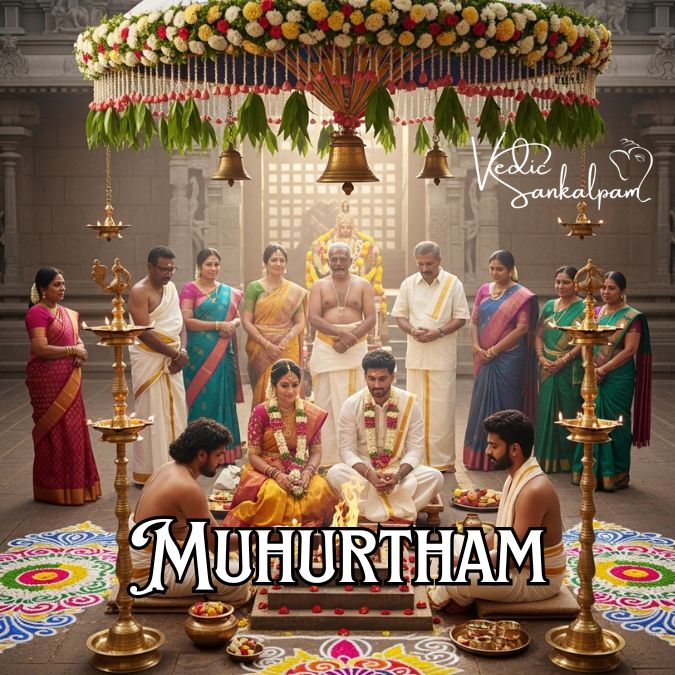
Perhaps nowhere is Muhurtham more important than in Hindu weddings. In the context of Indian weddings, “Muhurtham” refers to the auspicious or favorable time chosen for conducting the wedding ceremony.
How Wedding Muhurtham Is Calculated
Based on the couple’s horoscopes, the Priest determines the most auspicious day to conduct the marriage and time to start the ceremony. The calculation is derived from Hindu Vedic Astrology.
There is no fixed formula to calculate an auspicious Muhurat for marriage rituals. Even Hindu sages had different viewpoints on some of the elements considered while selecting auspicious marriage dates. The process considers multiple factors including lunar days, star positions, and planetary alignments.
The Role of Horoscopes and Astrology
Monday, Wednesday, Thursday, and Friday are considered best for marriage. Sunday and Saturday are moderate days. Tuesday should be avoided.
Taurus, Gemini, Cancer, Virgo, Libra, Sagittarius and Pisces are best lagnas for marriage. Jupiter or Venus should be in lagna or aspecting it for the best possible time.
The astrologer carefully examines both families’ charts, looking for compatibility and the most harmonious time for the union. The selection of an auspicious Muhurtham is believed to bring good luck, harmony, and blessings to the couple and their married life.
Benefits of Brahma Muhurtham for Meditation and Yoga
If you’re serious about spiritual practice, Brahma Muhurtham deserves your attention. Brahma muhurta is considered to be the ideal time to practice asanas, pranayama, or meditation.
Physical and Mental Health Benefits
Waking up at Brahma Muhurta will benefit your lungs in breathing fresh and unpolluted oxygen. The air quality at this time is generally better, with less pollution and higher oxygen content.
Research shows that high oxygen levels improve brain functioning and boost energy. Performing exercises or yoga during Brahma Muhurta increases lung capacity.
Modern science suggests that the natural production of melatonin is high during Brahma Muhurta. Melatonin is responsible for preparing our body for a conducive atmosphere, which is why meditation is more impactful in this period.
Spiritual Growth and Inner Peace
Spiritually, Brahma Muhurta is said to open a direct pathway to higher consciousness. The subtle energies present in this period make meditation deeper, prayers more effective, and intentions more powerful.
During Brahma Muhurta, Prana Vayu and Apana Vayu are the most active. Prana Vayu increases the intake of Cosmic energy, while Apana Vayu helps with the outward movement of air, detoxing us from negativity.
The only time when you are fresh, aware, and can easily tune within is Brahma Muhurta timing, making it a special time for yourself.
How to Calculate Your Own Muhurtham
Key Factors in Muhurtham Selection
When determining an auspicious time, several elements come into play:
Muhurta is only one of the four elements that play a role in the success of an event. The other three are Tithi, Nakshatra, and Karaṇa.
The key considerations include the weekday, lunar phase, star constellation the moon is passing through, and the rising sign at the moment the activity begins. All these factors must align favorably for a truly auspicious Muhurtham.
Modern Tools and Resources
While traditional calculations required deep astrological knowledge, today we have tools to help. Many websites and apps can calculate Muhurthams based on your location and the type of activity you’re planning. However, for important life events like weddings, consulting a learned astrologer is still recommended.
Panchang Shuddhi is the first step to decide an auspicious marriage day, and a learned scholar in astrology should be consulted before choosing a marriage date.
Common Misconceptions About Muhurtham
Many people think Muhurtham is pure superstition with no basis in reality. But as we’ve seen, there’s a complex system of astronomical observations behind it. Others believe that missing a good Muhurtham dooms an activity to failure – that’s also not true. While favorable timing can help, it’s not the only factor in success.
Some sages have said that if one’s mind is pure, all the planets will become favorable, and it is not necessary to find an auspicious time to do something. Your intentions and efforts matter too!
Muhurtham in Modern Life
In our fast-paced world, can Muhurtham still be relevant? Absolutely! Jakatdar suggests a shift in the contemporary temperament regarding the traditional approach to calculating such events, to accommodate the ever increasing complexity of modern life.
You don’t have to plan every activity around Muhurtham, but understanding these principles can help you make more conscious choices about timing. Even if you’re skeptical, there’s wisdom in the idea that timing matters – ask any successful person about the importance of good timing!
Conclusion
Muhurtham represents thousands of years of human observation, spiritual insight, and practical wisdom compressed into a system for choosing favorable moments. Whether you see it through the lens of science, spirituality, or simple respect for tradition, there’s something profound about the idea that time has quality, not just quantity.
From the sacred Brahma Muhurtham before dawn to the victorious Abhijit Muhurtham at midday, these ancient concepts continue to guide millions in their important life decisions. Even in our modern age of scientific rationalism, the practice endures – perhaps because at some deep level, we all sense that certain moments really are more special than others.
So the next time you’re about to start something important, take a moment to consider – is this the right time? You might just find that the ancient wisdom of Muhurtham has something valuable to offer your modern life.
FAQs
1. What is the best Muhurtham for starting a new business?
Abhijit Muhurtham, which occurs around midday, is considered excellent for new ventures as it’s associated with victory and success. Consulting a Panchang or astrologer for your specific date can help you find the most auspicious time.
2. How early should I wake up for Brahma Muhurtham?
Brahma Muhurtham begins approximately 1 hour and 36 minutes before sunrise and lasts for 48 minutes. Since sunrise times vary by location and season, you’ll need to calculate based on your local sunrise time.
3. Can I still succeed if I miss an auspicious Muhurtham?
Absolutely! While favorable timing can provide support, your effort, intention, and actions play crucial roles in any outcome. Many sages have taught that a pure mind and sincere effort can overcome any planetary challenges.
4. Is Muhurtham the same as Muhurat?
Yes, they’re the same concept – just different spellings. “Muhurtham” is more commonly used in South India, while “Muhurat” is the North Indian pronunciation. Both refer to the auspicious time period.
5. How do astrologers calculate wedding Muhurtham?
Astrologers consider multiple factors including the bride and groom’s birth charts, favorable nakshatras (star constellations), auspicious weekdays, lunar phases, and planetary positions to find the most harmonious time for the wedding ceremony.