Kaal Sarp Dosh is one of the most discussed and influential astrological combinations in Vedic astrology, believed to significantly impact an individual’s life, destiny, and karmic journey. This dosh occurs when all seven planets (Sun, Moon, Mars, Mercury, Jupiter, Venus, and Saturn) are positioned between Rahu (North Node) and Ketu (South Node) in a birth chart (Kundli). The symbolic representation of Rahu and Ketu as a serpent swallowing all planets gives rise to the term “Kaal Sarp”, where Kaal denotes time and Sarp signifies a snake.
We observe that this dosh is associated with delays, obstacles, mental unrest, financial instability, relationship issues, and repeated struggles, especially during Rahu and Ketu Mahadasha or Antardasha periods.
Astrological Formation of Kaal Sarp Dosh
Kaal Sarp Dosh forms when:
Rahu occupies one house of the horoscope
Ketu occupies the opposite house
All remaining planets are confined between Rahu and Ketu
The house placement, strength of Rahu-Ketu, and aspect of benefic or malefic planets determine the intensity of the dosh. Not all Kaal Sarp Dosh charts yield negative outcomes; the results vary depending on planetary dignity, conjunctions, and dashas.
Types of Kaal Sarp Dosh and Their Effects
Kaal Sarp Dosh
There are 12 primary types of Kaal Sarp Dosh, each linked to the house placement of Rahu and Ketu. Below is a detailed explanation of each type:
1. Anant Kaal Sarp Dosh
Occurs when Rahu is in the 1st house and Ketu in the 7th house. Effects: Health concerns, lack of confidence, marital discord, delays in success.
2. Kulik Kaal Sarp Dosh
Rahu in 2nd house, Ketu in 8th house. Effects: Financial instability, family disputes, speech-related issues.
3. Vasuki Kaal Sarp Dosh
Rahu in 3rd house, Ketu in 9th house. Effects: Struggles in communication, lack of sibling support, hurdles in higher education.
4. Shankhpal Kaal Sarp Dosh
Rahu in 4th house, Ketu in 10th house. Effects: Disturbed domestic life, property issues, career instability.
5. Padma Kaal Sarp Dosh
Rahu in 5th house, Ketu in 11th house. Effects: Delays in childbirth, problems in love life, fluctuating income.
6. Mahapadma Kaal Sarp Dosh
Rahu in 6th house, Ketu in 12th house. Effects: Legal disputes, debts, health complications, anxiety.
7. Takshak Kaal Sarp Dosh
Rahu in 7th house, Ketu in 1st house. Effects: Marriage delays, partner conflicts, emotional imbalance.
8. Karkotak Kaal Sarp Dosh
Rahu in 8th house, Ketu in 2nd house. Effects: Sudden losses, inheritance issues, fear and insecurity.
9. Shankhnaad Kaal Sarp Dosh
Rahu in 9th house, Ketu in 3rd house. Effects: Weak luck, strained relations with mentors, lack of spiritual clarity.
10. Ghatak Kaal Sarp Dosh
Rahu in 10th house, Ketu in 4th house. Effects: Career obstacles, professional dissatisfaction, family stress.
11. Vishdhar Kaal Sarp Dosh
Rahu in 11th house, Ketu in 5th house. Effects: Unfulfilled desires, problems with children, unstable friendships.
12. Sheshnag Kaal Sarp Dosh
Rahu in 12th house, Ketu in 6th house. Effects: Expenditure issues, sleep disorders, hidden enemies.
Common Symptoms of Kaal Sarp Dosh
We frequently identify the presence of Kaal Sarp Dosh through the following life patterns:
Repeated failures despite hard work
Delayed marriage or unstable relationships
Financial ups and downs
Mental stress, fear, or depression
Career stagnation
Health issues without clear diagnosis
Lack of peace and spiritual disconnect
Is Kaal Sarp Dosh Always Harmful?
Contrary to widespread belief, Kaal Sarp Dosh is not always destructive. Many renowned personalities have had this dosh and achieved extraordinary success. When benefic planets aspect Rahu or Ketu, or when strong yogas coexist, the negative effects reduce significantly. In some cases, Kaal Sarp Dosh enhances focus, ambition, research abilities, and spiritual growth.
Powerful Remedies for Kaal Sarp Dosh
Astrology offers several effective remedies to balance the energies of Rahu and Ketu:
1. Kaal Sarp Dosh Nivaran Puja
Performed at spiritually potent locations such as Ujjain, Trimbakeshwar, Nasik, and Haridwar, this puja pacifies Rahu-Ketu energies and reduces karmic burdens.
2. Maha Mrityunjaya Mantra
Regular chanting helps in overcoming fear, illness, and psychological stress.
3. Rahu-Ketu Beej Mantra
Chanting these mantras strengthens planetary harmony and mental stability.
4. Charity and Donations
Offering food, black sesame seeds, blankets, or donating on Saturdays and Amavasya yields positive karmic results.
5. Wearing Gemstones
Under expert guidance, gemstones like Gomed (Hessonite) and Cat’s Eye (Lehsunia) may help stabilize Rahu and Ketu effects.
Best Time to Perform Kaal Sarp Dosh Puja
The most auspicious days include:
Amavasya (New Moon)
Nag Panchami
Rahu-Ketu transit periods
Shravan month
Performing remedies during these times amplifies their effectiveness.
Scientific and Psychological Perspective
From a psychological standpoint, belief in Kaal Sarp Dosh can intensify stress if misunderstood. However, when approached constructively, remedies function as ritualistic therapy, promoting discipline, hope, and inner balance. Astrology, when used wisely, serves as a guidance system rather than a fear mechanism.
Transforming Challenges into Strength
Kaal Sarp Dosh symbolizes intense karmic lessons, not permanent misfortune. With correct astrological interpretation, timely remedies, and conscious effort, individuals can convert struggles into stepping stones for growth. We believe that understanding this dosh empowers individuals to navigate life with clarity, resilience, and spiritual awareness.
Have you ever wondered why certain words or sounds seem to resonate deep within your soul? Why does repeating a simple phrase bring peace to a restless mind? Welcome to the fascinating world of mantras—ancient tools that have been used for thousands of years to transform consciousness, heal the spirit, and connect us with something greater than ourselves.
What Are Mantras?
At their core, mantras are sacred sounds, words, or phrases that are repeated during meditation or prayer. Think of them as spiritual formulas—concentrated packets of energy wrapped in syllables. But they’re much more than just words you say out loud or in your head.
The Origins of Mantras
Mantras trace their roots back to ancient India, where they emerged from the Vedic traditions over 3,000 years ago. The sages and seers of that time discovered that specific sound vibrations could influence both the physical and spiritual realms. These weren’t random discoveries—they came from deep meditation and an intimate understanding of the universe’s energetic fabric.
The word “mantra” itself comes from two Sanskrit words: “man,” meaning mind, and “tra,” meaning tool or instrument. So essentially, a mantra is a tool for the mind. Pretty straightforward, right? But the simplicity of the definition doesn’t diminish its profound power.
The Science Behind Mantras
You might be thinking, “Okay, but does science back this up?” Surprisingly, yes! Modern neuroscience has shown that repetitive sound patterns can actually alter brain wave activity. When you chant a mantra, you’re essentially giving your brain a focal point, which helps reduce the mental chatter that normally dominates our thoughts.
Studies using brain imaging have revealed that mantra meditation activates areas associated with attention, emotional regulation, and even pain management. The rhythmic repetition creates a kind of neurological harmony that brings about measurable physiological changes—lower blood pressure, reduced stress hormones, and improved immune function.
Understanding the Deeper Meaning of Mantras
So what makes mantras different from just repeating any old word over and over? It all comes down to intention and vibration.
Vibration and Energy
Everything in the universe vibrates at different frequencies—from the chair you’re sitting on to the thoughts in your head. Ancient yogis understood this concept long before quantum physics came along. They believed that certain sound vibrations could align our personal energy with universal energy.
When you chant a mantra, you’re not just making noise. You’re creating specific vibrations that resonate through your body, mind, and the space around you. It’s like tuning a guitar—when the strings vibrate at the right frequency, you get beautiful music. When your energy vibrates at the right frequency, you experience harmony and peace.
Intention and Focus
But vibration alone isn’t enough. The real magic happens when you combine sound with intention. Your intention acts as the steering wheel, directing the energy of the mantra toward a specific purpose—whether that’s healing, wisdom, compassion, or spiritual awakening.
Have you ever noticed how the same song can affect you differently depending on your mood? That’s because your internal state influences how you receive and interpret vibrations. Similarly, approaching mantras with sincerity, respect, and clear intention amplifies their effectiveness exponentially.
Types of Mantras
Not all mantras are created equal. There are different categories, each serving unique purposes and coming from various spiritual traditions.
Vedic Mantras
These are the oldest mantras, originating from the Vedas—ancient Indian scriptures. They’re typically in Sanskrit and are often quite lengthy and complex. Vedic mantras were traditionally passed down from teacher to student in an unbroken lineage, ensuring their pronunciation and power remained intact.
Examples include the Gayatri Mantra and the Mahamrityunjaya Mantra, both of which carry deep spiritual significance and are believed to offer protection, enlightenment, and liberation.
Buddhist Mantras
Buddhism adopted the practice of mantra recitation and developed its own collection of sacred sounds. Buddhist mantras often focus on cultivating compassion, wisdom, and the awakening of Buddha-nature within all beings.
The most famous Buddhist mantra is probably “Om Mani Padme Hum,” which embodies the compassion of all Buddhas. Tibetan Buddhism especially emphasizes mantra practice as a core part of spiritual development.
Personal Affirmations
In modern times, the concept of mantras has expanded to include personal affirmations—positive statements that you repeat to reprogram your subconscious mind. While these aren’t traditional mantras in the spiritual sense, they operate on similar principles of repetition and focused intention.
Phrases like “I am worthy of love” or “I trust in the process of life” might not have the ancient lineage of Sanskrit mantras, but they can still be powerful tools for personal transformation.
Popular Mantras and Their Meanings
Let’s dive into some of the most well-known mantras and unpack what they actually mean.
Om (Aum)
If mantras had a king, Om would wear the crown. This single syllable is considered the primordial sound of the universe—the vibration from which all creation emerges. When you chant Om, you’re aligning yourself with the fundamental frequency of existence itself.
The sound is actually composed of three parts: “A-U-M,” representing the waking state, dream state, and deep sleep state of consciousness. The silence that follows represents the fourth state—pure consciousness or enlightenment.
Om Mani Padme Hum
This six-syllable Tibetan Buddhist mantra is all about compassion. While translations vary, it’s often interpreted as meaning something along the lines of honoring the jewel in the lotus of the heart. Each syllable purifies a different negative emotion: pride, jealousy, desire, ignorance, greed, and anger.
Tibetan Buddhists believe that reciting this mantra, even once, can bring tremendous benefit. Imagine it as a spiritual shower that cleanses your mind and heart of impurities.
Gayatri Mantra
This is one of the most revered Vedic mantras, traditionally chanted at sunrise and sunset. It’s a prayer to the sun god Savitr, asking for enlightenment and the removal of darkness from our minds.
Breaking Down the Gayatri Mantra
The mantra acknowledges the divine light that illuminates the three worlds (earth, atmosphere, and heaven) and asks that this light guide our intellect and understanding. It’s essentially saying, “May the divine light illuminate my mind and lead me toward truth.”
The beauty of the Gayatri Mantra lies not just in its meaning but in its rhythm and vibration. Many practitioners report feeling an immediate shift in consciousness when they chant it with devotion.
How Do Mantras Work?
You’ve probably gathered by now that mantras are more than just words. But what’s actually happening when you practice them?
The Role of Repetition
Repetition is key to mantra practice. When you repeat a mantra over and over, you’re essentially training your mind to focus. Think of it like building a muscle—the more you practice, the stronger your concentration becomes.
This repetitive practice also helps to bypass the critical, analytical mind and access deeper levels of consciousness. It’s like sneaking past a guard to enter a secret garden—the guard being your busy, chattering mind.
Neurological Benefits
From a neuroscience perspective, mantra repetition activates the brain’s default mode network, which is associated with self-referential thinking and mind-wandering. By giving the mind a single point of focus, mantras help quiet this network, leading to a state of calm awareness.
Research has also shown that mantra meditation increases grey matter in the brain, particularly in areas responsible for emotional regulation and self-awareness. Over time, regular practice can literally reshape your brain in positive ways.
Benefits of Chanting Mantras
Mantras and Meanings
So what can you actually expect from incorporating mantras into your life? The benefits are both immediate and cumulative.
Mental Clarity and Focus
In our distraction-filled world, maintaining focus feels like trying to hold water in your hands—it just slips away. Mantras provide an anchor for your attention, helping you develop laser-like concentration.
Many practitioners report that after just a few weeks of regular mantra practice, they notice improvements in their ability to focus at work, remember information, and stay present in conversations.
Emotional Healing
Emotions can be overwhelming, can’t they? Like waves that threaten to pull you under. Mantras act as a life raft, giving you something stable to hold onto during emotional storms.
The vibrations of certain mantras are believed to release stored emotional trauma from the body’s energy centers. Whether you believe in chakras or not, there’s something undeniably therapeutic about the rhythmic repetition of sacred sounds when you’re feeling anxious, sad, or angry.
Spiritual Growth
Beyond the practical benefits, mantras are fundamentally spiritual tools. They’re designed to connect you with something greater than your individual self—whether you call that God, the Universe, Source, or simply your highest potential.
Regular mantra practice cultivates qualities like compassion, humility, devotion, and inner peace. It’s like watering a spiritual garden—with patience and consistency, beautiful things begin to bloom.
How to Practice Mantra Meditation
Ready to give it a try? Here’s how to get started with your own mantra practice.
Choosing Your Mantra
The first step is selecting a mantra that resonates with you. You might feel drawn to a traditional Sanskrit mantra, or you might prefer something in your native language. Some people receive mantras from spiritual teachers, while others choose their own.
Trust your intuition here. If a particular mantra gives you goosebumps or brings tears to your eyes, that’s a good sign it’s right for you. You can always change mantras later if your needs evolve.
Creating the Right Environment
While you can technically practice mantras anywhere, creating a dedicated space can enhance your experience. Find a quiet spot where you won’t be disturbed. Some people like to create a small altar with candles, incense, or meaningful objects.
The key is consistency. Try to practice at the same time and place each day. This trains your mind and body to enter a meditative state more easily over time.
Techniques for Chanting
There are several ways to practice mantras:
Vocal chanting: Speaking or singing the mantra out loud. This is the most powerful method for creating vibrations in the physical body.
Whisper chanting: Softly repeating the mantra in a whisper. This creates subtle vibrations and is useful when you want to practice quietly.
Mental repetition: Silently repeating the mantra in your mind. This is the most subtle form and is said to be the most powerful for spiritual advancement.
Many practitioners use mala beads (similar to a rosary) to count repetitions—traditionally 108 times. The tactile sensation of moving the beads helps maintain focus.
Common Misconceptions About Mantras
Let’s clear up some confusion about mantras.
First, you don’t need to be religious or follow a specific spiritual path to benefit from mantras. While many mantras have religious origins, the practice itself is non-denominational. You can honor the tradition while adapting it to your personal beliefs.
Second, you don’t need to understand Sanskrit or the exact meaning of every syllable for a mantra to work. The vibration itself carries power. That said, understanding the meaning can certainly deepen your connection and intention.
Third, mantras aren’t magic spells that instantly solve all your problems. They’re tools that work gradually through consistent practice. Think of them as spiritual exercise—you wouldn’t expect to get fit after one trip to the gym, right?
Integrating Mantras into Daily Life
The real transformation happens when you bring mantras off the meditation cushion and into everyday life.
You might repeat your mantra while stuck in traffic, waiting in line at the grocery store, or before an important meeting. Some people use mantras to help them fall asleep or to shift their energy when they notice themselves spiraling into negative thought patterns.
The beauty is that mantras are portable—you carry them with you wherever you go. No equipment necessary, no special clothing required. Just you and the sacred sound vibrating through your consciousness.
Conclusion
Mantras are much more than ancient words from faraway lands. They’re living tools that bridge the gap between our ordinary human experience and the extraordinary potential that lies within us. Whether you’re seeking mental clarity, emotional healing, or spiritual awakening, mantras offer a proven path forward.
The key is to approach them with an open heart, consistent practice, and patience. You might not experience instant enlightenment, but over time, you’ll likely notice subtle shifts—more peace, greater focus, deeper compassion, and a sense of connection to something meaningful.
So why not give it a try? Choose a mantra that speaks to you, set aside just five minutes a day, and see what unfolds. You might be surprised by the transformation that awaits in the simple repetition of sacred sound.
FAQs
1. How long should I chant a mantra for it to be effective?
Most traditions suggest a minimum of 108 repetitions (one mala) per session, which typically takes about 10-15 minutes. However, even 5 minutes of sincere practice can bring benefits. Consistency matters more than duration—daily practice of 10 minutes is more effective than occasional hour-long sessions.
2. Can I create my own mantra or should I stick to traditional ones?
Both approaches work! Traditional mantras carry the power of thousands of years of collective practice, but personal affirmations in your native language can also be powerful tools for transformation. If you’re drawn to traditional mantras, honor that. If creating your own feels more authentic, that’s equally valid.
3. Do I need to chant mantras out loud or can I repeat them silently?
All three methods—vocal, whisper, and mental repetition—are effective, just in different ways. Vocal chanting creates the strongest physical vibrations, while mental repetition is considered most powerful for advanced spiritual practice. Many practitioners use all three methods at different times.
4. What’s the difference between a mantra and an affirmation?
Traditional mantras are sacred sounds passed down through spiritual lineages, often in Sanskrit, and are believed to carry inherent spiritual power through their vibration. Affirmations are personal, positive statements in any language designed to reprogram thinking patterns. Both use repetition, but mantras typically have a spiritual dimension that affirmations may lack.
5. Can mantras help with anxiety and stress?
Absolutely! Scientific research has shown that mantra meditation effectively reduces anxiety, lowers stress hormones, and promotes relaxation. The rhythmic repetition gives your mind something to focus on besides anxious thoughts, while the vibrations help regulate your nervous system. Many people find mantras especially helpful during panic attacks or high-stress situations.
Have you ever experienced that sudden, involuntary flutter in your right eye and wondered if the universe was trying to tell you something? You’re not alone. For centuries, women across the globe have looked beyond the physical sensation of eye twitching to find deeper, spiritual meanings hidden in this peculiar phenomenon. Whether you’re a believer in superstitions or simply curious about what different cultures say, the right eye twitch has sparked countless interpretations, especially when it happens to women.
In this comprehensive guide, we’ll explore everything from ancient beliefs to modern medical explanations, helping you understand what that little flutter might mean—or if it means anything at all beyond your body sending you a signal.
Understanding Eye Twitching
What is Eye Twitching?
Eye twitching, medically known as myokymia, is an involuntary spasm of the eyelid muscles. It typically affects the lower eyelid of one eye, though it can occur in the upper lid or even both eyes. These twitches are usually harmless and temporary, lasting anywhere from a few seconds to several minutes. Sometimes they can persist for days or even weeks.
The sensation feels like a tiny pulse or flutter beneath your skin. While it’s noticeable to you, others usually can’t see it happening. Think of it as your eyelid doing a little dance without your permission—annoying, yes, but typically nothing to worry about from a health perspective.
Common Medical Causes of Eye Twitching
Before we dive into the mystical meanings, let’s ground ourselves in science. Medical professionals point to several common triggers for eye twitching:
Stress and fatigue top the list. When you’re running on empty, your body protests in various ways, and eye twitching is one of them. Too much caffeine can overstimulate your nervous system, causing those eyelid spasms. Eye strain from staring at screens for hours or reading in poor lighting conditions also contributes significantly.
Other factors include dry eyes, nutritional deficiencies (particularly magnesium), alcohol consumption, and allergies. In rare cases, eye twitching can signal neurological conditions, but this is accompanied by other symptoms and affects more than just the eyelid.
The Cultural Significance of Eye Twitching
Eye Twitching in Different Cultures
Across continents and centuries, humans have attributed supernatural significance to bodily phenomena they couldn’t fully explain. Eye twitching sits prominently in this category. From ancient civilizations to modern societies, the twitch of an eye has been interpreted as an omen, a message, or a warning.
Different cultures have developed elaborate systems to decode these twitches based on which eye is affected, the time of day, the day of the week, and even the specific part of the eyelid that twitches. For women specifically, these interpretations often differ from those applied to men, reflecting broader cultural attitudes toward gender and intuition.
Why Superstitions Around Eye Twitching Exist
Why do we create superstitions in the first place? Humans are pattern-seeking creatures. When something unexplained happens—like an eye twitch—followed by a significant event, our brains create a connection. Over generations, these observations get passed down, refined, and become embedded in cultural folklore.
For women, who have historically been associated with intuition and spiritual sensitivity in many cultures, physical signs like eye twitching have been given special attention. It’s seen as the body’s way of receiving signals from the universe, ancestors, or the divine.
Right Eye Twitching Meaning for Females
Right Eye Twitching Superstition Meaning for Female
Positive Interpretations
In many cultures, a twitching right eye in females is considered an auspicious sign. Let’s explore what good fortune might be heading your way:
Good news is coming. Many traditions believe that a right eye twitch signals that you’ll soon receive positive news. This could be related to your career, relationships, or personal endeavors. Perhaps that job offer you’ve been waiting for is finally on its way, or a long-awaited message from someone special is about to arrive.
Financial gains. Some cultures associate right eye twitching in women with incoming money or financial opportunities. This doesn’t necessarily mean you’ll win the lottery (though wouldn’t that be nice?), but it could signal a raise, a successful business deal, or an unexpected windfall.
Meeting someone special. Romantic interpretations abound, with some believing that a right eye twitch means you’ll soon encounter someone significant—whether a potential romantic partner, a new friend who’ll change your life, or the return of someone from your past.
Spiritual awakening. In more mystical interpretations, the right eye twitch represents opening your spiritual vision. It’s as if your third eye is waking up, preparing you to receive divine messages or heightened intuition.
Negative Interpretations
Not all cultures view right eye twitching in women positively. Some traditions carry warnings:
Approaching difficulties. Certain belief systems suggest that a right eye twitch warns of upcoming challenges or obstacles. Consider it your body’s early warning system, telling you to prepare yourself mentally and emotionally for what’s ahead.
Someone is gossiping about you. This interpretation is particularly common in several Asian and African cultures. The belief goes that when your right eye twitches, someone somewhere is talking about you—and not necessarily in a flattering way.
Energy depletion. Some spiritual practitioners believe that a right eye twitch indicates you’re giving away too much of your energy to others, whether through worry, excessive caregiving, or negative relationships draining you.
Time-Based Interpretations
The meaning can shift dramatically depending on when your eye decides to do its little dance:
Morning twitches (sunrise to noon) often predict good fortune arriving by the end of the day or week. It’s like receiving a cosmic notification that something positive is in transit.
Afternoon twitches (noon to evening) are sometimes interpreted as warnings to be cautious in your dealings, especially financial decisions or important conversations.
Evening twitches (sunset to midnight) might suggest emotional events ahead—perhaps a heartfelt conversation, the resolution of a conflict, or news that will affect you emotionally.
Night twitches (midnight to sunrise) are considered the most spiritually significant by some, representing messages from the subconscious or divine realm that require your attention.
Regional Variations in Superstitions
Indian Beliefs About Right Eye Twitching in Women
Indian astrology and folklore have particularly detailed interpretations of eye twitching for women. In many Indian traditions, a twitching right eye for females is generally considered inauspicious, contrary to many other cultures. It’s often interpreted as a sign of upcoming difficulties, tears, or emotional distress.
However, interpretations can vary by region within India. Some communities in South India believe it signals the arrival of guests or unexpected visitors. Others connect it to specific weekdays, with each day carrying different meanings. For instance, a right eye twitch on a Monday might mean something entirely different than one on a Saturday.
The position of the twitch matters too—upper eyelid versus lower eyelid, corner versus center. This intricate system reflects the complexity of Indian spiritual and astrological traditions.
Chinese Superstitions
Chinese culture has a saying: “Left eye jumps, wealth; right eye jumps, disaster.” However, this interpretation traditionally applies more to men. For women, the meaning often reverses—a right eye twitch can indicate good fortune, while a left eye twitch might signal problems.
Chinese beliefs also incorporate the time element extensively. The day is divided into 12 two-hour segments, each associated with different animals from the Chinese zodiac. The meaning of your eye twitch varies depending on which time segment it occurs in, creating a highly personalized interpretation system.
Additionally, Chinese face reading (mian xiang) considers eye twitching as part of a larger language of facial signs that can reveal your current luck, health, and fortune trajectory.
African Perspectives
African cultures, with their rich diversity, offer various interpretations. In some West African traditions, a right eye twitch in women suggests that someone from your past will reappear in your life. This could be an old friend, a former lover, or even someone you’ve lost touch with who carries important information.
Other African belief systems connect eye twitching to ancestral communication. Your ancestors might be trying to get your attention, guide you away from danger, or confirm you’re on the right path. This perspective encourages introspection and meditation when experiencing eye twitches.
Some traditions also link right eye twitching to the evil eye—the belief that someone harbors jealousy or ill will toward you, and their negative energy is manifesting as physical symptoms in your body.
Western Views
Western cultures generally take a more practical approach, though superstitions still exist. In parts of Europe, particularly Eastern Europe, some believe a right eye twitch means you’ll soon cry, while a left eye twitch means you’ll laugh.
However, modern Western society largely dismisses these superstitions in favor of medical explanations. The prevailing attitude is that if your eye is twitching, you probably need more sleep, less coffee, or should take a break from your computer screen.
That said, interest in alternative spirituality and cross-cultural beliefs has brought renewed curiosity about superstitions, even in Western contexts. Many people now explore these interpretations as interesting possibilities rather than hard facts.
Scientific Explanation vs Superstition
What Doctors Say About Eye Twitching
Let’s bring some medical perspective into the conversation. Ophthalmologists and neurologists will tell you that eye twitching is almost always benign and related to lifestyle factors. The medical community doesn’t recognize supernatural or prophetic qualities in eye twitches.
From a scientific standpoint, the phenomenon occurs when the orbicularis oculi muscle—the muscle responsible for closing your eyelid—experiences involuntary contractions. These contractions happen when the nerves controlling the muscle fire without your conscious command.
Stress triggers the release of cortisol and other hormones that can affect nerve signaling. Caffeine and other stimulants increase neural excitability. Fatigue disrupts the normal functioning of your nervous system. Eye strain causes muscle fatigue around the eyes. All these factors create the perfect conditions for those annoying twitches.
When to Worry About Eye Twitching
While most eye twitching is harmless, certain signs warrant medical attention:
If your eye twitch lasts more than a few weeks, see a doctor. When the twitching spreads to other parts of your face, this could indicate a neurological issue. If you experience complete eyelid closure during twitches (blepharospasm), professional evaluation is necessary. Twitching accompanied by eye redness, discharge, drooping eyelid, or vision changes requires immediate medical attention.
These symptoms might indicate conditions like hemifacial spasm, blepharospasm, or, in rare cases, multiple sclerosis or other neurological disorders. Don’t let superstition prevent you from seeking medical care when your body is genuinely signaling something’s wrong.
How to Stop Eye Twitching
Lifestyle Changes
Whether you believe in superstitions or not, you probably want that annoying twitch to stop. Here’s how:
Reduce stress. Easier said than done, right? But incorporating stress-management techniques like deep breathing, meditation, yoga, or simply taking regular breaks can significantly reduce eye twitching. Your body is telling you to slow down—maybe it’s time to listen.
Get adequate sleep. Aim for seven to nine hours of quality sleep each night. Create a bedtime routine, keep your bedroom cool and dark, and avoid screens before bed. Your eyes need rest to function properly.
Limit caffeine and alcohol. Both substances can trigger or worsen eye twitching. Try cutting back gradually and notice if your symptoms improve. Switch to decaf or herbal tea, at least temporarily.
Manage screen time. Follow the 20-20-20 rule: every 20 minutes, look at something 20 feet away for 20 seconds. Adjust your screen brightness and positioning to reduce eye strain. Consider blue light filtering glasses if you work at a computer all day.
Home Remedies
Several natural approaches can help soothe twitchy eyes:
Warm compress. Apply a warm, damp cloth over your closed eyes for 5-10 minutes. The warmth relaxes the muscles and can stop spasms.
Massage. Gently massage the area around your eye with clean fingers, using circular motions. This increases blood flow and releases tension.
Stay hydrated. Dehydration can contribute to muscle spasms. Drink plenty of water throughout the day.
Magnesium supplements. Some research suggests magnesium deficiency contributes to eye twitching. Foods rich in magnesium include dark leafy greens, nuts, seeds, and whole grains. Consult your doctor before starting supplements.
Eye exercises. Simple exercises like rapid blinking, focusing on distant and near objects alternately, and rolling your eyes can help relax eye muscles.
When to See a Doctor
If lifestyle changes and home remedies don’t resolve your eye twitch within a few weeks, or if you experience any of the warning signs mentioned earlier, schedule an appointment with your doctor or eye specialist. They can rule out underlying conditions and provide appropriate treatment if necessary.
Treatment options for persistent eye twitching include Botox injections to paralyze the affected muscles temporarily, medications to relax muscles or treat underlying conditions, and in severe cases, surgery.
Conclusion
The right eye twitch in females carries a fascinating tapestry of meanings across different cultures and belief systems. Whether you view it as a divine message, an ancestral warning, a sign of good fortune, or simply your body telling you to get more sleep, the phenomenon connects us to centuries of human interpretation and meaning-making.
What’s most important is finding the balance that works for you. If exploring superstitions and spiritual meanings enriches your life and helps you feel connected to something larger, embrace that journey. If you prefer scientific explanations and practical solutions, that’s equally valid. Perhaps the real wisdom lies in acknowledging both perspectives—respecting cultural traditions while also taking care of your physical health.
The next time your right eye decides to do its little involuntary dance, you can choose your own interpretation. Maybe it’s the universe sending you a message. Maybe it’s your body asking for rest. Or maybe, just maybe, it’s both—a reminder that we exist in a world where the mystical and the mundane constantly intertwine.
Listen to your body, honor your beliefs, and remember that whether it’s superstition or science, the most important thing is your wellbeing.
FAQs
1. Is right eye twitching different for females compared to males?
Yes, many cultural traditions have different interpretations for eye twitching based on gender. In most Asian cultures, right eye twitching meanings for females are often opposite to those for males. However, from a medical perspective, eye twitching occurs for the same physiological reasons regardless of gender.
2. How long does eye twitching typically last?
Most eye twitches are temporary and last from a few seconds to a few days. If your eye twitch persists beyond two to three weeks or worsens over time, you should consult a healthcare professional to rule out any underlying conditions.
3. Can stress really cause eye twitching?
Absolutely. Stress is one of the leading triggers of eye twitching. When you’re stressed, your body releases hormones that can affect nerve signaling and muscle control, leading to involuntary spasms like eye twitches. Managing stress through relaxation techniques often resolves the twitching.
4. Should I believe in eye twitching superstitions?
This is entirely a personal choice. Superstitions provide cultural richness and can offer comfort or guidance to those who believe in them. However, they shouldn’t replace medical advice when dealing with persistent or concerning symptoms. You can appreciate cultural beliefs while also taking care of your health practically.
5. What deficiency causes eye twitching?
Magnesium deficiency is most commonly associated with eye twitching, though deficiencies in calcium, vitamin D, and B vitamins can also contribute. If you suspect a nutritional deficiency, consult your doctor for proper testing and supplementation recommendations rather than self-diagnosing.
Have you ever wondered if your financial destiny is literally written in your hands? For thousands of years, people across cultures have studied palm lines seeking answers about wealth, success, and prosperity. Among these mystical markings, the money line holds particular fascination. But what exactly is this mysterious line, and can it really predict your financial future?
Let’s dive deep into the world of palmistry and uncover everything you need to know about the money line in your hand.
What Is the Money Line in Palmistry?
The money line is one of the lesser-known but highly significant markings in palmistry. Unlike the major lines—heart, head, and life lines—that most people recognize, the money line is a secondary indicator that palm readers believe reveals information about your financial potential and wealth accumulation abilities.
Origins of Palm Reading
Palm reading, or chiromancy, dates back thousands of years with roots in ancient India, China, and Greece. Ancient practitioners believed that the lines on our palms were cosmic imprints that carried information about our character, health, and destiny. The concept of reading financial indicators in hands emerged as societies became more complex and wealth became a defining aspect of human life.
Identifying the Money Line
So where exactly is this elusive money line? In traditional palmistry, the money line isn’t actually a single, universally defined line. Instead, it refers to several possible markings that indicate financial fortune. The most commonly referenced money line is a short vertical or slightly diagonal line located between the pinky finger and the ring finger, typically underneath the ring finger in the area palmists call the “Mercury mount.”
Where to Find Your Money Line
Finding your money line requires examining your palm carefully under good lighting. Let’s break down exactly where to look.
Primary Location on the Palm
The classic money line appears as a short vertical line beneath your ring finger. To find it, extend your hand and look at the area between your ring and pinky fingers. You might see one or more small vertical lines in this zone. Some palm readers also consider lines that start from the base of your thumb and move toward your fingers as wealth indicators, particularly if they’re deep and clear.
Variations in Different Hands
Here’s something interesting: your dominant and non-dominant hands may show different lines. Traditional palmistry suggests that your non-dominant hand (left for right-handed people) shows your potential and inherited traits, while your dominant hand reveals what you’ve done with that potential. So if your money line appears stronger on your dominant hand, it might indicate you’re actively building wealth through your choices and actions.
Different Types of Money Lines
Not all money lines look the same, and their appearance can tell different stories about your financial journey.
Straight Money Lines
A straight, clear money line is considered the most favorable marking. It suggests steady financial growth, sound money management skills, and consistent income. People with straight money lines are often described as practical with finances and capable of building wealth gradually over time.
Curved Money Lines
When the money line curves, it might indicate a more flexible approach to finances. Some interpretations suggest curved lines represent people who earn money through creative or unconventional means. The curve might also indicate ups and downs in financial circumstances, but ultimately positive outcomes.
Broken or Fragmented Lines
Broken or interrupted money lines can feel concerning, but they don’t necessarily spell financial doom. These markings might represent temporary setbacks, career changes, or periods of financial challenge followed by recovery.
What Broken Lines Mean
Rather than viewing breaks as permanently negative, modern palm readers interpret them as transformation points. A break might coincide with a major life change—perhaps you left a stable job to start a business, faced an unexpected expense, or made a significant investment. The key is looking at whether the line continues after the break, which would suggest recovery and continued growth.
What Does Your Money Line Reveal?
Let’s get to the heart of what people really want to know: what can your money line actually tell you about your financial future?
Financial Success Indicators
According to palmistry traditions, certain characteristics suggest strong financial prospects. Multiple clear money lines are considered especially fortunate, suggesting multiple income streams or diverse financial opportunities. Deep, prominent lines indicate strong earning potential and the ability to accumulate significant wealth.
Wealth Accumulation Patterns
The depth and length of your money line might reveal how you accumulate wealth. A long money line could suggest sustained earning power throughout your life, while shorter lines might indicate concentrated periods of financial success or inheritance. Some palm readers believe that lines extending upward toward the fingers show ambition and upward mobility in wealth creation.
Career and Money Connection
Your money line doesn’t exist in isolation—it interacts with other lines on your palm. When combined with a strong fate line (the vertical line running up the center of your palm), it might suggest financial success through career achievements. If your money line connects with your head line, it could indicate that your intellectual abilities and smart decisions drive your financial success.
How to Read Your Money Line
Ready to examine your own palm? Here’s how to interpret what you see.
Length and Depth Significance
Length matters in palmistry. A longer money line generally indicates sustained financial stability over your lifetime. Depth is equally important—a deep, well-etched line suggests strong financial energy and potential for significant wealth accumulation. Think of it like a river: a deep, wide river carries more water than a shallow stream.
Clarity and Visibility
Can you see your money line clearly, or do you need to squint and search for it? Clear, visible lines are considered more powerful than faint ones. A barely visible money line might suggest that while financial success is possible, it requires more effort and conscious attention to manifest.
Faint vs. Deep Lines
Faint money lines don’t mean you’re destined for poverty! They might simply indicate that money isn’t your primary life focus or that your wealth comes through less obvious channels. Deep lines, conversely, suggest that financial success plays a significant role in your life path and that you have natural abilities for wealth creation.
Money Line vs. Other Prosperity Indicators
The money line is just one piece of the financial puzzle in palmistry. Let’s see how it relates to other prosperity signs.
The Fate Line Connection
Your fate line—that vertical line running up the middle of your palm—is another crucial indicator of life direction and success. When the fate line is strong and clear alongside prominent money lines, palmists interpret this as a powerful combination for career success and financial achievement. The fate line represents your life path, while the money line shows the financial fruits of that path.
Sun Line and Success
The sun line, located parallel to the fate line under the ring finger, represents fame, success, and recognition. When combined with money lines, it might suggest not just wealth but also public acknowledgment of your achievements. Think of successful entrepreneurs or entertainers who have both wealth and recognition—this combination of lines might reflect that dual success.
Scientific Perspective on Palm Reading
Now, let’s address the elephant in the room: what does science say about all this?
Modern Research
Modern science remains skeptical about palmistry’s predictive abilities. There’s no scientific evidence that hand lines can predict financial outcomes or any other specific life events. Dermatoglyphics—the scientific study of skin ridge patterns—has medical applications for identifying certain genetic conditions, but it doesn’t support palmistry’s broader claims about personality or destiny.
Cultural Beliefs vs. Evidence
Despite lacking scientific validation, palmistry persists across cultures for several reasons. It taps into our natural desire to understand our future and find patterns in uncertainty. Some argue that palm reading works through cold reading techniques and the Barnum effect—where vague statements seem personally meaningful. Others view it as a cultural tradition or self-reflection tool rather than a literal prediction method.
Common Misconceptions About Money Lines
Money line in hand
Let’s clear up some myths about money lines that circulate widely.
Myth 1: No visible money line means you’ll be poor. Reality: Many successful, wealthy people have faint or no discernible money lines. Wealth creation depends on countless factors—education, opportunities, decisions, market conditions, and luck—not palm markings.
Myth 2: Money lines guarantee wealth without effort. Reality: Even traditional palmists emphasize that lines show potential, not guarantees. They require action, smart decisions, and hard work to manifest.
Myth 3: Money lines never change. Reality: Many palm readers claim lines can shift over time as your life circumstances change, though this remains unverified scientifically.
Myth 4: Everyone’s money line is in the same spot. Reality: Different palmistry traditions identify various lines as “money indicators,” leading to confusion about which line is the “real” money line.
Can Your Money Line Change Over Time?
This question fascinates both believers and skeptics. Traditional palmists often claim that palm lines can evolve as your life changes. Major life events, shifts in mindset, or significant decisions might manifest as changes in your palm lines over months or years.
From a physiological perspective, the basic patterns of major palm lines are formed before birth and remain relatively stable. However, minor lines can appear or fade based on hand usage, aging, and skin changes. Whether these changes have mystical significance or are simply physical variations remains a matter of personal belief.
The more interesting question might be: if you believe your lines can change, might that belief motivate positive financial behaviors that actually improve your circumstances? Sometimes the power of belief itself creates real-world results, regardless of supernatural explanations.
Enhancing Your Financial Fortune
Whether you believe in palmistry or not, let’s talk about practical steps to improve your financial situation.
Practical Steps Beyond Palm Reading
Instead of relying solely on palm lines, focus on actionable strategies: Create a budget and stick to it. Build an emergency fund with three to six months of expenses. Invest in your education and skills to increase earning potential. Diversify income sources. Make informed investment decisions. Network with successful people who can open doors to opportunities.
These concrete actions will impact your financial future far more reliably than any palm marking.
Mindset and Money Management
Your beliefs about money significantly influence your financial outcomes. Whether you call it a “money line mindset” or simply financial confidence, cultivating a positive relationship with money matters. Educate yourself about personal finance, challenge limiting beliefs about wealth, set clear financial goals, celebrate small wins, and learn from setbacks without becoming discouraged.
Think of palmistry as one possible tool for self-reflection rather than a definitive answer. If examining your money line motivates you to think more intentionally about finances, it serves a purpose regardless of its predictive accuracy.
Famous Personalities and Their Money Lines
While detailed palm analyses of celebrities aren’t readily available (famous people rarely publish their palm prints!), palmistry enthusiasts have long speculated about the hands of wealthy and successful individuals. Some claim that many successful entrepreneurs and businesspeople have prominent money lines, though these observations remain anecdotal and unverified.
What we do know is that successful people tend to share certain traits: persistence, strategic thinking, willingness to take calculated risks, and ability to learn from failure. Whether these qualities correlate with specific palm markings is an open question that science hasn’t answered.
How to Interpret Multiple Lines
What if you have several lines in the money line area? Traditional palmistry views this favorably, suggesting multiple income streams or diverse financial opportunities. Each line might represent a different source of wealth—perhaps your primary career, a side business, investments, or inheritance.
Multiple lines can also indicate complexity in your financial journey. You might experience money coming from unexpected sources or find success in multiple endeavors throughout your life. Rather than focusing on a single career or income path, you might be someone who thrives on diversity and multiple projects.
Conclusion
The money line in your hand remains one of palmistry’s most intriguing concepts. Whether you view it as an ancient mystical indicator or simply an interesting cultural tradition, exploring your palm lines can be a fun exercise in self-reflection. While science doesn’t support palmistry’s predictive claims, the practice continues to captivate people worldwide.
Remember that your financial future isn’t predetermined by the lines on your palm—it’s shaped by your decisions, actions, education, and opportunities. Use palmistry as inspiration if it motivates positive financial behaviors, but never substitute it for solid financial planning, education, and hard work.
Your hands might be remarkable tools for creating wealth—not because of the lines on them, but because of what you can build and achieve with them. So whether your money line is prominent or barely visible, your real power lies in the choices you make every single day.
FAQs
1. Can I have a money line on one hand but not the other?
Yes, it’s common for lines to appear differently on each hand. Palmists traditionally read the non-dominant hand as showing potential and the dominant hand as showing what you’ve actually developed through life choices. If your money line appears only on your non-dominant hand, it might suggest untapped financial potential.
2. Does having no money line mean I’ll never be wealthy?
Absolutely not. Many financially successful people have faint or no visible money lines. Your wealth is determined by countless factors including education, opportunities, decisions, effort, and circumstances—not palm markings. Palmistry shows potential paths, not guaranteed outcomes, and should never limit your financial ambitions.
3. How often should I check my money line to see if it changes?
If you’re interested in tracking changes, palm readers suggest checking every few months or after major life events. However, remember that major palm lines remain relatively stable throughout life. Any perceived changes might be due to lighting conditions, hand position, or natural skin variations rather than mystical transformations.
4. Are money lines more accurate for certain age groups?
Traditional palmistry doesn’t specify age-related accuracy differences. However, palm readers sometimes claim that lines become more defined and “settled” as you age and your life patterns become established. Young people might have less defined minor lines because their financial paths aren’t yet fully developed. Older individuals might show clearer patterns reflecting their actual financial journey.
5. Should I make financial decisions based on my money line?
No. Never make important financial decisions based solely on palm reading. Use proven financial planning strategies, consult with qualified financial advisors, research investment options thoroughly, and base decisions on facts, analysis, and your personal circumstances. Treat palmistry as entertainment or self-reflection, not as financial advice or a prediction tool.
Have you ever wondered what that tiny mole on your face might reveal about your destiny? In Indian astrology, moles aren’t just random beauty marks—they’re cosmic signatures that tell fascinating stories about your personality, fortune, and future. Let’s dive deep into this ancient practice and uncover what your facial moles might be saying about you.
Introduction to Mole Astrology (Samudrika Shastra)
Mole astrology, known as Samudrika Shastra in Sanskrit, is an ancient Indian science that studies body marks, including moles, to predict a person’s character and fate. This practice has been part of Indian culture for thousands of years, mentioned in classical texts like the Garuda Purana and Brahma Vaivarta Purana.
Think of moles as nature’s tattoos—permanent marks that the universe places on your body to give you hints about your life journey. In Indian astrology, every mole has a story, and its position on your face acts like a roadmap to understanding your strengths, weaknesses, and what the stars have in store for you.
The fascinating part? This isn’t just superstition. Many people in India still consult mole readings before making major life decisions, from choosing careers to selecting marriage partners. It’s woven into the cultural fabric, passed down through generations like precious wisdom.
The Science Behind Mole Reading
You might be asking, “How can a small spot on my face predict my future?” Well, according to Samudrika Shastra, your physical body is a reflection of your karmic blueprint. Every feature, including moles, corresponds to planetary positions at the time of your birth.
Indian astrology divides the face into different zones, each governed by specific planets. When a mole appears in a particular zone, it indicates the influence of that planet on your life. For instance, the forehead is ruled by Jupiter and Saturn, while the nose is governed by Venus.
The interpretation also considers the mole’s color, size, shape, and whether it’s raised or flat. A prominent, dark mole generally has a stronger influence than a faint, light-colored one. It’s like reading a cosmic message—the clearer the mark, the stronger the signal.
General Significance of Facial Moles
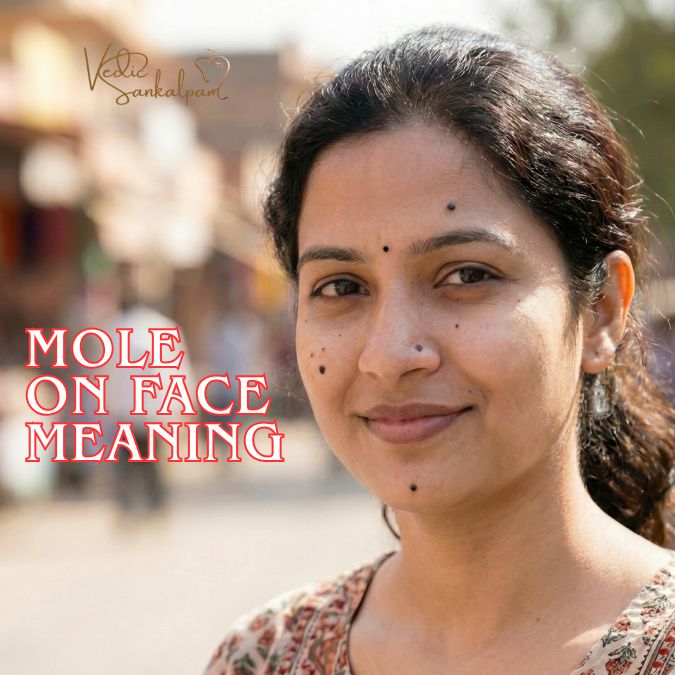
Mole on face meaning
Before we explore specific locations, let’s understand some general principles. Not all moles are created equal in astrology!
Lucky moles are typically round, slightly raised, and have a rich black or honey color. They’re considered auspicious signs that bring good fortune, wealth, and happiness. On the other hand, unlucky moles tend to be irregular in shape, dull in color, or appear in certain inauspicious locations.
Here’s something interesting: the same mole position can have different meanings for men and women. Indian astrology recognizes that masculine and feminine energies interact differently with cosmic forces. For example, a mole on the right side of a man’s face might be considered lucky, while the same position on a woman’s face could have a different interpretation.
Mole on Forehead
The forehead is prime real estate in mole astrology! It’s associated with intellect, authority, and your public image.
Center of Forehead
A mole right in the middle of your forehead—between the eyebrows or slightly above—is considered highly auspicious. This is often called the “royal mole” because it indicates leadership qualities, wisdom, and spiritual inclination. People with this mole tend to be intuitive, respected in society, and often achieve positions of authority.
If you’ve got this mole, you’re likely someone who thinks deeply about life’s big questions. You might be drawn to philosophy, spirituality, or roles where you guide others. It’s like having a built-in compass pointing you toward enlightenment.
Right Side of Forehead
A mole on the right side of the forehead suggests intelligence and creativity. For men, this is particularly favorable, indicating success in business ventures and the ability to accumulate wealth. You’re probably the problem-solver in your group, the person everyone turns to when they need practical solutions.
This position also hints at good fortune in relationships and a harmonious family life. Your practical nature helps you navigate life’s challenges with grace.
Left Side of Forehead
On the left side? This indicates someone who might struggle with financial management or face obstacles in early life. However, don’t lose hope! These individuals often develop strong resilience and creativity as they overcome challenges.
For women, a mole on the left forehead suggests a tendency toward overthinking and emotional sensitivity. But here’s the silver lining—this sensitivity often translates into artistic talent and deep empathy for others.
Moles Around the Eyes
Eyes are the windows to the soul, and moles near them reveal much about your emotional nature and relationships.
Near Right Eye
A mole near the right eye indicates a calm, composed personality with good earning potential. You’re probably someone who makes sound financial decisions and maintains stable relationships. In Indian astrology, this position is associated with Venus, suggesting a love for beauty and comfort.
People with this mole often have successful marriages and enjoy harmonious domestic life. They’re loyal partners who value stability over drama.
Near Left Eye
Here’s where things get interesting. A mole near the left eye suggests a passionate, sometimes impulsive nature. You might experience ups and downs in relationships, but you’re also incredibly charismatic and attractive to others.
This position indicates someone who wears their heart on their sleeve. Your emotions run deep, and you’re not afraid to show vulnerability. While this can lead to heartache, it also means you experience love and joy more intensely than most.
Between Eyebrows (Third Eye Region)
A mole in the third eye area is spiritually significant. It suggests heightened intuition, psychic abilities, and a strong connection to the divine. If you have this mole, you might find yourself naturally drawn to meditation, yoga, or other spiritual practices.
This is considered one of the most powerful positions for a mole, indicating wisdom beyond your years and the potential for spiritual leadership.
Mole on Nose
The nose represents financial prosperity and business acumen in face reading.
Tip of the Nose
Got a mole on your nose tip? You’re probably impulsive and passionate about life! This position suggests someone who takes risks—sometimes they pay off spectacularly, and sometimes they don’t. You’re the friend who books spontaneous trips and tries new experiences without overthinking.
In terms of finances, this mole can indicate fluctuating income. You might earn well but also spend freely. The key is developing financial discipline without losing your adventurous spirit.
Bridge of the Nose
A mole on the nose bridge indicates health concerns, particularly digestive issues. However, it also suggests strong willpower and determination. You’re someone who doesn’t give up easily, even when facing health challenges or obstacles.
This position requires paying extra attention to wellness and maintaining a balanced lifestyle.
Side of the Nose
Moles on either side of the nose suggest a sensual, pleasure-loving nature. You appreciate good food, comfortable surroundings, and life’s finer things. For women, this position is considered particularly fortunate, indicating a happy married life and material comfort.
Moles on Cheeks
Cheeks represent social interactions and your relationship with the world.
Right Cheek Mole
A mole on the right cheek indicates sensitivity and emotional depth. You’re probably the friend everyone confides in because you genuinely care and offer thoughtful advice. This position suggests success in careers involving communication, counseling, or creative arts.
For men, this mole indicates a loving family life and respect in the community. For women, it suggests beauty, grace, and the ability to maintain harmonious relationships.
Left Cheek Mole
Left cheek moles suggest introversion and a reserved nature. You might prefer small, intimate gatherings over large social events. However, this introspection gives you depth and makes your friendships meaningful rather than superficial.
This position also indicates potential struggles with self-esteem or confidence, especially in youth. The good news? As you mature, you often develop inner strength that’s more powerful than external confidence.
Mole on Lips
Lips govern communication and sensuality.
Upper Lip
A mole on the upper lip indicates a charismatic personality with excellent communication skills. You’re probably popular in social circles and might have a talent for public speaking or entertainment. This position is associated with a love for good food and culinary expertise.
People with upper lip moles often attract admiration effortlessly. They have a magnetic presence that draws others in.
Lower Lip
Lower lip moles suggest someone who’s family-oriented and values domestic harmony. You might be the peacemaker in your family, always working to keep everyone happy. This position also indicates a generous nature and willingness to help others.
However, there’s a caution here—people with lower lip moles should watch their words, as they might sometimes speak without thinking, leading to misunderstandings.
Corner of Lips
A mole at the corner of the mouth? Lucky you! This is considered highly auspicious, indicating wealth, happiness, and the ability to enjoy life’s pleasures. You’re someone who finds joy in everyday moments and spreads positivity wherever you go.
Mole on Chin
The chin represents determination and willpower.
A mole on the chin indicates a stubborn but goal-oriented personality. Once you set your mind on something, you pursue it relentlessly. This determination often leads to career success and financial stability, particularly in later life.
For women, a chin mole suggests frequent travel opportunities and a love for exploration. For men, it indicates leadership abilities and success in business or politics. These individuals often become pillars of their communities, respected for their reliability and wisdom.
Moles on Ears
Ears are associated with wealth and intelligence in Indian astrology.
On the Earlobe
A mole on the earlobe is a jackpot! This position indicates wealth, prosperity, and high intelligence. You’re probably someone who makes wise financial decisions and enjoys material comfort throughout life. Children with earlobe moles are considered blessed and often excel academically.
Inside or Behind the Ear
Hidden ear moles suggest a secretive nature and good fortune that comes quietly, without fanfare. You might accumulate wealth gradually or receive unexpected inheritances. This position also indicates excellent health and longevity.
Mole on Temples
The temples connect to travel and life changes.
A mole on the temple suggests frequent travel, possibly for work or spiritual purposes. You’re someone who feels restless staying in one place too long. This position is favorable for careers in import-export, travel industry, or international business.
Temple moles also indicate sudden life changes—both positive and challenging. Your life path might have unexpected turns, but you possess the adaptability to handle them gracefully.
Color and Size of Moles
The physical characteristics of moles matter just as much as their position.
Black Moles
Dark black moles are considered the most powerful, indicating strong karmic influences. They suggest clear, definite outcomes—whether positive or negative—depending on their location. Black moles on auspicious positions bring exceptional luck.
Red or Brown Moles
Lighter colored moles indicate gentler influences. Red or honey-colored moles are generally favorable, suggesting warmth, prosperity, and positive personality traits. Brown moles fall somewhere in between, with moderate influence.
Large vs Small Moles
Size matters in mole astrology! Larger, prominent moles have stronger influences on your life, while small, subtle moles indicate gentler effects. Think of it as volume control—the bigger the mole, the louder its message.
Hidden vs Visible Moles
Visibility affects interpretation significantly.
Moles in visible locations suggest public life influences—your career, social reputation, and external success. Hidden moles, covered by hair or in less visible spots, relate to private life—your inner thoughts, family matters, and personal development.
A person with many visible moles might have a public career or be well-known in their community. Someone with hidden moles might prefer working behind the scenes or valuing privacy over fame.
Remedies for Inauspicious Moles
What if you have a mole in an unfavorable position? Don’t worry—Indian astrology offers solutions!
Traditional remedies include wearing specific gemstones, chanting mantras, or performing charitable acts to mitigate negative effects. Some astrologers recommend covering inauspicious moles with makeup or clothing when possible.
The question of mole removal is controversial in astrology. Some believe removing a mole removes its influence—good or bad. Others argue that the karmic imprint remains regardless. Most astrologers suggest accepting your moles as part of your destiny and working with their energies rather than against them.
Remember, even “unlucky” moles often come with hidden blessings. That challenging mole might be pushing you toward personal growth that ultimately makes you stronger and wiser.
Conclusion
The ancient wisdom of mole astrology offers a fascinating lens through which to view ourselves and our destinies. Whether you’re a firm believer or a curious skeptic, there’s something undeniably intriguing about the idea that our bodies carry cosmic messages written in tiny marks and spots.
Your facial moles tell a unique story—one written in the stars at the moment of your birth. They speak of strengths to embrace, challenges to overcome, and possibilities waiting to unfold. While modern science might see them as random collections of melanin cells, Indian astrology sees them as deliberate signs from the universe.
The most important takeaway? Every mole, regardless of its astrological meaning, makes you uniquely you. Whether it promises wealth, warns of challenges, or simply adds character to your face, it’s part of your personal narrative. Embrace your moles, understand their potential meanings, and use this ancient knowledge as a tool for self-reflection rather than a rigid prediction of fate.
After all, astrology is meant to guide us, not limit us. Your moles might indicate tendencies and possibilities, but your choices, actions, and free will ultimately shape your destiny.
Frequently Asked Questions
1. Are mole predictions accurate in Indian astrology?
Mole astrology’s accuracy depends on various factors, including the skill of the reader and the overall astrological chart. Many people find general personality traits surprisingly accurate, while specific predictions may vary. It’s best viewed as guidance rather than absolute truth, offering insights into potential tendencies rather than fixed outcomes.
2. Does the meaning of a mole change if it appears later in life?
According to traditional astrology, moles present at birth carry the strongest astrological significance. However, moles that appear later in life are also considered meaningful, often indicating changes in your karmic journey or the activation of certain planetary influences that were dormant earlier. Their interpretation might be slightly different from birth moles.
3. Should I remove a mole if it has negative astrological meaning?
This is a personal decision. From a purely astrological perspective, some believe removal can lessen negative influences, while others argue that karmic patterns remain regardless. If considering removal, prioritize medical reasons (like potential health concerns) over astrological ones. Many astrologers recommend working with the energy of challenging moles through spiritual practices rather than removal.
4. Why do men and women have different interpretations for the same mole position?
Indian astrology recognizes that masculine and feminine energies interact differently with cosmic forces. This stems from traditional beliefs about gender roles and energy polarities. The right side is considered solar (masculine) and the left lunar (feminine), which is why interpretations vary. Modern practitioners sometimes offer more universal interpretations acknowledging diverse gender identities.
5. Can mole astrology predict marriage compatibility?
While mole astrology can provide insights into personality traits and life tendencies that might affect relationships, it’s not typically used alone for marriage compatibility. Traditional Indian astrology relies more heavily on birth chart analysis (Kundali matching) for compatibility predictions. Mole readings might supplement this analysis but shouldn’t be the sole determining factor in relationship decisions.
Have you ever felt the need for a quiet corner in your home where you can connect with the divine? A pooja mandir for home serves exactly that purpose—it’s your personal sanctuary, a sacred space where spirituality meets tranquility. Whether you’re deeply religious or simply seeking a peaceful spot for meditation, having a dedicated pooja mandir can transform your daily spiritual practice.
What is a Pooja Mandir?
A pooja mandir is essentially a small temple or altar designed for home worship. It’s a designated space where you place idols, pictures, or symbols of deities you worship. Think of it as your personal connection to the divine—a place where you can offer prayers, light incense, and find inner peace away from the chaos of daily life.
These mandirs come in various shapes, sizes, and designs, ranging from elaborate wooden structures to simple wall-mounted units. The beauty of a pooja mandir lies not just in its aesthetic appeal but in the sacred energy it brings to your home.
Why Do You Need a Pooja Mandir at Home?
Spiritual Significance
Having a pooja mandir at home goes beyond just following tradition. It creates a focal point for your spiritual energy and helps establish a routine for daily prayers. When you have a designated space, you’re more likely to maintain consistency in your spiritual practices. It’s like having a gym at home—the convenience encourages regular use.
A mandir also serves as a visual reminder of your faith and values. Every time you pass by it, you’re subtly reminded to stay grounded and connected to your spiritual roots.
Creating a Dedicated Prayer Space
Let’s be honest—in today’s fast-paced world, finding time for spirituality can be challenging. A pooja mandir solves this problem by providing a ready-to-use space for worship. You don’t have to set up and pack away prayer items daily. Everything has its place, making your spiritual practice more accessible and less of a chore.
Types of Pooja Mandirs for Home
Wall-Mounted Mandirs
Short on floor space? Wall-mounted mandirs are your best friend. These space-saving designs attach directly to your wall, making them perfect for apartments or smaller homes. They typically feature shelves and compartments for storing prayer essentials while keeping your deities at eye level.
Freestanding Mandirs
If you have more space to work with, freestanding mandirs offer grandeur and presence. These standalone units often feature intricate carvings, multiple levels, and ample storage. They become a statement piece in your home while serving their spiritual purpose.
Compact and Portable Mandirs
For those who travel frequently or live in temporary accommodations, compact portable mandirs offer flexibility. These lightweight designs can be easily moved or packed, ensuring you never have to compromise on your spiritual practices, wherever life takes you.
Traditional Wooden Mandirs
Wooden mandirs exude warmth and authenticity. Crafted from materials like teak, sheesham, or mango wood, these mandirs often feature traditional Indian architectural elements like pillars, domes, and intricate jaali work. They’re timeless pieces that can be passed down through generations.
Materials Used in Pooja Mandirs
Wooden Mandirs
Wood remains the most popular choice for pooja mandirs. It’s durable, easy to carve, and adds natural warmth to any space. Different woods offer different benefits—teak is known for its longevity, while sheesham offers beautiful grain patterns.
Marble Mandirs
Marble mandirs bring elegance and purity to your prayer space. They’re cool to touch, easy to clean, and create a temple-like atmosphere. While they’re heavier and more expensive, their aesthetic appeal and durability justify the investment.
Metal Mandirs
Brass and Copper Variations
Metal mandirs, particularly those made from brass or copper, offer a traditional yet modern look. They’re relatively lightweight, resistant to wear, and develop a beautiful patina over time. Brass mandirs are especially popular in South Indian homes.
Choosing the Right Location for Your Pooja Mandir
Vastu Shastra Guidelines
According to Vastu Shastra, the ancient Indian science of architecture, the placement of your pooja mandir significantly impacts the energy flow in your home. While you don’t have to be a Vastu expert, understanding basic principles can help you make informed decisions.
Ideal Directions for Placement
The northeast corner is considered the most auspicious location for a pooja mandir. This direction is associated with positive energy and spiritual growth. The east and north directions are also favorable. Avoid placing your mandir in bedrooms, bathrooms, or under staircases, as these locations are considered inauspicious.
When positioning your mandir, ensure you face east or north while praying. This orientation is believed to enhance concentration and spiritual connection.
Design Elements to Consider
Size and Space Requirements
Before purchasing a mandir, measure your available space carefully. Consider not just the mandir’s dimensions but also the space needed to sit or stand comfortably during prayers. You’ll want some breathing room around the mandir for movement and to prevent it from feeling cramped.
Storage and Compartments
A well-designed mandir includes storage for prayer essentials—incense sticks, diyas, prasad containers, prayer books, and more. Look for designs with drawers, shelves, and closed compartments to keep your prayer space organized and clutter-free.
Lighting and Ambiance
Lighting plays a crucial role in creating the right ambiance. Many modern mandirs come with built-in LED lights that illuminate the deities beautifully. If your mandir doesn’t have lighting, consider adding small lamps or spotlights to highlight the sacred space, especially for evening prayers.
How to Set Up Your Pooja Mandir
Pooja Mandir for Home Designs
Essential Items for Your Mandir
Setting up a pooja mandir isn’t complicated, but having the right items makes the experience complete. Essential items include idols or pictures of deities, a bell, incense holder, diya (lamp), kalash (water vessel), flowers, prasad plate, and sacred texts if you use them during prayers.
Arranging Deities and Idols
When arranging multiple deities, place the primary deity you worship at the center and at a slightly higher level. Smaller idols can be arranged on either side. Ensure all deities face you when you’re praying. Keep the mandir clean and orderly—it reflects your respect and devotion.
Maintenance and Care Tips
Maintaining your pooja mandir is an act of devotion in itself. Clean the mandir regularly using a soft, dry cloth for wooden surfaces. For marble mandirs, use a damp cloth with mild soap. Polish metal mandirs occasionally to maintain their shine.
Change flowers daily and dispose of them respectfully. Clean brass items with tamarind paste or lemon to remove tarnish. Ensure the area around your mandir remains dust-free and organized.
Modern vs. Traditional Pooja Mandirs
The debate between modern and traditional designs often boils down to personal preference and home décor. Traditional mandirs feature intricate carvings, dome structures, and classic Indian architectural elements. They work beautifully in homes with ethnic or traditional interiors.
Modern mandirs embrace minimalism with clean lines, simple designs, and contemporary materials. They blend seamlessly with modern home décor without compromising functionality. Some designs cleverly combine both aesthetics, offering traditional elements with modern finishes.
Budget Considerations
Affordable Options
You don’t need to break the bank to bring spirituality into your home. Affordable pooja mandirs made from engineered wood or MDF are widely available and surprisingly durable. Wall-mounted designs and compact units generally cost less than elaborate freestanding structures.
Premium and Custom Designs
If budget isn’t a constraint, premium mandirs crafted from solid wood, marble, or featuring custom designs offer unmatched beauty and durability. Custom mandirs allow you to incorporate specific design elements, dimensions, and features that perfectly match your space and spiritual needs.
Where to Buy Pooja Mandirs
You’ll find pooja mandirs at furniture stores specializing in ethnic furniture, online marketplaces like Amazon and Flipkart, and dedicated spiritual stores. Local carpenters can also create custom designs based on your specifications.
Online shopping offers convenience and variety, but visiting physical stores lets you assess quality firsthand. Check reviews, compare prices, and don’t hesitate to negotiate, especially for custom pieces.
DIY Pooja Mandir Ideas
Feeling creative? Building your own pooja mandir can be a fulfilling project. Simple designs using wooden crates, floating shelves, or repurposed furniture can create beautiful prayer spaces. You can personalize every aspect—from dimensions to finishes to decorative elements.
DIY mandirs also work great for rental homes where permanent installations aren’t possible. Use command strips for wall-mounted elements, and keep designs modular for easy disassembly when moving.
Common Mistakes to Avoid
Don’t rush into buying the first mandir you see. Common mistakes include choosing a size that doesn’t fit your space, ignoring Vastu guidelines completely, compromising on quality for price, or selecting designs that clash with your home décor.
Another mistake is creating a mandir that’s difficult to maintain. If you can’t easily reach all areas for cleaning, or if the design collects dust in hard-to-reach corners, your beautiful mandir will become a maintenance headache.
Conclusion
A pooja mandir for home is more than just furniture—it’s a bridge between your daily life and spiritual aspirations. Whether you choose a grand traditional design or a sleek modern unit, what matters most is the devotion and peace it brings to your life. The right mandir creates a sacred atmosphere, encourages regular spiritual practice, and becomes a cherished part of your home.
Remember, there’s no one-size-fits-all solution. Your perfect pooja mandir depends on your space, budget, aesthetic preferences, and spiritual needs. Take your time, explore options, and choose something that resonates with your heart. After all, this sacred space will be where you seek solace, offer gratitude, and connect with the divine for years to come.
FAQs
1. What is the ideal height for a pooja mandir? The ideal height positions the deities at or slightly above eye level when you’re seated for prayers. Typically, this means the main platform should be between 3 to 5 feet from the ground, but adjust based on your comfort and whether you pray sitting or standing.
2. Can I place my pooja mandir in the bedroom? While traditionally discouraged, modern space constraints sometimes necessitate bedroom placement. If you must place it in a bedroom, ensure it’s in the northeast corner, keep it covered when not in use, and maintain the sanctity by keeping the area clean and respectful.
3. How often should I clean my pooja mandir? Daily light dusting and weekly thorough cleaning are recommended. Remove old flowers daily, wipe surfaces, and deep clean monthly. Regular maintenance not only preserves the mandir’s appearance but also shows respect for the sacred space.
4. What’s the difference between wooden and marble mandirs? Wooden mandirs offer warmth, are easier to customize, and generally cost less. Marble mandirs are more durable, easier to clean, and provide a temple-like appearance but are heavier and more expensive. Choose based on your budget, space, and aesthetic preferences.
5. Can I customize a pooja mandir according to Vastu requirements? Absolutely! Custom mandirs allow you to incorporate specific Vastu elements like proper dimensions, appropriate materials, and correct positioning of compartments. Many carpenters and manufacturers specialize in Vastu-compliant designs and can guide you through the process.
Have you ever wondered why certain days feel more challenging than others, or why some people seem to face repeated obstacles despite their best efforts? In Vedic astrology, planetary combinations called yogas can explain these patterns. One such yoga is Vyaghata Yoga, a celestial configuration that has intrigued astrologers and seekers for centuries. Let’s dive deep into understanding what Vyaghata Yoga is, how it affects our lives, and what we can do about it.
What is Vyaghata Yoga?
Vyaghata Yoga is one of the 27 yogas in Vedic astrology, formed by specific combinations of the Sun and Moon’s positions. The word “Vyaghata” comes from Sanskrit, meaning “obstacle” or “hindrance.” As the name suggests, this yoga is generally considered inauspicious and is believed to bring challenges, delays, and unexpected hurdles in various aspects of life.
In the Panchanga (Hindu calendar), Vyaghata is listed among the yogas that astrologers consider when determining auspicious times for important activities. When this yoga is active, it’s traditionally recommended to avoid starting new ventures, making major decisions, or conducting important ceremonies.
The Origins and Significance of Vyaghata Yoga
Ancient Vedic texts, including the Brihat Samhita and various Panchanga compilations, mention Vyaghata Yoga as part of the 27-yoga system. This system has been used for thousands of years to help people align their actions with cosmic energies.
The significance of Vyaghata Yoga lies in its ability to reveal periods when natural energies are not favorable for progress. Think of it as the universe’s way of saying, “Hold on, this might not be the best time.” Our ancestors recognized these patterns and used them to make informed decisions about everything from weddings to business launches.
How is Vyaghata Yoga Formed?
Planetary Positions and Combinations
Vyaghata Yoga forms based on the angular relationship between the Sun and Moon. Specifically, it occurs when the combined longitudinal movement of these two luminaries falls within a particular range in the zodiac. The calculation involves adding the degrees of the Sun and Moon and determining which of the 27 yogas corresponds to that sum.
Each yoga covers approximately 13 degrees and 20 minutes of arc (360 degrees divided by 27). When the Sun-Moon combination falls within Vyaghata’s designated range, this yoga becomes active.
The Role of Nakshatras
Nakshatras, or lunar mansions, also play a crucial role in determining yogas. The Moon’s position in specific nakshatras can intensify or modify the effects of Vyaghata Yoga. When the Moon transits through certain nakshatras while Vyaghata is active, the yoga’s influence may become more pronounced.
Characteristics of Vyaghata Yoga
Impact on Personality
People born during Vyaghata Yoga often display unique personality traits. They may be:
Resilient and able to bounce back from setbacks
Cautious and careful in their approach to life
Prone to overthinking and anxiety
Determined to overcome obstacles
Sometimes pessimistic or defensive due to repeated challenges
These individuals might feel like they’re constantly swimming against the current, but this struggle often builds tremendous inner strength and character.
Influence on Career and Profession
In professional life, Vyaghata Yoga can manifest as:
Delays in promotions or recognition
Unexpected obstacles in projects
Difficulty in establishing businesses
Challenges with authority figures
Need to work harder than others for similar results
However, those who persist despite these challenges often develop exceptional problem-solving skills and become more resourceful than their peers.
Effects on Relationships and Family Life
Vyaghata Yoga can create ripples in personal relationships:
Misunderstandings with family members
Delays in marriage or relationship commitments
Communication challenges with loved ones
Need for extra effort to maintain harmony
Occasional feelings of isolation
The key is recognizing these patterns and working consciously to maintain open communication and understanding with loved ones.
Positive Aspects of Vyaghata Yoga
Hidden Strengths and Resilience
While Vyaghata Yoga is traditionally considered challenging, it’s not all doom and gloom. This yoga can actually forge incredible strength. Like a diamond formed under pressure, individuals born under this yoga often develop:
Exceptional perseverance
Deep wisdom gained from overcoming obstacles
Empathy for others facing difficulties
Innovative problem-solving abilities
Spiritual depth and philosophical outlook
Opportunities for Transformation
Challenges are often disguised opportunities. Vyaghata Yoga can push individuals toward personal transformation and spiritual growth. When life doesn’t come easy, we’re forced to look within, question our assumptions, and develop a more meaningful understanding of life’s purpose.
Challenges Associated with Vyaghata Yoga
Vyaghata Yoga in Vedic Astrology
Obstacles and Difficulties
The primary challenge of Vyaghata Yoga is the recurring nature of obstacles. These might include:
Projects that face unexpected delays
Plans that require revision or cancellation
Financial setbacks or unexpected expenses
Conflicts arising from misunderstandings
Feeling blocked despite sincere efforts
It’s important to remember that these obstacles are temporary and can be navigated with patience and proper remedies.
Health Concerns
Some astrologers believe Vyaghata Yoga can influence health, particularly:
Stress-related conditions
Digestive issues
Sleep disturbances
Nervous system sensitivity
Chronic conditions that resist quick treatment
Maintaining a healthy lifestyle and regular health check-ups becomes particularly important for those influenced by this yoga.
Remedies for Vyaghata Yoga
Vedic Rituals and Pujas
Traditional Vedic astrology offers several remedies to mitigate Vyaghata Yoga’s effects:
Performing Navagraha Puja to balance planetary energies
Conducting special homas (fire rituals) on auspicious days
Offering prayers to Lord Hanuman, known for removing obstacles
Visiting temples regularly, especially on Tuesdays and Saturdays
Feeding animals, particularly cows and dogs, as acts of compassion
Gemstone Recommendations
Wearing appropriate gemstones can help balance the challenging energies of Vyaghata Yoga. An experienced astrologer might recommend:
Ruby for strengthening the Sun’s positive influence
Pearl for calming the Moon’s emotional turbulence
Hessonite (Gomed) for Rahu-related challenges
Cat’s Eye for Ketu-related issues
Always consult a qualified astrologer before wearing any gemstone, as improper use can sometimes amplify problems rather than solve them.
Mantras and Meditation
Spiritual practices can significantly reduce Vyaghata Yoga’s negative impact:
Daily meditation to calm the mind and reduce anxiety
Yoga practice to balance physical and mental energies
Pranayama (breathing exercises) for emotional stability
Regular chanting of protective mantras
Specific Mantras for Relief
Some powerful mantras for Vyaghata Yoga include:
Gayatri Mantra: “Om Bhur Bhuvaḥ Swaḥ, Tat Savitur Vareṇyaṃ, Bhargo Devasya Dhīmahi, Dhiyo Yo Naḥ Prachodayāt”
Hanuman Chalisa: Regular recitation for obstacle removal
Chanting these mantras with devotion and correct pronunciation, ideally 108 times daily, can create positive energy shifts.
Vyaghata Yoga in Daily Life
Best Times for Important Decisions
If you’re aware of Vyaghata Yoga’s timing in the Panchanga, you can plan around it. Avoid:
Starting new businesses or ventures
Signing important contracts
Getting married or engaged
Making major purchases
Initiating legal proceedings
Beginning construction projects
Instead, choose days when more favorable yogas like Siddha, Brahma, or Indra are active.
Activities to Avoid During Vyaghata Periods
During Vyaghata Yoga periods, it’s wise to:
Postpone important meetings when possible
Avoid confrontations or difficult conversations
Delay travel for crucial purposes
Refrain from making impulsive decisions
Skip risky investments or speculations
Use these times instead for planning, reflection, research, and preparation for when more favorable energies return.
Vyaghata Yoga vs Other Inauspicious Yogas
Vyaghata is one of several inauspicious yogas in Vedic astrology. Others include:
Vishkambha: Creates obstacles in new beginnings
Vajra: Brings hardness and inflexibility to situations
Parigha: Creates barriers and restrictions
Shula: Associated with sharp, piercing difficulties
Vaidhriti: Brings emptiness and lack of support
While all these yogas present challenges, Vyaghata is specifically known for creating unexpected hindrances and reversals. Understanding the nuances helps in applying the right remedies.
Real-Life Examples and Case Studies
Throughout history, astrologers have documented cases where Vyaghata Yoga influenced outcomes. For instance, business ventures launched during Vyaghata periods often faced unexpected regulatory issues, partnership disputes, or market challenges that weren’t present in the initial planning.
Conversely, individuals born with Vyaghata Yoga who embraced spiritual practices and remained persistent often achieved remarkable success later in life. Their early struggles became the foundation for wisdom that benefited not just themselves but entire communities.
Consulting an Astrologer for Vyaghata Yoga
If you suspect Vyaghata Yoga is affecting your life, consulting a knowledgeable Vedic astrologer can provide:
Accurate identification of the yoga in your birth chart
Personalized remedies based on your unique planetary configuration
Timing guidance for important life decisions
Understanding of how this yoga interacts with other factors in your chart
Spiritual practices tailored to your needs
A good astrologer won’t just predict problems but will empower you with practical solutions and a positive perspective.
Conclusion
Vyaghata Yoga, while traditionally considered inauspicious, is ultimately a teacher in disguise. Like all challenging aspects in Vedic astrology, it serves a purpose in our spiritual evolution. The obstacles it brings aren’t meant to defeat us but to strengthen us, develop our character, and push us toward our highest potential.
Understanding Vyaghata Yoga helps us work with cosmic energies rather than against them. By timing our activities wisely, applying appropriate remedies, and maintaining a positive mindset, we can minimize this yoga’s challenges and maximize the growth opportunities it presents.
Remember, the stars may incline, but they don’t compel. Your free will, determination, and spiritual practices can overcome any astrological challenge. Vyaghata Yoga is simply one thread in the vast tapestry of your life’s journey—acknowledge it, work with it, but never let it define your limits.
FAQs
Q1: Can Vyaghata Yoga be completely removed from one’s life?
No, if Vyaghata Yoga is present in your birth chart, it remains a part of your astrological blueprint. However, its negative effects can be significantly reduced through consistent spiritual practices, remedies, and conscious living. Think of it like having a chronic condition that’s manageable with proper care rather than something curable.
Q2: How often does Vyaghata Yoga occur in the Panchanga?
Vyaghata Yoga occurs approximately once every 27 days as the Moon completes its cycle through the zodiac. Each occurrence lasts for about 24 hours. Additionally, if you’re born during this yoga, its influence remains throughout your life, though it may be more pronounced during certain planetary transits.
Q3: Is it possible to get married during Vyaghata Yoga?
Traditional Vedic astrology strongly advises against conducting marriages during Vyaghata Yoga, as it’s considered inauspicious for new beginnings. However, if you must proceed due to unavoidable circumstances, perform additional rituals, have a priest conduct protective prayers, and choose an otherwise favorable muhurta (auspicious time) to minimize negative influences.
Q4: Does Vyaghata Yoga affect everyone the same way?
No, Vyaghata Yoga’s effects vary based on individual birth charts. Factors like the strength of your ascendant, the position of benefic planets like Jupiter and Venus, and the overall chart strength can modify its impact. Someone with a strong chart might experience only minor delays, while someone with multiple challenging placements might face more significant obstacles.
Q5: Can wearing gemstones alone neutralize Vyaghata Yoga?
While gemstones can help, they work best when combined with other remedies like mantras, meditation, charitable acts, and conscious behavior. Vedic astrology teaches a holistic approach—gemstones address the energetic level, mantras work on the mental and spiritual planes, and good karma through right action completes the remedy. Relying on just one method is like trying to row a boat with one oar; you’ll go in circles rather than forward.
Ever wondered who controls the cosmic bank account? In Hindu mythology, that supreme treasurer is none other than Lord Kubera. Known as the god of wealth, prosperity, and material abundance, Kubera holds a special place in the hearts of devotees seeking financial stability and success. But he’s much more than just a deity associated with money – he’s a guardian, a king, and a symbol of righteous wealth earned through honest means.
In this comprehensive guide, we’ll explore everything about Lord Kubera – from his mythological origins to his modern-day relevance. Whether you’re spiritually inclined or simply curious about ancient wisdom, this article will give you fascinating insights into the divine treasurer of the heavens.
Who is Lord Kubera?
Origins and Birth of Kubera
Lord Kubera’s story begins with interesting lineage. According to Hindu scriptures, Kubera was born to the sage Vishrava and Ilavila, making him a grandson of the great sage Pulastya, one of the ten mind-born sons of Lord Brahma. What makes his birth particularly noteworthy is that he shares the same father with Ravana, the legendary king of Lanka. Yes, you read that right – Kubera and Ravana are half-brothers, though their paths in life took drastically different directions.
Kubera initially wasn’t the lord of wealth. He earned this position through intense penance and devotion to Lord Brahma. His dedication was so profound that Brahma granted him lordship over all worldly treasures and made him one of the Lokapalas (guardians of directions). Talk about working your way up the divine corporate ladder!
Physical Appearance and Iconography
Unlike the typically handsome Hindu deities, Kubera has a distinctive appearance that sets him apart. He’s usually depicted as a stout, dwarfish figure with a pot belly – symbolizing abundance and prosperity. His complexion is often shown as white or golden, representing purity and wealth.
Kubera typically has three legs and only eight teeth, which might seem unusual but carries deep symbolic meaning. The three legs represent the three sources of energy – Brahma, Vishnu, and Shiva – while the eight teeth are said to represent the eight forms of wealth (Dhana Ashtaishwarya).
He’s adorned with jewels and ornaments, carries a money pot (Nidhi) or a bag of gold coins, and holds a mace or a club called Gada. Sometimes he’s shown riding his divine vehicle, the Pushpaka Vimana (a flying chariot), or sitting on a throne with a mongoose that spits jewels by his side.
The Role of Kubera in Hindu Mythology
Guardian of Wealth and Treasures
Kubera’s primary role is managing the universe’s treasury. Think of him as the divine CFO of creation! He distributes wealth to worthy beings and protects treasures hidden within the earth. But here’s the interesting part – Kubera doesn’t just hand out wealth randomly. He rewards those who work hard, live righteously, and use wealth for good purposes. This makes him different from deities who grant wishes unconditionally.
In many texts, Kubera is shown as a friend to gods and humans alike, always willing to help those in genuine need. He symbolizes the principle that wealth should be earned through honest means and used responsibly for the benefit of society.
King of the Yakshas
Beyond his treasurer duties, Kubera is the king of Yakshas – semi-divine nature spirits who are guardians of natural treasures hidden in the earth and roots of trees. Yakshas are known for their connection to fertility, wealth, and the wilderness. As their king, Kubera commands respect from these mystical beings who serve as protectors of hidden riches.
The Yakshas under Kubera’s command aren’t just treasure guardians; they’re also known for their benevolent nature, often helping travelers and protecting sacred groves. This aspect of Kubera shows his connection to nature and environmental guardianship.
Protector of the North Direction
In Hindu cosmology, Kubera holds the prestigious position of Dikpala (guardian of direction) for the North. This direction is considered highly auspicious and is associated with wealth accumulation and material prosperity. Vastu Shastra, the ancient Indian architectural science, places significant importance on the north direction precisely because of Kubera’s association with it.
Many believe that keeping the north direction of your home clean, clutter-free, and properly arranged can attract Kubera’s blessings. This isn’t superstition but rather an ancient understanding of energy flow and spatial harmony.
Kubera’s Abode – The Glorious City of Alaka
Description of Alaka
Kubera resides in the magnificent city of Alaka (also called Alakapuri), described in ancient texts as a city of unparalleled splendor. Imagine streets paved with gold, palaces adorned with precious gems, and gardens where wish-fulfilling trees grow. The city is said to be so beautiful that even celestial beings visit it to marvel at its grandeur.
Alaka represents the ultimate manifestation of prosperity – not just material wealth but also aesthetic beauty, cultural richness, and spiritual abundance. It’s said that nobody in Alaka ever experiences poverty, hunger, or suffering. The city symbolizes the ideal state of human civilization when wealth is distributed justly and used wisely.
Mount Kailash Connection
What makes Alaka even more special is its location – it’s situated on Mount Kailash, the sacred abode of Lord Shiva. This proximity to Shiva isn’t coincidental; it represents the divine relationship between spiritual enlightenment (Shiva) and material prosperity (Kubera). True wealth, the mythology suggests, comes when material abundance is balanced with spiritual wisdom.
The connection between Kubera and Kailash also explains why he’s often shown as a devotee of Lord Shiva. This relationship teaches us that seeking wealth without spiritual grounding can lead to ruin, while spiritual pursuit without addressing material needs creates imbalance.
Kubera’s Family and Relationships
His Divine Consort – Goddess Bhadra
Kubera is married to Goddess Bhadra (also known as Riddhi), who represents prosperity and good fortune. Their union symbolizes the complete form of wealth – Kubera brings material riches while Bhadra brings luck and auspiciousness. Together, they form the perfect partnership for holistic prosperity.
Goddess Bhadra is also associated with happiness and well-being, teaching us that true wealth includes emotional and mental prosperity, not just money in the bank. Their relationship reminds devotees that financial success should go hand-in-hand with family happiness and inner peace.
Sons of Kubera
Kubera has several sons, with Nalakubara and Manigriva being the most prominent. These sons feature in interesting mythological stories that often carry moral lessons. In one famous tale, they were cursed by Sage Narada for their arrogance and transformed into trees, only to be later liberated by young Lord Krishna.
This story serves as a powerful reminder that wealth can lead to pride and downfall if not accompanied by humility and respect for others. Even the sons of the wealth god weren’t immune to the corrupting influence of unchecked prosperity!
Stories and Legends Associated with Lord Kubera
Kubera and Ravana – The Tale of Two Brothers
One of the most fascinating stories involves Kubera and his half-brother Ravana. Initially, Kubera ruled from the golden city of Lanka (now Sri Lanka), which he had built himself. However, Ravana, through severe penance, gained immense powers from Lord Brahma and became virtually invincible.
Driven by ambition and jealousy of his brother’s wealth, Ravana conquered Lanka and forced Kubera to retreat to Alaka. Ravana even took possession of Kubera’s famed Pushpaka Vimana, the flying chariot. This story illustrates an important lesson: ill-gotten wealth, even when taken from the god of wealth himself, ultimately leads to destruction. Ravana’s end, as we know from the Ramayana, was tragic despite all his stolen riches.
Kubera’s Encounter with Lord Shiva
Another beautiful story tells of Kubera’s devotion to Lord Shiva. Once, Kubera invited Shiva for a feast, thinking he would impress the lord with his wealth and hospitality. However, Shiva sent his son Ganesha instead. Young Ganesha had such an enormous appetite that he consumed all the food Kubera had prepared, then started eating the vessels, decorations, and even threatened to eat Kubera himself!
Terrified, Kubera rushed to Shiva, who gave him a handful of roasted rice with his blessings. When Ganesha ate this humble offering, his hunger was instantly satisfied. This story teaches that divine satisfaction doesn’t come from ostentatious displays of wealth but from offerings made with genuine devotion. A small gesture with a pure heart outweighs elaborate shows of riches.
The Story of Kubera and Lord Ganesha
Beyond the feast incident, Kubera and Ganesha share another interesting connection. Kubera is often invoked alongside Ganesha in prayers for removing obstacles to prosperity. While Ganesha removes barriers in your path to success, Kubera provides the resources and opportunities to achieve that success.
This partnership represents the Hindu understanding that success requires both opportunity (removal of obstacles) and resources (wealth). Worshipping both deities together is considered highly auspicious for new business ventures and financial undertakings.
Symbolism and Attributes of Lord Kubera
Lord Kubera, the divine treasurer, depicted with his iconic mongoose and pot of endless wealth
The Mongoose – Symbol of Prosperity
One of Kubera’s most distinctive symbols is the mongoose (Nakula), often shown sitting beside him or in his lap. But this isn’t an ordinary mongoose – it spits out jewels and precious stones from its mouth! This magical creature represents the conversion of venom into wealth, as mongooses are natural enemies of snakes.
The mongoose also symbolizes the victory of prosperity over poverty and abundance over scarcity. In some interpretations, it represents the control of greed – just as a mongoose kills snakes, Kubera’s wealth should kill the snake of excessive desire and greed in human hearts.
The Pot of Gold
Kubera is frequently depicted holding a pot or bag filled with gold coins and precious gems. This pot, known as Nidhi, is never empty – it represents the inexhaustible nature of divine wealth. The symbolism goes deeper: just as the pot never empties, true prosperity comes from sources that don’t deplete but rather regenerate and multiply.
This attribute teaches an important economic principle – sustainable wealth creation rather than mere accumulation. Kubera’s pot suggests that wealth should flow, circulate, and benefit many, not sit stagnant in one place.
The Divine Vehicle
Kubera’s vehicle, the Pushpaka Vimana, is legendary in Hindu mythology. This self-moving aerial chariot was originally created by Vishwakarma (the divine architect) for Brahma but was later gifted to Kubera. The vimana could travel anywhere at the speed of thought and adjust its size based on the number of passengers.
The Pushpaka Vimana represents rapid progress and the ability to reach goals swiftly when blessed by Kubera. It’s a metaphor for how proper financial resources can accelerate your journey toward success, just as a vehicle speeds up travel compared to walking.
Kubera Mantras and Their Significance
Popular Kubera Mantras
Mantras dedicated to Lord Kubera are powerful tools for attracting wealth and prosperity. The most famous is the Kubera mantra:
These sacred sounds are believed to carry vibrational frequencies that align the chanter with prosperity consciousness.
Benefits of Chanting Kubera Mantras
Regular chanting of Kubera mantras is said to bring multiple benefits. Devotees report increased financial opportunities, unexpected gains, recovery of lost money, and overall improvement in material circumstances. But the benefits aren’t purely material – chanting also develops a prosperity mindset, confidence in financial matters, and clarity in money management.
The mantras work on psychological and spiritual levels simultaneously. They help remove mental blocks about money, dissolve limiting beliefs about deserving wealth, and create positive energy around financial matters. Think of it as spiritual programming for abundance!
Worshipping Lord Kubera – Rituals and Practices
How to Perform Kubera Puja
Performing Kubera puja at home is relatively simple yet powerful. Start by placing an image or idol of Lord Kubera in the north direction of your home or puja room. Clean the area thoroughly and decorate it with flowers, preferably yellow or white.
Begin the puja by lighting a ghee lamp and incense sticks. Offer fresh fruits, especially bananas and coconuts, and sweets like jaggery or honey. Sprinkle water mixed with turmeric around the idol while chanting Kubera mantras. You can also offer coins or small amounts of money as symbolic offerings.
The key to Kubera worship is consistency and purity of intention. It’s not about elaborate rituals but sincere devotion. Many people perform a simple daily worship by lighting a lamp, offering flowers, and reciting a Kubera mantra 108 times.
Best Days to Worship Kubera
While Kubera can be worshipped any day, certain times are considered especially auspicious. Fridays are traditionally dedicated to Goddess Lakshmi (wealth) and are excellent for Kubera worship too. Diwali, the festival of lights and wealth, is the most significant day for propitiating Kubera.
Dhanteras, which falls two days before Diwali, is specifically dedicated to wealth worship. Many businesses and individuals perform special Kubera pujas on this day. The full moon day (Purnima) of each month is also considered favorable, particularly the Sharad Purnima in autumn.
The eighth day (Ashtami) of the bright fortnight in any lunar month is another auspicious time for Kubera worship. However, remember that sincere daily worship on any day carries more power than occasional elaborate rituals.
Offerings Pleasing to Lord Kubera
Kubera is pleased with specific offerings that carry symbolic meaning. Yellow flowers like marigolds and sunflowers are highly favored. Yellow represents gold and prosperity, making it Kubera’s preferred color. Betel leaves and nuts are traditional offerings that symbolize respect and devotion.
Food offerings can include sweet rice pudding (kheer), coconut, bananas, and sweets made with jaggery. Avoid offering items made with salt, as Kubera is traditionally offered only sweet items. Some devotees also offer camphor and sandalwood paste.
An interesting practice is to keep a silver or brass pot filled with grains or coins in your puja room as a symbolic representation of Kubera’s inexhaustible treasure pot. This serves as a constant reminder of abundance and attracts prosperity energy into your home.
Kubera Yantra – The Sacred Geometric Design
What is Kubera Yantra?
A yantra is a geometric design that represents divine energy in visual form. The Kubera Yantra is a specific mystical diagram believed to attract wealth and prosperity. It consists of numbers arranged in a 3×3 grid pattern, with each row, column, and diagonal adding up to the same number (usually 72).
The yantra looks like this:
The sacred Kubera Yantra used for attracting financial prosperity and abundance
24  28  20
22  24  26
26  20  26
This numerical arrangement is said to create a powerful energy field that resonates with Kubera’s vibration. The yantra is more than decorative; it’s considered a living energy tool that works on subtle levels to attract abundance.
How to Use Kubera Yantra for Wealth
To use the Kubera Yantra effectively, it should be placed in the north direction of your home or office – Kubera’s direction. The best material is copper or gold, though printed versions can also work if energized with proper mantras.
Before using the yantra, it should be energized through a ritual called Prana Pratishtha, where mantras are chanted to invoke Kubera’s energy into the yantra. Once energized, you can meditate on it daily, focusing your attention on the center point while visualizing your financial goals.
Many businesses place the Kubera Yantra in their cash box or near their accounts section. Some people carry a small version in their wallet. The key is regular attention – the yantra grows more powerful with consistent focus and devotion.
Kubera in Buddhist and Jain Traditions
Kubera in Buddhism
Interestingly, Kubera isn’t exclusive to Hinduism. In Buddhism, he’s known as Vaisravana or Jambhala and serves as one of the Four Heavenly Kings, protecting the northern direction. Buddhist traditions, especially in Tibet, Mongolia, and East Asia, venerate him as a deity of wealth and prosperity.
In Buddhist iconography, Kubera often appears holding a mongoose and a treasure banner. Tibetan Buddhists perform elaborate rituals invoking Yellow Jambhala (a form of Kubera) for material and spiritual prosperity. The Buddhist understanding emphasizes that Kubera’s wealth should support dharma practice and benefit all beings, not just individual accumulation.
Kubera in Jainism
Jain traditions also recognize Kubera, though with some differences. In Jainism, he’s considered a Yaksha – a protective deity associated with Tirthankaras (spiritual teachers). He serves as the guardian yaksha of several Jain shrines and is invoked for protection and prosperity.
Jain iconography sometimes depicts Kubera with slightly different attributes, but the core association with wealth and guardianship remains consistent. This cross-religious recognition of Kubera speaks to the universal human aspiration for prosperity and the archetypal nature of this divine treasurer.
Modern Relevance of Lord Kubera
Kubera Worship in Contemporary Times
In today’s materialistic world, you might think ancient wealth deities would lose relevance. Surprisingly, the opposite is true! Kubera worship has actually increased in urban India, especially among business communities and corporate professionals. Modern temples dedicated to Kubera attract thousands of devotees seeking financial breakthroughs.
The appeal lies in Kubera’s practical nature – he represents wealth you can see, touch, and use, not abstract spiritual concepts. For people struggling with debts, unemployment, or business failures, Kubera offers hope and a spiritual framework for improving financial circumstances.
Contemporary devotees use traditional methods like mantras and yantras alongside modern practices. Many maintain digital Kubera yantras as phone wallpapers or screen savers. Online Kubera pujas and virtual blessings have become popular, showing how ancient wisdom adapts to digital age.
Business and Financial Success
Kubera has become the patron deity of modern businesses. Many entrepreneurs perform Kubera puja before launching ventures or making significant investments. Corporate offices, especially in India, often have Kubera images or yantras in their finance departments.
The principles associated with Kubera – honest earning, wise management, and generous sharing of wealth – align perfectly with sustainable business ethics. He represents capitalism with conscience, prosperity with purpose. In an era of corporate scandals and economic inequality, Kubera’s model of righteous wealth creation offers valuable guidance.
Financial advisors and wealth managers sometimes reference Kubera’s wisdom when counseling clients about money management. The idea that wealth should be earned righteously, managed wisely, and shared generously resonates across cultures and religions.
Temples Dedicated to Lord Kubera
Famous Kubera Temples in India
While Lakshmi temples are common, dedicated Kubera temples are relatively rare, making them special pilgrimage sites. Each temple has its unique history and spiritual significance.
Kubera Temple in Mysore
The most famous Kubera temple is located in Kukkarahalli village near Mysore, Karnataka. This ancient temple attracts devotees from across India who seek financial blessings. The temple’s unique feature is that devotees can borrow money from the temple fund for business or personal needs and return it once their financial situation improves.
This practice of divine lending embodies Kubera’s role as a generous giver who expects responsible use and return of wealth. The temple maintains records of loans given and repaid, and interestingly, most devotees do return the borrowed amount with gratitude!
Other Notable Shrines
The Thirumananjeri Temple in Tamil Nadu houses a rare Kubera shrine where devotees perform special rituals for debt relief. The Venkatachalapathy Temple in Sholinghur also has a significant Kubera sanctum that’s popular among business people.
In North India, the Tantrik Sidh Peeth in Himachal Pradesh has a Kubera temple where wealth rituals are performed. Guwahati’s Basistha Temple complex includes a Kubera shrine visited by devotees seeking material prosperity.
These temples aren’t just religious sites but also economic equalizers in a way – they offer psychological support and practical help (through temple funds and community networks) to people in financial distress.
Lessons from Lord Kubera’s Life
Lord Kubera’s mythology offers timeless wisdom for modern life. First, wealth should be earned through righteous means. Kubera gained his position through penance and devotion, not shortcuts or deceit. This teaches that sustainable prosperity comes from honest work, not quick schemes.
Second, humility remains essential even with immense wealth. Kubera’s encounter with Ganesha taught him that material riches don’t impress the divine – devotion does. True prosperity includes humility and spiritual awareness, not just bank balances.
Third, wealth should be shared generously. Kubera distributes treasures to worthy recipients, teaching that hoarding creates stagnation while sharing creates flow. Modern philanthropy echoes this ancient wisdom – the wealthiest people today often become the most generous givers.
Fourth, respect for spiritual values must accompany material success. Kubera’s proximity to Mount Kailash and his devotion to Shiva symbolize that spiritual growth and material prosperity should develop together. One without the other creates imbalance and dissatisfaction.
Finally, Kubera teaches us that everyone deserves prosperity. He doesn’t discriminate based on birth or status but rewards those who work sincerely and live righteously. This democratic view of wealth creation empowers individuals to seek prosperity without guilt or shame.
Conclusion
Lord Kubera stands as a timeless symbol of prosperity, not just in terms of money but holistic abundance that includes material comfort, spiritual wisdom, and generous heart. His mythology offers practical wisdom wrapped in divine stories – teaching us that wealth should be earned honestly, managed wisely, and shared generously.
In our modern world obsessed with getting rich quickly, Kubera’s principles provide balance. He reminds us that true prosperity includes peace of mind, healthy relationships, and spiritual fulfillment alongside financial success. Whether you approach Kubera as a devotee seeking blessings or as someone interested in ancient wisdom, his teachings remain remarkably relevant.
The divine treasurer invites us to transform our relationship with money – from anxiety and scarcity consciousness to confidence and abundance mindset. By understanding and applying Kubera’s principles, we don’t just attract wealth; we become worthy custodians of prosperity who use resources for personal well-being and collective good. Isn’t that the kind of wealth worth pursuing?
FAQs About Lord Kubera
1. Can anyone worship Lord Kubera, or are there restrictions?
Anyone can worship Lord Kubera regardless of caste, creed, gender, or social status. Kubera doesn’t discriminate – he responds to sincere devotion and righteous living. However, the intention matters. If you seek wealth for selfish purposes or through dishonest means, the worship won’t bear fruit. Kubera blesses those who work honestly and plan to use wealth responsibly.
2. How long does it take to see results from Kubera worship?
There’s no fixed timeline because spiritual practices work differently for everyone. Some devotees report positive changes within weeks, while others may take months or even years. The results depend on your karma, consistency of practice, sincerity of devotion, and the nature of your financial situation. Remember, Kubera worship isn’t a magic pill but a spiritual practice that gradually transforms your relationship with wealth and opens doors to prosperity.
3. Should Kubera be worshipped alongside Goddess Lakshmi?
Absolutely! In fact, worshipping Kubera and Lakshmi together is considered highly auspicious. They complement each other perfectly – Lakshmi brings fortune and prosperity while Kubera provides material resources and management wisdom. Many people worship both deities, especially on Fridays and during Diwali. Some traditions consider them as divine partners in wealth creation, making their combined worship more powerful than individual devotion.
4. Is it necessary to visit a Kubera temple, or can I worship at home?
While visiting Kubera temples carries special significance and powerful energy, home worship is equally effective if done with devotion. Establishing a small Kubera shrine at home and worshipping daily often produces better results than occasional temple visits. The key is consistency and sincerity. However, if you’re facing severe financial difficulties, visiting a Kubera temple and seeking blessings from priests who perform traditional rituals can provide additional spiritual support.
5. What’s the difference between Kubera and Lakshmi since both represent wealth?
Though both are associated with wealth, they represent different aspects. Goddess Lakshmi embodies fortune, abundance, prosperity, and the grace that brings wealth. She’s the energy of wealth itself. Lord Kubera, on the other hand, is the treasurer and distributor of that wealth. He represents the practical management, protection, and righteous distribution of material resources. Think of Lakshmi as the source and Kubera as the manager. For complete financial well-being, both energies are needed – the grace to receive wealth and the wisdom to manage it properly.
Have you ever heard someone say they can’t get married because they’re “Manglik”? Or perhaps you’ve encountered this term while matching horoscopes for marriage? Manglik Dosh is one of the most talked-about concepts in Vedic astrology, especially when it comes to marriage compatibility. But what exactly is it, and should you really be concerned about it?
Let’s dive deep into this fascinating astrological phenomenon and separate fact from fiction.
What is Manglik Dosh?
The Astrological Definition
Manglik Dosh, also known as Mangal Dosha or Kuja Dosha, is an astrological condition that occurs when the planet Mars (Mangal) is positioned in certain houses of a person’s birth chart. In Vedic astrology, this planetary placement is believed to create challenges, particularly in married life.
Think of it like this: if your birth chart were a house, Mars would be that one guest who doesn’t quite fit in certain rooms. When Mars occupies specific positions, astrologers believe it can create turbulence in relationships and personal life.
Origins in Vedic Astrology
This concept has its roots deeply embedded in ancient Vedic astrology, which has been practiced in India for thousands of years. The ancient sages who developed this system observed planetary movements and their correlations with human behavior and life events. Mars, being the planet associated with energy, aggression, and passion, was considered particularly influential in matters of marriage and partnership.
How Does Manglik Dosh Form?
The Position of Mars in Your Birth Chart
Your birth chart is essentially a snapshot of where all the planets were positioned at the exact moment you were born. It’s divided into twelve houses, each representing different aspects of life. Mars travels through these houses, and its placement determines whether you have Manglik Dosh or not.
Houses That Create Manglik Dosh
According to traditional Vedic astrology, Manglik Dosh is formed when Mars is placed in the 1st, 2nd, 4th, 7th, 8th, or 12th house of your birth chart. Each house represents something specific:
1st House: Self and personality
2nd House: Family and wealth
4th House: Home and mother
7th House: Marriage and partnerships
8th House: Longevity and transformation
12th House: Losses and expenses
When Mars sits in any of these houses, it’s believed to bring its fiery energy into those life areas, potentially causing disruptions.
Types of Manglik Dosh
Anshik Manglik (Partial Manglik)
Not all Manglik Doshas are created equal. An Anshik or partial Manglik Dosh occurs when Mars is weakly placed or when certain planetary combinations reduce its intensity. Think of it as having a mild version of the condition—it’s there, but it’s not as powerful.
Purna Manglik (Complete Manglik)
A Purna or complete Manglik Dosh happens when Mars is strongly positioned in the problematic houses without any mitigating factors. This is considered the more intense version, and traditionally, astrologers pay more attention to such placements.
Effects of Manglik Dosh on Marriage
Comprehensive visual guide to Manglik Dosh showing how Mars placement in specific houses affects marriage and relationships, along with proven astrological remedies and solutions
Common Beliefs and Concerns
Here’s where things get interesting—and sometimes scary for those who believe in astrology. Traditional beliefs suggest that Manglik Dosh can lead to various marital problems, including:
Frequent conflicts and misunderstandings
Delay in marriage
Financial troubles after marriage
Health issues for the spouse
In extreme cases, separation or early death of the partner
Sounds intense, right? But before you panic, let’s look at the whole picture.
Impact on Marital Harmony
The core belief is that Mars brings aggressive energy into the relationship domain. Since marriage requires harmony, understanding, and compromise, this fiery planetary influence could theoretically create friction. It’s like trying to have a calm conversation while loud music is playing in the background—the environment isn’t quite right.
Does Manglik Dosh Affect Everyone the Same Way?
Intensity Variations
Here’s something many people don’t know: not everyone with Manglik Dosh experiences the same effects. The intensity depends on various factors, including which house Mars occupies, what sign it’s in, and what other planets are influencing it. It’s not a one-size-fits-all situation.
Age Factor in Manglik Dosh
There’s an interesting twist in the Manglik tale—some astrologers believe that the effects of Manglik Dosh diminish after a person crosses 28 years of age. Why 28? According to Vedic astrology, this is approximately when Saturn completes its first cycle around the sun, bringing maturity and stability to a person’s life. It’s nature’s way of saying, “You’ve grown up now; things will settle down.”
Myths vs. Reality About Manglik Dosh
Debunking Common Misconceptions
Let’s address the elephant in the room. Over the years, Manglik Dosh has been surrounded by numerous myths that have caused unnecessary fear and broken many potential relationships. Some of the biggest misconceptions include:
Myth: A Manglik person will definitely cause their spouse’s death.
Reality: There’s no statistical evidence supporting this claim.
Myth: Manglik people should never marry non-Mangliks.
Reality: Many successful marriages exist between Manglik and non-Manglik individuals.
Myth: Manglik Dosh is a curse.
Reality: It’s simply a planetary position; calling it a curse adds unnecessary negativity.
What Science Says
From a scientific standpoint, there’s no empirical evidence linking planetary positions at birth with marital outcomes. Astrology operates on a different paradigm than science, based on observation and correlation rather than causation. Whether you believe in it or not is ultimately a personal choice, but it’s important to approach it with a balanced mindset.
Can Manglik Dosh Be Canceled?
Natural Cancellation Conditions
Good news! According to astrology, there are several conditions under which Manglik Dosh gets automatically canceled or neutralized:
When Mars is in its own sign (Aries or Scorpio) or exalted sign (Capricorn)
When the spouse also has Manglik Dosh (both Mars energies balance each other)
When benefic planets like Jupiter aspect Mars
When Mars is in certain specific degrees that reduce its malefic nature
Double Manglik Marriages
Ever heard the saying “two negatives make a positive”? In Manglik astrology, when two Manglik individuals marry each other, their Mars energies are believed to neutralize each other. It’s like two strong personalities understanding each other’s intensity because they share the same trait.
Remedies for Manglik Dosh
Astrological Solutions
If you’re concerned about Manglik Dosh, Vedic astrology offers various remedies that are believed to reduce its negative effects:
Reciting Hanuman Chalisa or Mangal Mantras regularly
Observing fasts on Tuesdays (the day associated with Mars)
Donating red items like clothes, lentils, or sweets on Tuesdays
Visiting Hanuman temples regularly
Gemstone Recommendations
Wearing Red Coral
Red Coral (Moonga) is the gemstone associated with Mars. Many astrologers recommend wearing it to strengthen Mars positively and reduce its malefic effects. However, it’s crucial to consult a knowledgeable astrologer before wearing any gemstone, as incorrect usage can sometimes have adverse effects.
Rituals and Pujas
Various pujas and rituals are performed to appease Mars, including:
Mangal Shanti Puja
Kumbh Vivah (a symbolic marriage performed before actual marriage)
Offering prayers at specific Mars temples
While these are traditional practices, their effectiveness is a matter of personal belief.
Manglik Dosh in Modern Times
Changing Perspectives
Times are changing, and so are perspectives on Manglik Dosh. Younger generations are questioning traditional beliefs and making decisions based on compatibility, understanding, and love rather than just astrological charts. Many couples today choose to focus on building strong relationships through communication and mutual respect.
Balancing Tradition and Logic
You don’t have to completely reject tradition or blindly follow it. The key is finding a balance. If astrology is important to your family or culture, you can acknowledge it while also using your judgment and reasoning. After all, your happiness shouldn’t be dictated solely by planetary positions.
Should You Worry About Manglik Dosh?
Here’s my take on this: while respecting cultural and astrological beliefs, it’s essential not to let fear rule your life decisions. Successful marriages are built on trust, communication, respect, and compatibility—qualities that have nothing to do with Mars or any other planet.
If you have Manglik Dosh and it concerns you, by all means, consult a knowledgeable astrologer and perform the recommended remedies if they bring you peace of mind. But don’t let it become an obstacle to finding happiness. Remember, millions of people with Manglik Dosh live happily married lives, and countless marriages without any dosha face challenges.
The real question isn’t whether Mars is in your 7th house—it’s whether you and your partner are willing to work together, understand each other, and grow as a team.
Conclusion
Manglik Dosh is a complex astrological concept that has influenced marriage decisions in many cultures, particularly in India, for centuries. While it originates from ancient Vedic wisdom and continues to hold significance for many people, it’s important to approach it with both respect and rationality.
Understanding what Manglik Dosh is, how it forms, and what remedies exist can help you make informed decisions rather than acting out of fear or superstition. Whether you choose to follow astrological guidance closely or take it with a grain of salt, remember that the strength of any relationship ultimately depends on the people in it, not the planets above them.
Your birth chart might show where Mars was when you were born, but you write the story of your life and your relationships through your choices, actions, and commitment.
FAQs
1. Can Manglik Dosh be completely removed?
According to Vedic astrology, while Manglik Dosh itself cannot be completely removed from your birth chart (since it’s a fixed planetary position), its negative effects can be neutralized through specific remedies, planetary combinations, or by marrying another Manglik person. The intensity also naturally reduces after age 28.
2. Is it true that a Manglik should only marry another Manglik?
This is a common belief but not an absolute rule. While marrying another Manglik is one solution that astrologers suggest, many other factors in compatibility matter more. Numerous successful marriages exist between Manglik and non-Manglik individuals. Remedies can also be performed to reduce concerns.
3. How can I check if I have Manglik Dosh?
You need your complete birth details—date, time, and place of birth—to create an accurate birth chart. A qualified Vedic astrologer can analyze your chart and determine if Mars is positioned in the houses that create Manglik Dosh. Several online calculators are also available, though consulting an expert is recommended for accuracy.
4. Does Manglik Dosh affect career or health, or only marriage?
While Manglik Dosh is primarily discussed in the context of marriage and relationships, Mars’s placement can influence other life areas too, including career ambition, energy levels, and courage. However, the term “Manglik Dosh” specifically refers to its impact on marital prospects and harmony.
5. Are there any famous people who have Manglik Dosh?
Yes, several well-known personalities reportedly have Manglik Dosh and yet lead successful personal and professional lives. This demonstrates that having this astrological condition doesn’t determine your destiny—your choices, efforts, and circumstances play far more significant roles in shaping your life outcomes.
Have you ever wondered why certain patterns keep repeating in your life? Why do some relationships feel destined while others fizzle out? Your Vedic astrology birth chart might hold the answers. Think of it as a cosmic fingerprint—a unique map of the heavens at the exact moment you took your first breath. This ancient system doesn’t just predict your future; it reveals the very essence of who you are and the karmic blueprint you’ve brought into this lifetime.
What Is Vedic Astrology?
The Ancient Roots of Jyotish
Vedic astrology, also known as Jyotish (which translates to “the science of light”), has been practiced in India for over 5,000 years. It’s one of the six auxiliary disciplines connected to the Vedas, the ancient sacred texts of Hindu philosophy. Unlike modern horoscopes you might read in magazines, Vedic astrology is a sophisticated mathematical and spiritual science that requires precise birth data and complex calculations.
The sages who developed this system observed the heavens with remarkable accuracy, noting how planetary movements correlated with earthly events and human experiences. They understood that we’re not separate from the cosmos—we’re intimately connected to it.
How Vedic Astrology Differs from Western Astrology
If you’ve explored Western astrology, you might notice some differences when you dive into Vedic astrology. The most significant distinction is the zodiac system itself. Vedic astrology uses the sidereal zodiac, which accounts for the precession of the equinoxes—the wobble in Earth’s axis that causes the positions of constellations to shift over time.
Western astrology uses the tropical zodiac, which is fixed to the seasons. This means your sun sign in Vedic astrology might actually be different from what you’ve always believed! Additionally, Vedic astrology places greater emphasis on the moon sign and ascending sign, uses different house systems, and incorporates unique elements like nakshatras and planetary periods called dashas.
What Is a Birth Chart in Vedic Astrology?
The Blueprint of Your Soul
Your Vedic birth chart, called a Kundali or Janma Kundali, is essentially a snapshot of the sky at the precise moment and location of your birth. Imagine freezing time at that instant—where was the sun? The moon? What about Jupiter, Saturn, and the other planets? This celestial arrangement creates a unique energetic signature that influences your personality, relationships, career path, health tendencies, and spiritual journey.
The birth chart doesn’t dictate your fate with rigid certainty. Instead, it reveals your karmic tendencies, natural strengths, potential challenges, and the spiritual lessons you’re here to learn. Think of it as a roadmap rather than a predetermined route—you still have free will to navigate the terrain.
Key Components of a Vedic Birth Chart
A Vedic birth chart contains several essential elements working together like instruments in an orchestra. You have the twelve houses representing different life areas, nine planets showing various energies and influences, twelve zodiac signs coloring how those planets express themselves, and 27 nakshatras adding another layer of refinement to planetary placements.
Each component interacts with others, creating an intricate web of influences that makes your chart uniquely yours. Two people born even minutes apart in different locations will have different charts because the ascending sign changes approximately every two hours.
The Twelve Houses in Vedic Astrology
Understanding House Significance
The twelve houses in your birth chart represent different areas of your life experience. Unlike Western astrology which often uses the Placidus house system, Vedic astrology typically uses whole sign houses, where each house corresponds to an entire zodiac sign.
Each house has specific significations that remain consistent across all charts. The condition of planets placed in these houses, the signs occupying them, and which planets “own” or rule those signs all contribute to how that life area manifests for you.
Houses of Identity and Wealth
The first house, or Lagna, represents your physical body, personality, and overall life approach. It’s your window to the world and how others first perceive you. The second house governs wealth, family, speech, and food—basically, the resources you accumulate and how you nourish yourself physically and emotionally.
The third house relates to siblings, courage, communication, and short journeys. It shows your efforts and willpower. The fourth house represents your mother, home, emotional foundations, property, and inner peace. These foundational houses set the stage for your material and psychological security.
Houses of Relationships and Career
The fifth house governs creativity, children, romance, intelligence, and past-life merits. It’s where you express your unique talents and find joy. The sixth house deals with obstacles, enemies, health issues, daily work, and service—essentially, the challenges you must overcome.
The seventh house is your partnership sector, covering marriage, business partnerships, and how you relate to others one-on-one. The eighth house is transformative, ruling sudden events, inheritance, occult knowledge, longevity, and psychological depth. The ninth house represents your father, higher learning, spiritual beliefs, long journeys, and luck or fortune.
The tenth house governs your career, reputation, and public standing. The eleventh house relates to gains, friendships, aspirations, and elder siblings. Finally, the twelfth house represents losses, expenses, foreign lands, spirituality, isolation, and liberation—it’s where you transcend material concerns.
The Nine Planets (Navagrahas)
Sun and Moon: The Luminaries
In Vedic astrology, the Sun represents your soul, vitality, authority, father, and ego. It’s your core essence and life purpose. A strong Sun gives confidence, leadership ability, and recognition, while a weak or afflicted Sun might bring struggles with authority or self-esteem issues.
The Moon governs your mind, emotions, mother, and mental peace. Since it changes signs approximately every 2.5 days, it’s incredibly personal to your chart. A well-placed Moon brings emotional stability, nurturing abilities, and popularity, while a challenged Moon might indicate mood swings, anxiety, or emotional turbulence.
Mars, Mercury, Jupiter, Venus, and Saturn
Mars represents energy, courage, siblings, property, and your capacity for action. It’s the warrior planet that drives ambition and determination. Mercury governs intelligence, communication, business acumen, and analytical abilities. It’s neutral by nature and takes on the qualities of planets it associates with.
Jupiter is the great benefic, representing wisdom, expansion, children, teachers, and spiritual growth. It brings optimism, knowledge, and good fortune where it’s placed. Venus governs beauty, luxury, relationships, creativity, and pleasure. It’s about harmony, art, and what you value.
Saturn is often misunderstood but incredibly important. It represents discipline, structure, limitations, hard work, and karmic lessons. Where Saturn sits in your chart, you’ll face your greatest challenges but also achieve your most enduring accomplishments through perseverance.
Rahu and Ketu: The Shadow Planets
Rahu and Ketu aren’t physical planets—they’re the north and south lunar nodes, the points where the Moon’s orbit intersects the ecliptic. They’re always exactly opposite each other in your chart and represent your karmic axis.
Rahu is associated with worldly desires, obsessions, unconventional thinking, foreign influences, and sudden events. It amplifies whatever it touches and can bring success through unorthodox means. Ketu represents spiritual detachment, past-life talents, intuition, and liberation. It can indicate areas where you have innate abilities but may feel disinterested or disconnected.
The Twelve Zodiac Signs (Rashis)
Fire, Earth, Air, and Water Elements
The twelve zodiac signs in Vedic astrology are grouped by element, just as in Western astrology. Fire signs (Aries, Leo, Sagittarius) are enthusiastic, dynamic, and action-oriented. Earth signs (Taurus, Virgo, Capricorn) are practical, stable, and material-focused. Air signs (Gemini, Libra, Aquarius) are intellectual, communicative, and social. Water signs (Cancer, Scorpio, Pisces) are emotional, intuitive, and sensitive.
Each sign also has qualities: cardinal (initiating), fixed (sustaining), or mutable (adapting). These qualities describe how the signs operate and respond to life circumstances.
How Signs Influence Planetary Expression
When a planet occupies a zodiac sign, that sign colors how the planet expresses its energy. For example, Mars in fiery Aries is bold, direct, and competitive—it’s in its own sign and operates at full strength. But Mars in watery Cancer is in its debilitation, where the assertive, action-oriented energy becomes emotionally reactive and indirect.
Each planet has signs where it’s exalted (performing at its best), debilitated (struggling to express naturally), owns its own sign (comfortable and powerful), or is neutral. These relationships significantly impact how planetary energies manifest in your life.
Nakshatras: The Lunar Mansions
The 27 Nakshatras Explained
Here’s where Vedic astrology gets really precise. The zodiac is divided into 27 nakshatras or lunar mansions, each spanning 13°20′ of arc. Each nakshatra has its own ruling deity, symbol, qualities, and planetary ruler, adding incredible nuance to chart interpretation.
While your sun and moon might be in the same zodiac sign as someone else, your nakshatra placements could be completely different, explaining why you might express that energy so uniquely. Nakshatras are especially important for compatibility analysis, timing of events, and understanding the subtle psychological patterns in your personality.
Your Birth Star and Its Significance
Your birth star is the nakshatra where your Moon was placed at birth. This is considered one of the most important points in your chart for understanding your emotional nature and subconscious patterns. It influences your thinking style, habits, instinctive reactions, and even your health tendencies.
In Indian tradition, your birth star is used for naming ceremonies, matching horoscopes for marriage, and predicting auspicious timing for important life events. Each nakshatra has different characteristics—some are gentle and nurturing, others are fierce and transformative.
Ascendant (Lagna): Your Rising Sign
Why the Ascendant Matters Most
If you learn one thing about your Vedic chart, make it your ascendant or Lagna. This is the zodiac sign that was rising on the eastern horizon at your birth moment. It sets the entire structure of your chart, determining which signs occupy which houses.
Your Lagna represents your physical body, personality, life path, and overall chart strength. The planet that rules your Lagna sign (your Lagna lord) becomes the most important planet in your entire chart. Its placement and condition significantly influence your life circumstances and how you navigate challenges.
Calculating Your Lagna
The Lagna changes approximately every two hours, which is why accurate birth time is absolutely essential for Vedic astrology. Even a difference of a few minutes can shift your Lagna, changing your entire chart interpretation.
To calculate your Lagna, you need your exact birth time (ideally verified from your birth certificate), birth date, and birth location coordinates. Many online Vedic astrology calculators can generate your chart, but for serious analysis, it’s worth consulting with a knowledgeable astrologer who can verify your birth time through a process called rectification if needed.
Planetary Aspects (Drishti)
In Vedic astrology, planets don’t just influence the house they occupy—they also cast aspects (drishti) to other houses and planets. All planets aspect the seventh house from their position, meaning they influence whatever is directly opposite them in the chart.
Additionally, Mars aspects the fourth and eighth houses from its position, Jupiter aspects the fifth and ninth houses, and Saturn aspects the third and tenth houses. These special aspects add layers of influence throughout your chart. When planets aspect each other, they create relationships that can be harmonious, challenging, or neutral depending on their natural friendship and the aspects involved.
Yogas: Special Planetary Combinations
One of the most fascinating aspects of Vedic astrology is yogas—specific planetary combinations that create distinct life patterns. There are hundreds of yogas, ranging from extremely auspicious (Raja Yogas indicating power and success) to challenging (Duryogas indicating obstacles).
For example, when the lords of the first, ninth, and tenth houses connect through conjunction or aspect, they create powerful Raja Yogas that can indicate leadership, recognition, and achievement. Gaja Kesari Yoga forms when Jupiter and Moon are in mutual angles, bringing wisdom and prosperity.
Not all yogas manifest equally for everyone, though. Their effects depend on the overall chart strength, the planetary periods you’re running, and how you choose to work with these energies. Yogas are potentials, not guarantees—they show where opportunities exist if you align with them.
Dashas: The Planetary Periods
Understanding Vimshottari Dasha
This is where Vedic astrology really distinguishes itself from Western astrology. The Vimshottari Dasha system divides your life into planetary periods, with each of the nine planets ruling specific time periods in a 120-year cycle.
The sequence begins based on your Moon’s nakshatra at birth. You might be born into Mercury’s period, followed by Ketu, then Venus, and so on. Each major period (Mahadasha) lasts from 6 to 20 years depending on the planet, and within each Mahadasha are sub-periods (Antardashas) of all nine planets.
These dashas are incredibly accurate for timing life events. The planet whose period you’re running becomes activated in your chart, bringing forth whatever it promises based on its placement, condition, and the houses it rules. This is why two people with similar charts might experience very different lives—they’re running different planetary periods that activate different parts of their charts at different times.
How to Read Your Vedic Birth Chart
A comprehensive Vedic astrology birth chart displays planetary positions, houses, and zodiac signs at the moment of birth.
Step-by-Step Interpretation Guide
Reading your birth chart can seem overwhelming at first, but here’s a systematic approach. First, identify your Lagna (ascendant) and its ruling planet. Where is your Lagna lord placed? This gives you the primary narrative of your life path.
Next, examine your Moon sign and nakshatra for understanding your emotional nature and mind. Then look at your Sun placement for your soul purpose and vitality. Assess which planets are strong (in own sign, exalted, well-placed in benefic houses) versus weak (debilitated, combust, afflicted by malefics).
Consider which houses are occupied by planets and which are empty. Examine aspects between planets and their relationships. Look for prominent yogas. Finally, check which Mahadasha and Antardasha you’re currently running—this timing factor is crucial for understanding which parts of your chart are “switched on” right now.
Benefits of Understanding Your Birth Chart
Why should you invest time in understanding your Vedic birth chart? For starters, it provides profound self-awareness. You’ll understand why certain situations trigger you, why you’re naturally talented in specific areas, and where you need to put in extra effort.
Your chart reveals optimal timing for important decisions like career changes, marriage, investments, or relocation. It helps you understand relationship dynamics by comparing charts with partners, family members, or business associates. You’ll gain insight into health vulnerabilities and prevention strategies.
Perhaps most importantly, your birth chart illuminates your spiritual path and life purpose. It shows your karmic lessons, areas where you need to develop, and natural dharma (life purpose). This knowledge doesn’t limit you—it empowers you to work with your natural strengths and consciously address challenging patterns.
Common Misconceptions About Vedic Astrology
Let’s clear up some myths. First, Vedic astrology isn’t about fatalism or believing your life is predetermined. It’s about understanding probabilities and tendencies while maintaining your free will to make conscious choices.
Second, not everything negative in your chart will manifest. Many challenging planetary positions can be mitigated through awareness, remedial measures, and conscious effort. Your chart shows potentials, not certainties.
Third, Vedic astrology isn’t superstition—it’s a sophisticated system based on astronomical observations and mathematical calculations refined over millennia. Yes, it requires spiritual openness to appreciate fully, but it’s grounded in observable celestial mechanics.
Finally, you don’t need to be Hindu or believe in reincarnation to benefit from Vedic astrology, though understanding the concept of karma (cause and effect) enhances the depth of insight you can gain.
Getting Your Birth Chart Analyzed
While you can learn to read your own chart with study and practice, consulting an experienced Vedic astrologer provides invaluable insights. A skilled astrologer can see patterns and connections you might miss, offer remedial suggestions, and help you understand timing for important life decisions.
When seeking an astrologer, look for someone trained in traditional Vedic methods, preferably with several years of practice. Be wary of anyone who makes fear-based predictions or demands expensive remedies. Ethical astrologers empower you with knowledge rather than creating dependency.
Prepare for your consultation by having accurate birth details ready and specific questions you’d like addressed. The best astrological consultations are dialogues where the astrologer explains principles and guides you toward your own insights rather than just making predictions.
Conclusion
Your Vedic astrology birth chart is an extraordinary tool for self-discovery, offering a window into your karmic blueprint and life purpose. It reveals the intricate cosmic patterns that influence your personality, relationships, career, health, and spiritual journey. While the system might seem complex at first—with its houses, planets, signs, nakshatras, aspects, yogas, and dashas—each element contributes to a remarkably accurate portrait of who you are and the path you’re here to walk.
Remember, your chart doesn’t imprison you in fate’s grip. Instead, it illuminates the terrain of your life journey, showing where roads are smooth, where challenges await, and where your greatest opportunities lie. Armed with this cosmic map, you can navigate life’s ups and downs with greater wisdom, timing your actions harmoniously with celestial rhythms and consciously choosing how to express your chart’s potentials.
Whether you’re just beginning to explore Vedic astrology or deepening your understanding, approaching your birth chart with curiosity, humility, and an open heart will yield the most profound insights. The stars don’t compel—they guide. And in that guidance lies tremendous power for conscious living and spiritual evolution.
FAQs
1. What’s the difference between Vedic and Western astrology birth charts?
The primary difference is that Vedic astrology uses the sidereal zodiac based on actual constellation positions, while Western astrology uses the tropical zodiac aligned with seasons. This means your planetary positions will differ by approximately 23-24 degrees between the two systems. Vedic charts also emphasize the Moon and ascending sign more heavily, use whole sign houses, incorporate nakshatras, and employ the dasha timing system which Western astrology doesn’t use.
2. Can my Vedic birth chart predict when I’ll get married or have children?
Vedic astrology can indicate favorable periods for marriage and children by analyzing the seventh house (marriage), fifth house (children), relevant planetary periods, and transits. However, it shows timing of opportunities and favorable conditions rather than predetermined events. Your free will, readiness, circumstances, and choices ultimately determine when these life events occur. An astrologer can guide you toward windows of opportunity but cannot guarantee specific outcomes.
3. What if I don’t know my exact birth time?
An accurate birth time is crucial for Vedic astrology since the ascendant changes every two hours. Without it, astrologers can’t determine your Lagna, house placements, or accurately calculate dashas. If you don’t have your exact birth time, you might explore birth time rectification with an experienced astrologer who uses significant life events to work backward to your likely birth time. Alternatively, some analysis is possible using just your Moon chart, though it’s much less comprehensive.
4. Are bad planetary placements in my chart permanent problems?
Not at all. Challenging planetary positions indicate areas requiring conscious effort and growth rather than permanent limitations. Many successful people have difficult charts—they simply learned to work constructively with those energies. Additionally, planetary periods (dashas) change throughout life, activating different chart areas at different times. Vedic astrology also offers remedial measures including mantras, gemstones, charitable acts, and lifestyle adjustments that can help balance challenging influences.
5. How often should I consult my Vedic birth chart?
Your birth chart itself never changes, but planetary transits and dashas constantly evolve, creating different circumstances at various life stages. Many people find annual consultations helpful around their birthday to understand the year ahead. You might also seek guidance during major life transitions, when facing important decisions, or during particularly challenging periods. However, becoming overly dependent on astrological consultations isn’t healthy—use astrology as one tool for self-awareness and decision-making alongside practical wisdom and intuition.