loading

Understanding the Difference Between Lagna and Rashi in Vedic Astrology

Vedic astrology, a profound system rooted in ancient Indian wisdom, revolves around the interplay of celestial bodies and their impact on human life. Two foundational concepts in this system are Lagna (Ascendant) and Rashi (Moon Sign). Although both are essential for a complete astrological analysis, they serve very different purposes and meanings. Understanding the difference between Lagna and Rashi is critical for anyone seeking deeper insight into their astrological chart.


What is Lagna (Ascendant)?

Lagna, also known as the Ascendant, refers to the zodiac sign that was rising on the eastern horizon at the exact moment of your birth. It changes roughly every two hours, making it extremely time-sensitive and location-dependent.

Key Characteristics of Lagna:

  • Represents the Self: Lagna symbolizes the physical body, personality, and general approach to life.

  • Determines the House Positions: It sets the starting point of the 12 houses in the birth chart, shaping how planets influence various areas like wealth, career, health, and relationships.

  • Rules Physical Appearance and Temperament: The rising sign can deeply influence how a person looks and behaves.


What is Rashi (Moon Sign)?

Rashi refers to the zodiac sign where the Moon is placed at the time of birth. Since the Moon takes approximately 2.5 days to transit a sign, the Moon sign is less sensitive to birth time than Lagna but remains a vital aspect of astrological interpretation.

Key Characteristics of Rashi:

  • Represents the Mind: Rashi governs the emotional makeup, instincts, and mental disposition.

  • Used in Traditional Vedic Astrology: Rashi is critical in Nakshatra analysis, Dasha periods, and matching for marriage.

  • Affects Emotional Reactions: It indicates how one processes feelings, reacts to emotional stimuli, and nurtures inner needs.


Major Differences Between Lagna and Rashi

Aspect Lagna (Ascendant) Rashi (Moon Sign)
Definition Zodiac sign rising in the east at birth Zodiac sign occupied by the Moon at birth
Represents Physical body, personality, outward behavior Mind, emotions, and inner psychology
Sensitivity Highly time and location-specific Less sensitive to exact birth time
Chart Relevance Sets the framework for the 12 houses Important for Dasha and Nakshatra calculations
Primary Focus Actions and decisions Feelings and emotional responses
Used In Daily behavior, health, career, personal growth Mental peace, relationships, emotional well-being

How Lagna and Rashi Work Together in a Natal Chart

While Lagna sets the outer shell of a person—the body, life direction, and worldly interactions—Rashi provides a window into the soul. Together, they give a comprehensive picture of an individual:

  • A person with a Leo Lagna and Cancer Rashi may appear bold and authoritative (Leo), but internally feel emotionally sensitive and protective (Cancer).

  • Someone with a Virgo Lagna and Aries Rashi might act with precision and analysis (Virgo), but emotionally operate with passion and impulsiveness (Aries).

Understanding both signs allows astrologers to accurately predict life events, health trends, career outcomes, and relationship dynamics.


Importance of Lagna in Predictive Astrology

Lagna holds an indispensable role in predictive astrology. Since it governs the first house, it defines the framework for interpreting the entire horoscope.

Why Lagna is Crucial:

  • Planetary Strength: Planets near the Lagna or aspecting it can significantly affect life events.

  • Ascendant Lord: The planet ruling the Lagna (Lagnesh) has a dominating influence on one’s life path.

  • Transit Interpretations: Planetary transits in relation to the Lagna are used to make timely predictions.

For example, if Saturn transits the 7th house from Lagna, it may indicate challenges in relationships or partnerships, regardless of the Moon sign.


Significance of Rashi in Emotional and Psychological Analysis

The Moon governs the mind and intuition, making the Rashi the lens through which the mind perceives the world.

How Rashi Influences Emotional Life:

  • Mental Stability: A strong Moon in a friendly Rashi provides emotional resilience, while a debilitated Moon can lead to mental fluctuations.

  • Relationship Compatibility: Most Kundali matching practices are based on Rashi and Nakshatra analysis, considering emotional harmony as a key to marital success.

  • Dasha Interpretation: The Mahadasha and Antardasha periods are calculated from the Moon’s position, making Rashi essential for timing life events.


Why Both Lagna and Rashi Matter Equally

Neglecting either Lagna or Rashi can lead to incomplete or inaccurate astrological readings. Each plays a unique and complementary role:

  • Lagna = External Life, Physical World, Karma

  • Rashi = Internal Life, Emotional World, Dharma

Astrology’s true depth is revealed when both these elements are harmonized in analysis. For example, a good career opportunity might show up when Jupiter aspects the 10th house from Lagna, but whether the individual feels emotionally satisfied depends on the Rashi and Moon’s dignity.


Case Studies: Understanding the Interaction of Lagna and Rashi

Case 1: Aries Lagna, Scorpio Rashi

  • Behavior: Outgoing, energetic, action-oriented

  • Emotions: Intense, secretive, emotionally guarded

  • Result: May appear bold but deals with inner emotional turmoil

Case 2: Gemini Lagna, Pisces Rashi

  • Behavior: Intellectual, communicative, curious

  • Emotions: Dreamy, idealistic, sensitive

  • Result: Expresses logic outwardly but driven by inner romanticism

These combinations help astrologers tailor remedies and guidance more effectively.


Conclusion: The Holistic View of Lagna and Rashi

In the vast ocean of Vedic astrology, Lagna and Rashi are the two oars that navigate the ship of personal destiny. Understanding the difference between Lagna and Rashi enables a more accurate and balanced interpretation of life’s possibilities and challenges.

When combined, they offer unparalleled insights into both the external circumstances and internal responses, helping individuals lead more self-aware and purposeful lives.

Chandra Grahan 2025: Effects on Indian Astrology

In India, celestial events like Chandra Grahan (Lunar Eclipse) are not just astronomical phenomena but also hold deep astrological significance. According to Vedic astrology, eclipses are powerful events that can influence human lives, behavior, and the environment. The Chandra Grahan 2025 is no exception, and its effects are expected to be felt across various aspects of life. In this article, we’ll explore the astrological significance of Chandra Grahan 2025, its impact on different zodiac signs, and the rituals to mitigate its effects.


What is Chandra Grahan?

Chandra Grahan, or Lunar Eclipse, occurs when the Earth comes between the Sun and the Moon, casting a shadow on the Moon. This celestial event can only happen during a full moon and is visible from the night side of the Earth. In Vedic astrology, eclipses are considered significant as they are believed to influence the energies of the planets and, consequently, human lives.


Chandra Grahan 2025: Key Details

1. March 14, 2025 – Total Lunar Eclipse

  • Visibility in India: This eclipse will not be visible in India as it will occur during the daytime.
  • Timings (UTC):
    • Penumbral Eclipse Begins: 04:57 UTC
    • Partial Eclipse Begins: 06:09 UTC
    • Total Eclipse Begins: 07:26 UTC
    • Maximum Eclipse: 07:59 UTC
    • Total Eclipse Ends: 08:31 UTC
    • Partial Eclipse Ends: 09:48 UTC
    • Penumbral Eclipse Ends: 11:00 UTC

2. September 7, 2025 – Total Lunar Eclipse

  • Visibility in India: This eclipse will be partially visible in India.
  • Timings (IST – Indian Standard Time):
    • Penumbral Eclipse Begins: 20:58 IST (September 7)
    • Partial Eclipse Begins: 22:06 IST
    • Total Eclipse Begins: 23:23 IST
    • Maximum Eclipse: 23:49 IST
    • Total Eclipse Ends: 00:15 IST (September 8)
    • Partial Eclipse Ends: 01:32 IST
    • Penumbral Eclipse Ends: 02:40 IST

Astrological Significance of Chandra Grahan

Chandra Grahan 2025
Chandra Grahan 2025

1. Rahu and Ketu: The Shadow Planets

In Vedic astrology, eclipses are associated with Rahu and Ketu, the shadow planets. Rahu and Ketu are considered karmic indicators, and their influence during eclipses is believed to bring about significant changes and transformations.

2. Impact on Zodiac Signs

The effects of Chandra Grahan vary depending on the zodiac sign in which it occurs. In 2025, the eclipses will take place in the signs of Virgo and Pisces, influencing the lives of individuals based on their moon signs.

3. Karmic Cleansing

Eclipses are seen as opportunities for karmic cleansing and spiritual growth. They bring hidden issues to the surface, allowing individuals to address and resolve them.


Effects of Chandra Grahan 2025 on Zodiac Signs

1. Aries (Mesha)

  • Impact: Focus on health and daily routines.
  • Advice: Avoid unnecessary risks and take care of your well-being.

2. Taurus (Vrishabha)

  • Impact: Changes in relationships and creative pursuits.
  • Advice: Communicate openly with loved ones and embrace new opportunities.

3. Gemini (Mithuna)

  • Impact: Shifts in home and family life.
  • Advice: Spend quality time with family and address any unresolved issues.

4. Cancer (Karka)

  • Impact: Increased focus on communication and learning.
  • Advice: Pursue new knowledge and express yourself clearly.

5. Leo (Simha)

  • Impact: Financial changes and material gains.
  • Advice: Manage your finances wisely and avoid impulsive decisions.

6. Virgo (Kanya)

  • Impact: Personal transformation and self-discovery.
  • Advice: Embrace change and focus on personal growth.

7. Libra (Tula)

  • Impact: Spiritual growth and introspection.
  • Advice: Meditate and reflect on your life’s purpose.

8. Scorpio (Vrishchika)

  • Impact: Changes in social circles and friendships.
  • Advice: Strengthen meaningful connections and let go of toxic relationships.

9. Sagittarius (Dhanu)

  • Impact: Career advancements and professional growth.
  • Advice: Set clear goals and work diligently towards them.

10. Capricorn (Makara)

  • Impact: Expansion of knowledge and travel opportunities.
  • Advice: Explore new horizons and broaden your perspective.

11. Aquarius (Kumbha)

  • Impact: Emotional and financial transformations.
  • Advice: Stay grounded and make informed decisions.

12. Pisces (Meena)

  • Impact: Relationship dynamics and partnerships.
  • Advice: Foster harmony and understanding in your relationships.

Rituals and Remedies for Chandra Grahan 2025

1. Fasting

  • Many people observe a fast during the eclipse to purify the body and mind.

2. Meditation and Prayer

  • Meditate and chant mantras like the Mahamrityunjaya Mantra to seek divine protection.

3. Charity

  • Donate food, clothes, or money to the needy to mitigate the negative effects of the eclipse.

4. Avoid Negative Activities

  • Refrain from starting new ventures, making important decisions, or engaging in conflicts during the eclipse.

5. Bathing After the Eclipse

  • Take a ritual bath after the eclipse to cleanse yourself of negative energies.

Scientific Perspective on Chandra Grahan

While the astrological significance of Chandra Grahan is deeply rooted in tradition, it’s also important to understand the scientific aspects:

  1. Lunar Phases: A lunar eclipse occurs during a full moon when the Earth blocks sunlight from reaching the Moon.
  2. Red Moon Phenomenon: The Moon turns red during a total lunar eclipse due to Rayleigh scattering of sunlight through the Earth’s atmosphere.
  3. Frequency: Lunar eclipses occur about two to four times a year, but total lunar eclipses are less frequent.

Conclusion

The Chandra Grahan 2025 is a significant celestial event with profound astrological implications. Whether you believe in its spiritual significance or are simply fascinated by the science behind it, this eclipse offers an opportunity for reflection, growth, and transformation. By understanding its effects on your zodiac sign and following the recommended rituals, you can navigate this period with positivity and grace.

Mark your calendars for the September 7, 2025 eclipse, and embrace the cosmic energies to enhance your life’s journey.

Understanding the Vedic Chart: Your Cosmic Blueprint for Life

Have you ever wondered why you are the way you are? Or why certain events happen in your life at specific times? The answers to these questions may lie in your Vedic Chart, also known as a Kundli or Birth Chart. This ancient tool, rooted in Vedic Astrology (Jyotish), is like a cosmic map that reveals your personality, strengths, challenges, and destiny.

In this article, we’ll break down what a Vedic Chart is, how it works, and why it’s so important. Whether you’re new to astrology or just curious about your life’s purpose, this guide will help you understand the basics of the Vedic Chart in simple words.


What is a Vedic Chart?

A Vedic Chart is a snapshot of the sky at the exact moment you were born. It shows the positions of the planets, stars, and other celestial bodies in relation to the Earth. This chart is unique to you, just like your fingerprint, and it serves as a blueprint of your life.

In Vedic Astrology, the chart is divided into 12 houses, 12 zodiac signs, and 9 planets. Each of these elements represents different aspects of your life, such as your personality, career, relationships, and health. By analyzing your Vedic Chart, an astrologer can uncover insights about your past, present, and future.


Key Components of a Vedic Chart

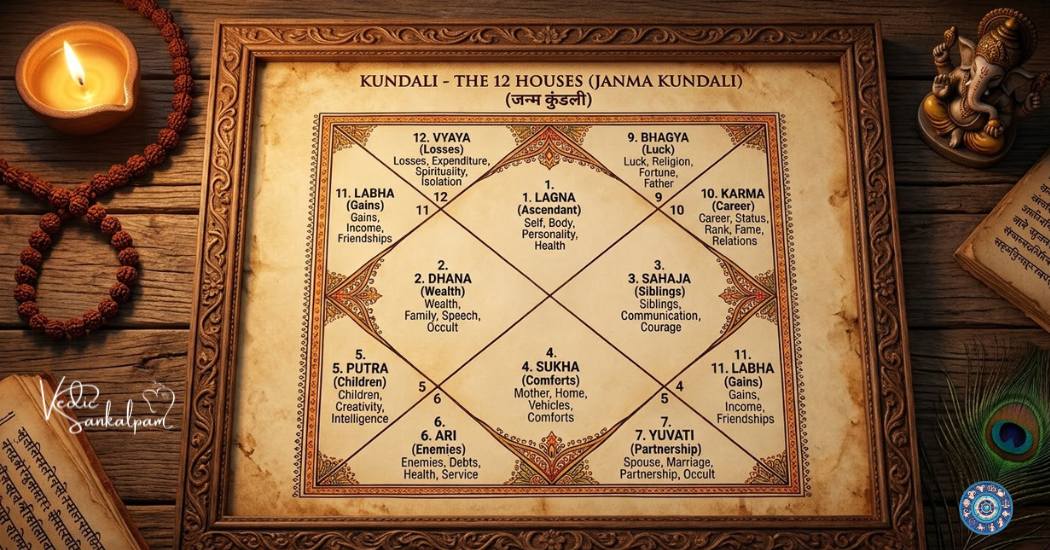
  1. The 12 Houses (Bhavas):

    The Vedic Chart is divided into 12 sections called houses. Each house represents a specific area of life:

    • 1st House: Personality, appearance, and self
    • 2nd House: Wealth, family, and speech
    • 3rd House: Courage, siblings, and communication
    • 4th House: Home, mother, and emotions
    • 5th House: Creativity, children, and education
    • 6th House: Health, enemies, and daily work
    • 7th House: Marriage, partnerships, and business
    • 8th House: Transformation, secrets, and longevity
    • 9th House: Luck, spirituality, and higher education
    • 10th House: Career, fame, and public image
    • 11th House: Income, friends, and aspirations
    • 12th House: Loss, spirituality, and foreign travel
  2. The 12 Zodiac Signs (Rashis):

    Zodiac Signs
    Zodiac Signs

    The zodiac signs in Vedic astrology are similar to Western astrology but are calculated differently. The 12 signs are:

    • Aries, Taurus, Gemini, Cancer, Leo, Virgo, Libra, Scorpio, Sagittarius, Capricorn, Aquarius, and Pisces.
  3. The 9 Planets (Grahas):

    Grahas
    Grahas

    Vedic astrology considers 9 planets, including the Sun, Moon, Mars, Mercury, Jupiter, Venus, Saturn, and two shadow planets called Rahu and Ketu. Each planet rules specific aspects of life:

    • Sun: Soul, confidence, and authority
    • Moon: Mind, emotions, and intuition
    • Mars: Energy, courage, and aggression
    • Mercury: Intelligence, communication, and business
    • Jupiter: Wisdom, growth, and prosperity
    • Venus: Love, beauty, and relationships
    • Saturn: Discipline, challenges, and karma
    • Rahu: Ambition, desires, and illusions
    • Ketu: Spirituality, detachment, and past life
  4. The Ascendant (Lagna):

    The Ascendant is the zodiac sign that was rising on the eastern horizon at the time of your birth. It represents your outer personality and how others see you.


How is a Vedic Chart Created?

To create a Vedic Chart, you need three key pieces of information:

  1. Date of Birth: The day you were born.
  2. Time of Birth: The exact time you were born (the more accurate, the better).
  3. Place of Birth: The city and country where you were born.

Using this information, an astrologer or software calculates the positions of the planets and maps them onto the 12 houses and 12 zodiac signs. This creates your unique Vedic Chart.


Why is the Vedic Chart Important?

  1. Self-Discovery:
    Your Vedic Chart reveals your true nature, strengths, and weaknesses. It helps you understand why you think, feel, and act the way you do.
  2. Life Guidance:
    The chart can provide insights into your career, relationships, health, and finances. It can help you make better decisions and avoid potential pitfalls.
  3. Timing of Events:
    Vedic astrology uses a system called Dashas (planetary periods) to predict when certain events will happen in your life. For example, it can tell you the best time to start a business, get married, or buy a house.
  4. Karmic Insights:
    The chart can reveal your past life karma and how it affects your current life. It can also suggest remedies, such as wearing gemstones, chanting mantras, or performing rituals, to balance your karma.

How to Read Your Vedic Chart

Reading a Vedic Chart can seem complicated at first, but here’s a simple way to start:

  1. Identify Your Ascendant:
    Look at the 1st house in your chart. The zodiac sign here is your Ascendant, which influences your personality and appearance.
  2. Check the Planets:
    See which planets are placed in which houses and signs. For example, if Jupiter is in your 10th house, it may indicate success in your career.
  3. Analyze the Houses:
    Focus on the houses that are most important to you. For example, if you’re curious about relationships, look at the 7th house.
  4. Consult an Expert:
    While it’s possible to learn the basics on your own, a trained Vedic astrologer can provide a deeper and more accurate interpretation of your chart.

How to Use Your Vedic Chart in Daily Life

  1. Plan Major Life Events:
    Use your chart to choose the best dates for weddings, job changes, or other important decisions.
  2. Improve Relationships:
    By understanding your partner’s chart, you can strengthen your relationship and resolve conflicts.
  3. Enhance Career Growth:
    Identify your strengths and choose a career path that aligns with your planetary positions.
  4. Boost Health and Well-Being:
    Pay attention to the planets influencing your 6th house (health) and take preventive measures if needed.

Conclusion

Your Vedic Chart is a powerful tool that can help you understand yourself and navigate life’s challenges. It’s not just about predicting the future; it’s about gaining clarity, making better choices, and living a more fulfilling life.

If you’re curious about your Vedic Chart, start by getting your birth details and creating your chart online or consulting an astrologer. Explore the wisdom of the stars and unlock the secrets of your destiny today!


Online Astrology Consulting

    Unlocking the Secrets of Vedic Astrology: A Guide to Your Destiny

    Vedic Astrology, also known as Jyotish, is an ancient system of astrology that originated in India over 5,000 years ago. It is one of the oldest forms of astrology in the world and is deeply rooted in the Vedas, the sacred texts of Hinduism. Unlike Western astrology, which focuses on the Sun signs, Vedic astrology places more emphasis on the Moon and its position in the sky. This makes it a powerful tool for understanding your life, personality, and future.

    In this article, we’ll explore what Vedic astrology is, how it works, and why it’s so popular today. Whether you’re new to astrology or looking to deepen your knowledge, this guide will help you understand the basics of Vedic astrology in simple words.


    What is Vedic Astrology?

    Vedic Astrology
    Vedic Astrology

    Vedic astrology is a system that uses the positions of planets, stars, and other celestial bodies to analyze and predict events in a person’s life. It is based on the idea that the universe is interconnected, and the movements of planets influence our lives on Earth.

    The word “Jyotish” means “the science of light,” and it is believed that this light can illuminate our path and help us make better decisions. Vedic astrology is not just about predicting the future; it’s also about understanding yourself and your purpose in life.


    Key Elements of Vedic Astrology

    1. The Birth Chart (Kundli):
      The foundation of Vedic astrology is the birth chart, also known as a Kundli. This chart is created based on the exact date, time, and place of your birth. It maps the positions of the planets at the moment you were born and serves as a blueprint of your life.
    2. The 12 Zodiac Signs (Rashis):
      Vedic astrology divides the sky into 12 zodiac signs, just like Western astrology. However, the dates for these signs may differ because Vedic astrology uses a fixed star system called the Sidereal Zodiac.
    3. The 9 Planets (Grahas):
      In Vedic astrology, there are 9 planets, including the Sun, Moon, Mars, Mercury, Jupiter, Venus, Saturn, and two shadow planets called Rahu and Ketu. Each planet represents different aspects of life, such as career, relationships, health, and wealth.
    4. The 12 Houses (Bhavas):
      The birth chart is divided into 12 houses, each representing a specific area of life. For example, the 1st house represents your personality, the 7th house represents marriage, and the 10th house represents career.
    5. Dashas and Transits:
      Vedic astrology uses a unique system of planetary periods called Dashas to predict when certain events will happen in your life. Transits, or the current movements of planets, are also used to analyze ongoing influences.

    How Vedic Astrology Can Help You

    1. Self-Discovery:
      Your birth chart can reveal your strengths, weaknesses, and hidden talents. It can help you understand why you think, feel, and act the way you do.
    2. Career Guidance:
      Vedic astrology can provide insights into the best career paths for you based on your planetary positions. It can also help you identify the right time to start a new job or business.
    3. Relationship Compatibility:
      By comparing two birth charts, Vedic astrology can determine the compatibility between partners. This is often used in arranged marriages in India to ensure a harmonious relationship.
    4. Health and Well-Being:
      Certain planets are associated with health issues in Vedic astrology. By analyzing your chart, an astrologer can warn you about potential health problems and suggest remedies.
    5. Timing of Events:
      Vedic astrology can predict the best times for important life events, such as marriage, having children, or buying a house.

    Why Vedic Astrology is Gaining Popularity

    In today’s fast-paced world, many people are turning to Vedic astrology for guidance and clarity. Here’s why:

    • Accuracy: Vedic astrology is known for its precise predictions and detailed analysis.
    • Holistic Approach: It considers all aspects of life, including karma and spirituality.
    • Remedies: Vedic astrology offers practical remedies, such as gemstones, mantras, and rituals, to overcome challenges.
    • Cultural Heritage: As people become more interested in ancient wisdom, Vedic astrology is gaining global recognition.

    How to Get Started with Vedic Astrology

    1. Get Your Birth Chart:
      To explore Vedic astrology, you’ll need your birth chart. You can create one online using your birth details or consult a professional astrologer.
    2. Learn the Basics:
      Start by understanding the 12 zodiac signs, 9 planets, and 12 houses. There are many books and online resources available for beginners.
    3. Consult an Expert:
      While it’s fun to learn on your own, a trained Vedic astrologer can provide deeper insights and personalized guidance.
    4. Apply the Knowledge:
      Use the insights from your birth chart to make better decisions and improve your life.

    Conclusion

    Vedic astrology is a timeless science that offers profound insights into our lives. By understanding the positions of the planets and their influences, we can navigate life’s challenges with greater confidence and clarity. Whether you’re seeking answers about your career, relationships, or purpose, Vedic astrology can be a valuable tool on your journey.

    So, why not explore the wisdom of the stars and unlock the secrets of your destiny? Start your journey into Vedic astrology today and discover the power of this ancient science!